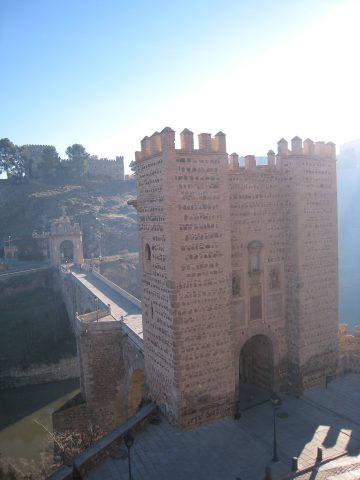
Toledo is a city where history isn’t just preserved—it lingers in the air, in the stones, in the quiet corners where time seems to pause. The Church of Santo Tomé is one of those places where the past feels almost tangible.
Tucked away on a narrow street in the old quarter, it doesn’t announce itself with grand facades or towering spires. Instead, it waits, unassuming, until you step inside.
The church was founded in the 12th century on the site of a former mosque, a detail that reflects Toledo’s layered identity. For centuries, this city was a crossroads of Christian, Muslim, and Jewish traditions, and Santo Tomé carries traces of that complexity. Rebuilt in the 14th century in the Gothic style, it retains subtle Moorish influences—thick walls, pointed arches, and vaulted ceilings. Walking through it, you sense the weight of history in the cool, dim interior.
The real reason most people come to Santo Tomé is the painting that hangs in the chapel behind the altar: El Greco’s *The Burial of the Count of Orgaz*. Commissioned in 1586, it depicts a local legend about a nobleman whose piety was so great that Saints Stephen and Augustine themselves descended from heaven to lay him to rest. The scene is divided into two parts—the earthly below, where mourners gather in somber black, and the divine above, where figures twist in ecstatic motion, their elongated forms dissolving into golden light. El Greco’s brushwork makes the boundary between the two feel porous.
What’s striking about the painting is how it refuses to be static. Depending on the light, the expressions of the figures shift—grief, awe, reverence—all rendered in quick, almost feverish strokes. The count’s armor gleams dully, while the saints’ robes seem to ripple. It’s easy to stand there for a long time, watching how the scene changes with each passing moment. El Greco spent his final years in Toledo, and this work feels like the culmination of everything the city gave him: a place where the sacred and the everyday blur.
Santo Tomé wasn’t always a tourist stop. For most of its existence, it was a parish church. That changed in the 20th century, when the painting’s fame turned it into a site for art lovers. Yet even now, it hasn’t lost its quiet dignity. There are no flashy displays—just the painting, a few other religious artifacts, and the occasional murmur of visitors. The simplicity is part of its power. You’re not being told how to feel; you’re simply given the space to look.
Toledo is a city that rewards slow exploration. Its labyrinth of streets, its hidden courtyards, its synagogues and mosques all tell stories of coexistence and conflict, of faiths that shaped one another. Santo Tomé is one part of that story, but it pulls you in. The painting seems to watch you as much as you watch it.
If you visit, don’t rush. Let yourself get lost in the old city first. Wander past the sword shops and the honey-colored buildings, sit in a plaza where the sound of a fountain mixes with the clatter of plates from a nearby café. Then, when you’re ready, step into Santo Tomé. The light inside is soft, the air cool. The painting waits.