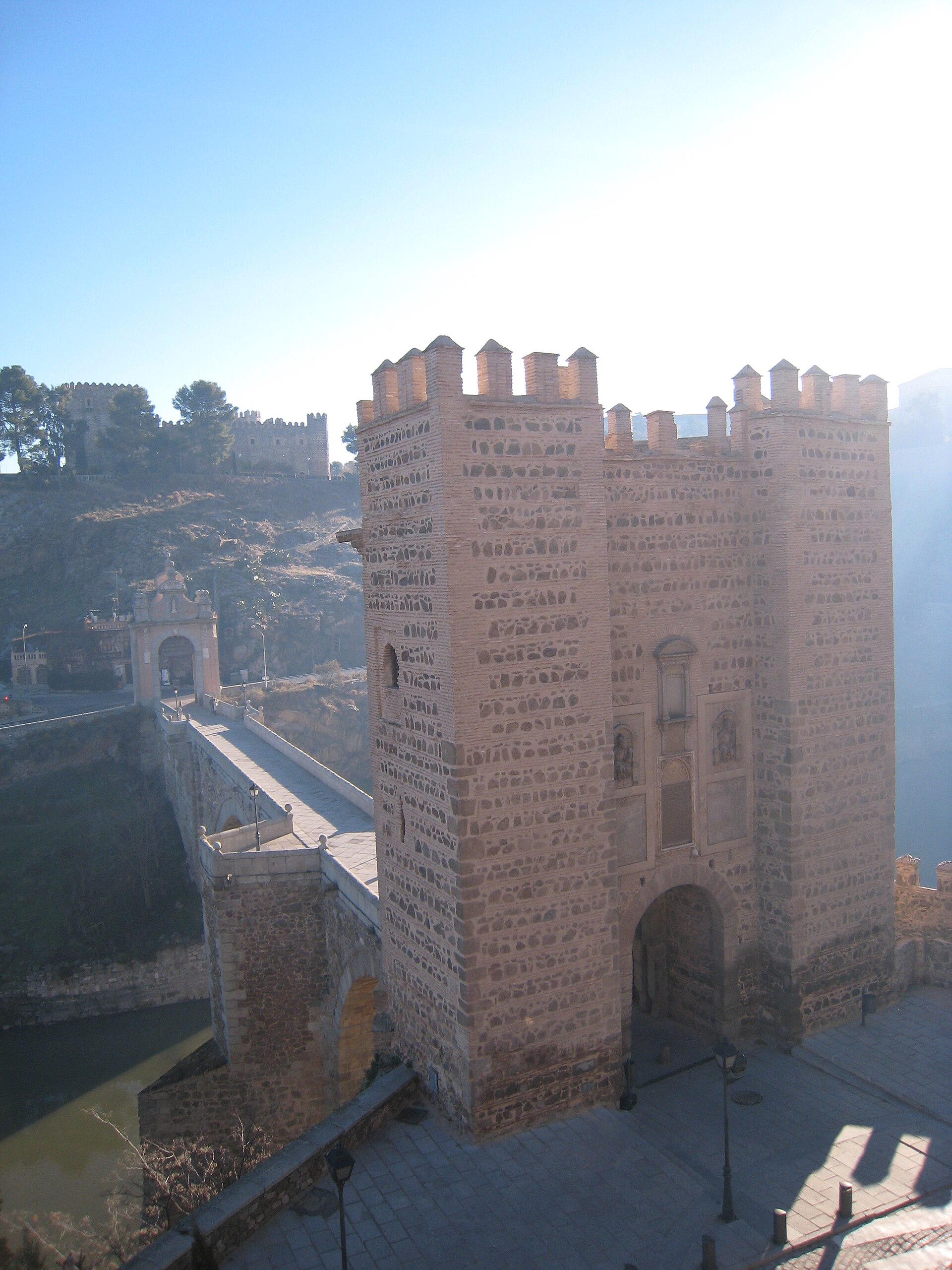
Alcántara Bridge in Toledo is one of those rare places that feels untouched by time, as if the centuries have simply passed it by without leaving a mark. Stretching across the deep gorge of the Tagus River, it connects two parts of the city while standing as a testament to endurance and craftsmanship. From its heights, the view unfolds like a living painting—ancient city walls, a maze of narrow streets, and the towering silhouettes of cathedrals that seem to hover above the rooftops. It’s easy to imagine medieval merchants, knights, and pilgrims crossing these stones, while the river below carries its waters past fortresses and monasteries, just as it has for generations.
The bridge’s name comes from Arabic, meaning simply "the bridge," and that’s no coincidence. While the first records of a crossing here date back to Roman times, the structure we see today owes much of its form to the Moors. They reinforced and expanded the original design, integrating it into the city’s defenses. Later, when Toledo came under Christian rule, the bridge was rebuilt multiple times, yet its core remained unchanged—solid, unyielding, much like the history of Spain itself.
Architecturally, Alcántara Bridge blends rugged functionality with a quiet elegance. The two massive towers at either end, resembling fortress battlements, were built not just for defense but for control. In the past, the gates within these towers would close at night, and guards would scrutinize every traveler attempting to enter the city. Today, the towers still hold an air of mystery, as if they’ve kept their secrets locked away. The bridge itself is constructed from gray granite, darkened by age but no less sturdy. Its arches, though appearing delicate, have borne the weight of countless footsteps and the relentless march of time.
Walking across Alcántara Bridge is more than just a way to get from one side of the river to the other—it’s a step into medieval Toledo. The stones beneath your feet creak faintly, the wind carries the scent of the river and the wild grasses clinging to the gorge’s slopes, and in the distance, the bells of the city’s churches ring out. The bridge is especially striking at sunset, when the fading light bathes the city’s walls in gold and the water below shimmers with reflections. In those moments, the bridge feels less like a structure and more like a living extension of the city, a link between past and present.
Toledo has always been a place where cultures and faiths intertwined. Christians, Muslims, and Jews lived side by side here, and Alcántara Bridge became one of the symbols of that coexistence. It witnessed armies marching across its span, livestock being driven to market, and weary travelers returning home. During the Middle Ages, Toledo was a hub of trade and craftsmanship, and the bridge played a crucial role in that life. Caravans laden with goods from across the Iberian Peninsula and beyond passed over it. Today, the city has changed, but if you listen closely, you can still catch echoes of those times in the hum of modern life.
Despite its age, Alcántara Bridge remains very much in use. Pedestrians cross it daily, cars drive over it, and occasionally, tourist buses rumble across its stones. Yet even in this modern rhythm, the bridge hasn’t lost its charm. Perhaps that’s because the spirit of the past lingers here—in every stone, every curve of the arches, in the very air, thick with history. For many visitors, the bridge is one of the first stops in Toledo, and it’s easy to see why. It doesn’t just invite you to look at the past; it lets you walk through it, following the same paths people have taken for centuries.
Toledo is often called an open-air museum, and Alcántara Bridge is one of its most compelling exhibits. But unlike many historical sites, it doesn’t feel like a relic frozen in time. The river still flows beneath it, the wind still sweeps through the gorge, and the city breathes at its own unhurried pace. That’s what makes the bridge so captivating. It doesn’t just remind you of history—it lets you feel it, if only for a moment.
If you find yourself in Toledo, don’t rush straight into the labyrinth of its streets. Take a moment on Alcántara Bridge. Look out over the city from its heights, breathe in the air filled with the scent of grass and stone. Let the Tagus River carry your thoughts back in time, then bring them gently back to the present, where this ancient city still thrives, full of secrets and stories. And then, perhaps, you’ll understand why Toledo is loved not just by visitors, but by those who call it home.