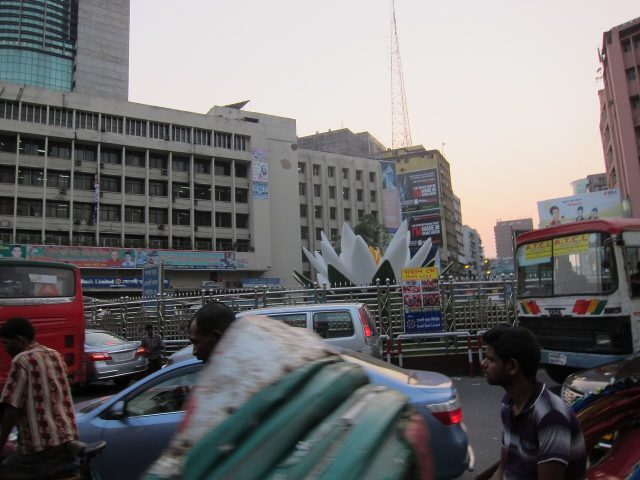
Shapla Square is one of those unassuming yet unmistakable spots in Dhaka’s bustling Motijheel district, a place that quietly anchors the city’s financial heart. Named after the water lily—Bangladesh’s national flower—the square centers around a striking metal sculpture of the bloom, its petals unfurling in the middle of the urban rush. By day, the area hums with the energy of office workers darting between meetings, rickshaws weaving through traffic, and street vendors hawking snacks to hurried passersby. By night, the sculpture glows under artificial lights, a rare moment of stillness in a neighborhood that never truly slows down.
The water lily isn’t just decorative; it’s a quiet nod to something deeper. You’ll find the same flower on Bangladesh’s national emblem, in folk songs, and in poetry—an enduring symbol of the country’s identity. Here, in the middle of one of Dhaka’s most commercialized zones, it serves as a reminder that even in the concrete jungle, there’s room for something softer, something rooted in tradition. The sculpture itself is simple but effective, its metallic curves catching the light in a way that makes it hard to miss, even amid the chaos of the surrounding streets.
Motijheel is where Dhaka’s economic pulse beats strongest, and Shapla Square sits at its core. The area is packed with banks, corporate headquarters, and government offices, their glass facades reflecting the constant movement of people below. During business hours, the square is a sea of suits and briefcases, a place where deals are made over quick cups of tea or hurried lunches from nearby stalls. But as evening falls, the crowd shifts. Office workers give way to locals unwinding on benches, families stopping by for a photo with the sculpture, or groups of friends catching up after work. On weekends, the square takes on a different rhythm, with children chasing each other around the base of the water lily while vendors sell ice cream and roasted nuts.
There’s nothing grand about Shapla Square’s architecture. Unlike Dhaka’s older neighborhoods, where Mughal-era buildings and colonial facades tell stories of the past, Motijheel is all about function over form. The square is surrounded by modern office towers, shopping arcades, and small eateries, none of which would stand out in any other business district. Yet its simplicity is part of its charm. It’s not a place you visit for history or aesthetics, but for the raw, unfiltered energy of the city. The square’s real value lies in its role as a crossroads—both literally and figuratively. It’s where people from all walks of life converge, whether they’re catching a bus, grabbing a bite, or just killing time between appointments.
The square’s story is tied to Motijheel’s rise as Dhaka’s financial hub. In the 1970s and 80s, as Bangladesh’s economy began to take shape, this area transformed from a quiet corner of the city into the nerve center of its commercial life. Banks sprouted up, followed by corporate offices and international firms, turning Motijheel into a symbol of the country’s economic ambitions. The water lily sculpture was added later, a deliberate choice to ground the district’s fast-paced, profit-driven atmosphere in something more enduring. Today, Shapla Square is more than just a landmark; it’s a small but vital piece of the city’s daily rhythm.
For first-time visitors, Shapla Square might seem like just another busy intersection, easy to overlook in a city as crowded as Dhaka. But for those who live and work here, it’s a familiar touchstone. It’s where colleagues arrange impromptu meetings, where students debate politics between classes, and where street performers occasionally set up for a spontaneous show. During national holidays, the square comes alive with decorations, and the water lily becomes the focal point for celebrations. It’s a place where the city’s many layers—business, culture, everyday life—overlap, if only for a moment.
Shapla Square won’t wow you with ancient ruins or sweeping vistas. There are no palaces or temples here, no grand narratives of kings and conquests. What it offers instead is something more immediate: a snapshot of Dhaka as it is now. This is a city of contrasts—where tradition and modernity collide, where the pace is relentless but the people are warm, where every corner seems to pulse with life. If you find yourself in Motijheel, take a few minutes to linger here. Watch the ebb and flow of the crowd, listen to the hum of the city, and let the water lily’s quiet presence remind you that even in the busiest places, there’s room to pause.