Baitul Mukarram stands as one of Dhaka’s most recognizable landmarks, a striking presence in the heart of the Motijheel commercial district. Unlike the ornate domes and towering minarets of traditional mosques, this structure embraces a bold, modernist design—clean lines, geometric precision, and an expansive courtyard framed by arcades. Its architecture was groundbreaking when it first took shape in the mid-20th century, offering a fresh interpretation of Islamic aesthetics that still draws attention today. The mosque’s resemblance to Mecca’s Kaaba is no accident; it was conceived as a spiritual anchor for the nation, a place where faith and contemporary design could coexist.
The idea for Baitul Mukarram emerged in 1958, when what was then East Pakistan sought to establish a national mosque that would reflect the country’s aspirations. Local architects, led by Abdul Hussain Thariani, were tasked with blending Islamic traditions with modern engineering. Construction wrapped up in 1968, and the mosque quickly became more than a place of worship—it evolved into a symbol of national identity. During the turbulent years of Bangladesh’s fight for independence in the early 1970s, it served as a gathering point for both worshippers and activists, its walls bearing witness to the country’s struggles and hopes.
Inside, the mosque feels vast and uncluttered. The main prayer hall can accommodate thousands, its high ceilings and large windows flooding the space with natural light. The walls are clad in pale marble, and the mihrab—the niche pointing toward Mecca—is marked by subtle carvings, avoiding the lavish ornamentation found in older mosques. This minimalism lends the interior a sense of quiet reverence, though it’s far from austere. Separate prayer areas for men and women, a library stocked with religious texts, and classrooms for Islamic studies ensure the mosque remains a hub of learning and community.
Beyond its religious role, Baitul Mukarram functions as a social and cultural center. The courtyard often hosts lectures, gatherings, and charitable events, while during festivals like Ramadan and Eid al-Adha, the mosque transforms into the city’s beating heart. Thousands flock here, turning the surrounding streets into a bustling marketplace of food stalls, vendors, and crowds spilling out in every direction. Even those who don’t observe Islam are drawn to the energy, the sense of shared celebration that fills the air. For a few days, the mosque isn’t just a place of prayer—it’s the center of Dhaka’s collective life.
Architecturally, the mosque defies easy categorization. Its white marble facade, punctuated by dark window bands and doorways, gives it a sleek, almost futuristic appearance. The main entrance, with its towering portal, echoes traditional Islamic gateways but strips away excessive decoration in favor of bold, clean forms. The minarets, though modest in height, serve a practical purpose, broadcasting the call to prayer across the neighborhood. The overall effect is one of understated grandeur—imposing without being overwhelming, a structure that commands attention without demanding it.
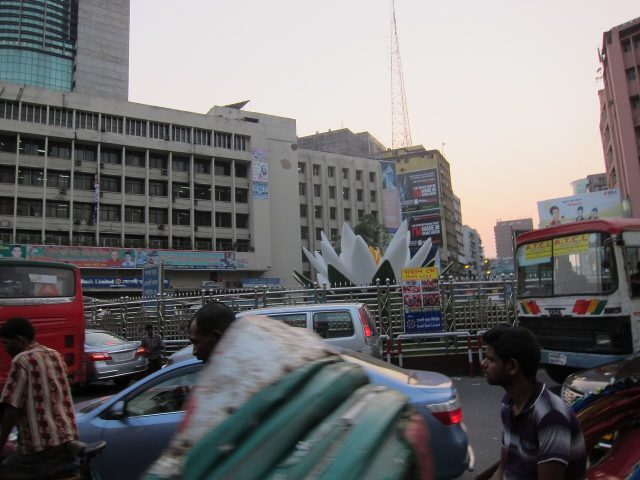
For Dhaka’s residents, Baitul Mukarram is woven into the fabric of daily life. People come here not just to pray but to escape the city’s relentless pace, lingering in the shade of the arcades or sitting on benches in the courtyard. The area around the mosque is always alive with activity: office workers rushing past, street vendors hawking everything from tea to phone chargers, and families strolling in the late afternoon. The contrast between the mosque’s serene presence and the chaotic energy of Motijheel is striking—here, the old and new coexist, from colonial-era buildings to glass-fronted skyscrapers, all orbiting around this quiet, enduring landmark.
Though relatively young compared to other great mosques of the world, Baitul Mukarram has already become a cornerstone of Bangladesh’s history. It has weathered wars, political upheavals, and economic shifts, remaining a place of solace and solidarity. Over the years, expansions have accommodated a growing congregation, yet the mosque’s original character has been carefully preserved. Today, it draws visitors from around the globe, not just as a religious site but as an example of how modern architecture can honor tradition while serving a living, breathing community.
A visit to Baitul Mukarram offers more than just a glimpse of Islamic architecture—it’s a chance to experience Dhaka’s rhythm. In the early morning, the first worshippers arrive as the city stirs to life, while in the evening, the mosque’s lights shimmer on wet pavement after a rain, casting a peaceful glow. Even at its busiest, the interior remains calm, a rare pocket of tranquility in a district known for its frenetic energy. That contrast, perhaps, is what makes the mosque so memorable. It’s a place where the past and present converge, where faith and daily life intersect, and where anyone can pause, even for a moment, to feel the pulse of the city.