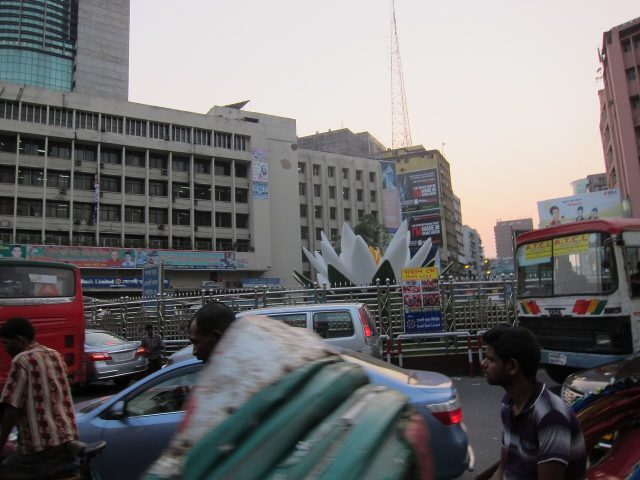
Motijheel is Dhaka’s financial hub. Every morning, professionals fill its streets, moving between office towers and the constant hum of city activity. The district formed in the mid-20th century as Dhaka expanded, shifting from a modest urban center to the nation’s economic focal point. Unlike Old Dhaka, where Mughal-era mosques and palaces remain, Motijheel is defined by its modern landscape. Glass skyscrapers rise above narrow lanes packed with rickshaws and street vendors, creating a contrast that shapes the district’s energy.
The buildings here reflect Bangladesh’s economic evolution. No grand monuments exist, but the architecture shows the country’s growth. Recent high-rises stand beside older office blocks from the 1970s and 80s, when Bangladesh first engaged with global markets. Many facades display bank and telecom advertisements, while ground floors house small cafes where workers eat lunch. During rush hour, traffic slows, but the sheer movement keeps the area alive.
Motijheel’s role goes beyond Dhaka. It hosts Bangladesh Bank, the central financial institution, along with major commercial banks, insurance firms, and corporations. Many of these emerged after 1971, when Bangladesh built its financial systems. Today, decisions made here affect interest rates and infrastructure projects. For locals, Motijheel means opportunity—and pressure. Competition is fierce, and long hours are common, with many working late.
Between meetings, workers visit eateries serving biryani, spicy curries, or sweet pitha pastries. Street vendors sell tea, fruit, and secondhand books. When the workday ends, the district stays active. Restaurants fill with business discussions, while younger crowds gather in cafes. Even on weekends, Motijheel remains busy, with shoppers visiting malls or walking along sidewalks.
Transportation defines the district. Motijheel sits at Dhaka’s major road junctions, connecting it to the city. One of the capital’s largest bus terminals is here, with intercity coaches departing for destinations across Bangladesh. During peak hours, rickshaws, motorbikes, and cars compete for space, while pedestrians navigate the chaos. For visitors, the movement can feel overwhelming, but locals move with ease.
Motijheel’s history reflects Bangladesh’s post-independence journey. In the 1970s, after the Liberation War, the country faced economic challenges. Motijheel became a development hub, with office buildings attracting investment and jobs. Today, the district shows layers of time—from early independence-era structures to recent towers. It evolves constantly, mirroring the country’s economic shifts.
Motijheel has a distinct atmosphere. It lacks Old Dhaka’s tourist sites or Gulshan’s greenery but offers something else: a sense of being at the center. The district wakes early, fills with workers, and slows in the evening—though it never fully stops. For those used to quieter cities, Motijheel may feel intense. But that’s what makes it compelling. Life here moves fast, at all hours.
Motijheel differs from other Dhaka areas. No ancient mosques or parks exist, just a dense urban space where every inch serves a purpose. Yet it has its own appeal. For business travelers, it’s Bangladesh’s economic nerve center. For others, it’s another neighborhood in a vast city, pulsing with modern energy. Whether you’re here for work or passing through, Motijheel shows a nation in motion.