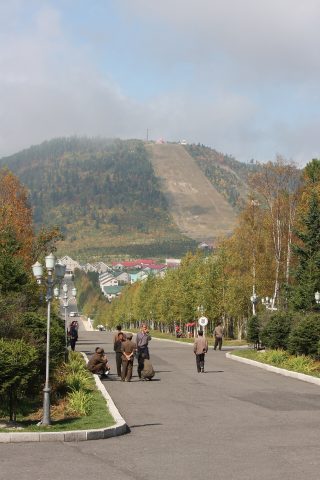
Samjiyon’s grand monumental complex stands in the far north of North Korea, where the rugged slopes of Mount Paektu meet the quiet town of the same name. This is a place where history, ideology, and landscape merge into something far greater than the sum of its parts. For Koreans, Mount Paektu is more than a mountain—it is a symbol of national identity, steeped in legend and revolutionary lore. The complex was built to honor the partisan struggle of the 1930s, when Kim Il Sung and his followers fought against Japanese occupation from these very hills. The story goes that it was here, in the harsh wilderness near the Chinese border, that the foundations of modern North Korea were laid.
Construction began in 1979 and took three years to complete, though the site has seen expansions and refinements over the decades. The architecture is designed to evoke permanence and reverence, with broad staircases leading to towering structures that dominate the skyline. At the heart of the complex stands a colossal bronze statue of Kim Il Sung, elevated on a pedestal so that it overlooks the valley below. The figure is flanked by sculptural groups depicting partisans, farmers, and workers—each rendered with meticulous detail, from the folds of their clothing to the expressions on their faces. The effect is striking, as if the past has been frozen in time, a moment of struggle and defiance preserved for future generations.
Behind the statues lies the Museum of Revolutionary Activities, a building that blends traditional Korean architectural motifs with monumental scale. Inside, the exhibits trace the story of the partisan movement, from the early days of resistance to the eventual triumph of the revolution. Visitors can see personal belongings of Kim Il Sung, weapons used in battle, and documents that shaped the course of history. For North Koreans, the museum is not just a collection of artifacts but a sacred space, a place to reflect on the sacrifices that shaped their nation.
Nearby, the Revolutionary Opera House hosts performances that bring the partisan struggle to life. The building itself resembles a vast tent nestled into the mountainside, its interior adorned with red upholstery, gold accents, and portraits of the country’s leaders. The productions staged here are more than entertainment—they are a form of ideological education, a way to pass down the nation’s history to younger generations. The stories told on this stage reinforce the narrative of resilience and victory, ensuring that the legacy of the revolution remains vivid in the public consciousness.
A short distance from the main complex lies Lake Samji, a serene body of water surrounded by dense forest. According to local lore, this was a place where Kim Il Sung and his comrades rested during their long marches through the mountains. On clear days, the lake mirrors the snow-capped peaks of Mount Paektu, creating a scene of almost unreal beauty. It’s hard to imagine that this tranquil setting was once a battleground, but the contrast only adds to the sense of reverence that surrounds the area. Today, the lake is a popular spot for walks, offering a quiet respite from the solemnity of the monuments.
The design of the complex is deliberate in its grandeur. Wide plazas, polished granite, and sweeping staircases create an atmosphere of solemnity and power. Yet there is also a certain elegance to the architecture, with curved rooflines and natural materials that echo traditional Korean aesthetics. The buildings don’t feel imposed on the landscape—they seem to grow from it, as if they’ve always been part of the mountains themselves.
For North Koreans, Samjiyon is far more than a tourist attraction. It is a place of pilgrimage, where delegations from across the country come to pay their respects. On national holidays, the complex becomes the center of patriotic gatherings, with speeches, performances, and ceremonies that reinforce the connection between past and present. The atmosphere is one of quiet dignity, a reminder of the values that the nation holds dear.
Visiting Samjiyon offers a glimpse into a world where history is not just remembered but actively woven into the fabric of daily life. There is no hustle here, no distraction—just the stillness of the mountains and the weight of memory. For outsiders, the experience can feel overwhelming, even surreal, but that is part of what makes it unique. This is a place where the past is not just honored but elevated to something almost sacred, a testament to how a nation chooses to see itself and its future.