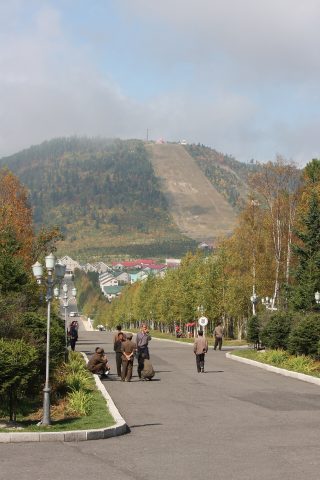
Samjiyon Park is one of those places in North Korea where the landscape and the nation’s ideology merge into something deeply meaningful for its people. Tucked away in the mountainous north, not far from the Chinese border, it isn’t just a tourist attraction but a living symbol of revolutionary history and national pride. The dense forests and rugged peaks here are tied to the childhood of Kim Il Sung, the founder of North Korea, and the myths that shape the country’s collective memory all trace back to these hills.
The park is framed by the sacred Mount Paektu, a place steeped in Korean legend. According to ancient stories, this is where Dangun, the mythical founder of the first Korean kingdom, was born. In the 20th century, the same mountains became a battleground for guerrilla resistance against Japanese occupation. The park itself was established in 1979 as a memorial to that revolutionary past, its landscape preserved as it was during the struggle for independence. The roads winding through the valleys lead visitors past meadows that turn lush green in summer and blanketed in snow in winter, creating a sense of isolation from the outside world.
At the heart of the park stands a collection of monuments, each telling a piece of the story. The most prominent is a statue of a young Kim Il Sung, perched on a hill overlooking the surroundings. He is depicted in partisan uniform, binoculars in hand, as if surveying the horizon. Nearby, granite slabs bear engraved quotes from his speeches and poems, including the famous *Samjiyon*, written in the 1930s, which praises the beauty of these mountains and calls for the fight for freedom. The words feel less like literature and more like a sacred text, recited by schoolchildren and visitors alike.
A short walk away is the house where, according to official history, Kim Il Sung spent part of his childhood. The modest wooden structure, with its traditional Korean roof, sits among pine trees, its interior preserved as it might have been in the early 1900s—simple furniture, clay pots, kerosene lamps. Guides recount how the future leader helped his parents with chores, studied at the local school, and already showed signs of the leadership that would define his legacy. For North Koreans, this house is more than a museum; it’s a pilgrimage site, a place to connect with the origins of the revolution.
Beyond the memorials, the park offers natural beauty that draws visitors just as much as its history. Samji Lake, a small, crystal-clear body of water surrounded by forest, is said to be where Kim Il Sung and his comrades rested during their partisan campaigns. In summer, families picnic along its shores, while in winter, the frozen surface becomes a skating rink. Trails lead from the lake to viewpoints overlooking the valley and distant ridges, where the silence is broken only by the wind through the trees.
The Revolutionary Museum nearby houses artifacts from the guerrilla struggle—weapons, documents, photographs, and personal items of those who fought. The exhibits focus heavily on Kim Il Sung’s role in organizing resistance, framing him as a strategic genius who united peasants and workers under his banner. The museum isn’t just a historical record; it’s an ideological statement, presenting the past through the lens of the state’s narrative. For outsiders, it offers a glimpse into how North Korea constructs its version of history.
The atmosphere in Samjiyon Park is unlike anywhere else in the country. There are no crowds, no commercial distractions, no hurried tourists. Everything moves at a deliberate pace—visitors travel in guided groups, the guides speak in measured tones, and the landscape feels frozen in time. Even the weather seems to play its part: cool and crisp in summer, still and biting in winter, as if nature itself is preserving the memory of the past. For foreigners, the lack of signs, advertisements, or modern amenities can feel jarring, but that austerity is part of what makes the place feel authentic.
Samjiyon isn’t just a park; it’s a cornerstone of North Korea’s national identity. Every path, every tree, every rock here is tied to the story of struggle, sacrifice, and victory. For locals, it’s a sacred space, a place to honor ancestors and reinforce the ideals of the revolution. For outsiders, it’s a rare opportunity to see how history, politics, and nature intertwine in a country that exists by its own rules. There’s no escaping the weight of what this place represents—it’s not just about what you see, but what you’re meant to feel.