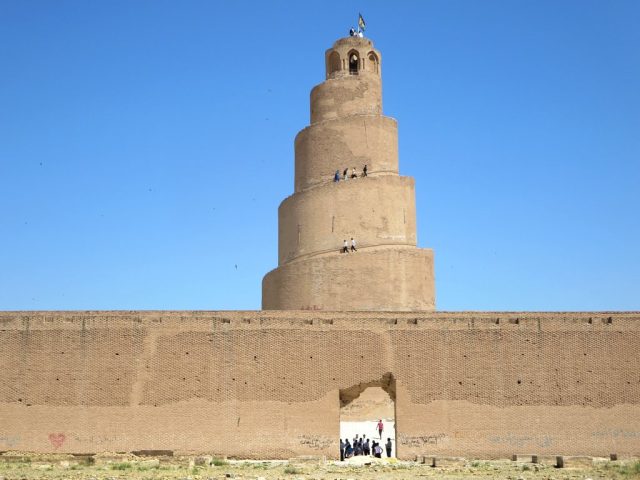
Samarra sits on the banks of the Tigris. A hundred and twenty kilometers north of Baghdad, it feels distant from the capital’s modern pulse. For a brief moment in the ninth century, this was the heart of the Abbasid Caliphate, an empire that stretched from North Africa to Persia. The caliphs chose Samarra as their capital to avoid Baghdad’s tensions—a place where their Turkish mercenary guards could live without clashing with locals. They built wide avenues, palaces, and mosques designed to impress. For fifty years, Samarra was one of the largest cities in the world, a center of power, culture, and trade. Then it was abandoned. The caliphs returned to Baghdad, and Samarra faded, leaving ruins that still hint at its past.
The Great Mosque of Samarra remains the most visible sign of that era. Its spiral minaret, al-Malwiya, rises from the earth. Built in the ninth century, the minaret is fifty-two meters high, with a ramp winding to the top. From there, you can see the plains around the city. The minaret was once a symbol of power, visible for miles. Today, it stands intact, though time and conflict have worn its stone. Climbing its ramp feels like moving through layers of history.
The Dar al-Khilafa palace complex lies nearby. Once the caliphs’ residence, it is now a maze of crumbling walls and scattered columns. Excavations have found fragments of mosaics, carved stucco, and audience halls. The buildings suggest a world of ceremony—long corridors, high arches, and courtyards where fountains once flowed. What remains shows a civilization that valued art and architecture.
Samarra’s history goes beyond the Abbasids. The Tigris has always been a lifeline, and the fertile plains around the city drew settlers for millennia. Later, under Ottoman rule, Samarra became a provincial town, its former glory forgotten. Yet it remained a crossroads where trade routes from Persia, Syria, and the Arabian Peninsula met. Caravans once passed through its markets, carrying silk, spices, and precious stones.
Today, Samarra is quiet. The streets are lined with low houses and small shops. Most people here are Arab or Kurdish, living from farming or trade. There are no tourist crowds, just the occasional visitor drawn by the ruins. In the evenings, locals gather by the river to drink tea and talk. The Tigris still flows, unchanged.
Samarra offers history without filters. The ruins stand as they have for centuries, untouched by reconstruction. You can walk through them, touch the stones, and feel the weight of time. Without crowds, the place feels more intimate. It’s easy to imagine the city as it once was—merchants, scholars, and soldiers filling its streets.
This is not a place to hurry. It rewards those who wander. Climb the minaret. Explore the palace ruins. Sit by the Tigris as the light fades. Each moment here feels like a conversation with the past. The city doesn’t give up its secrets quickly. It waits for those willing to listen. For travelers seeking something beyond scripted tours, Samarra offers a direct connection to history. The past isn’t just remembered here—it lingers in the quiet and the crumbling walls.