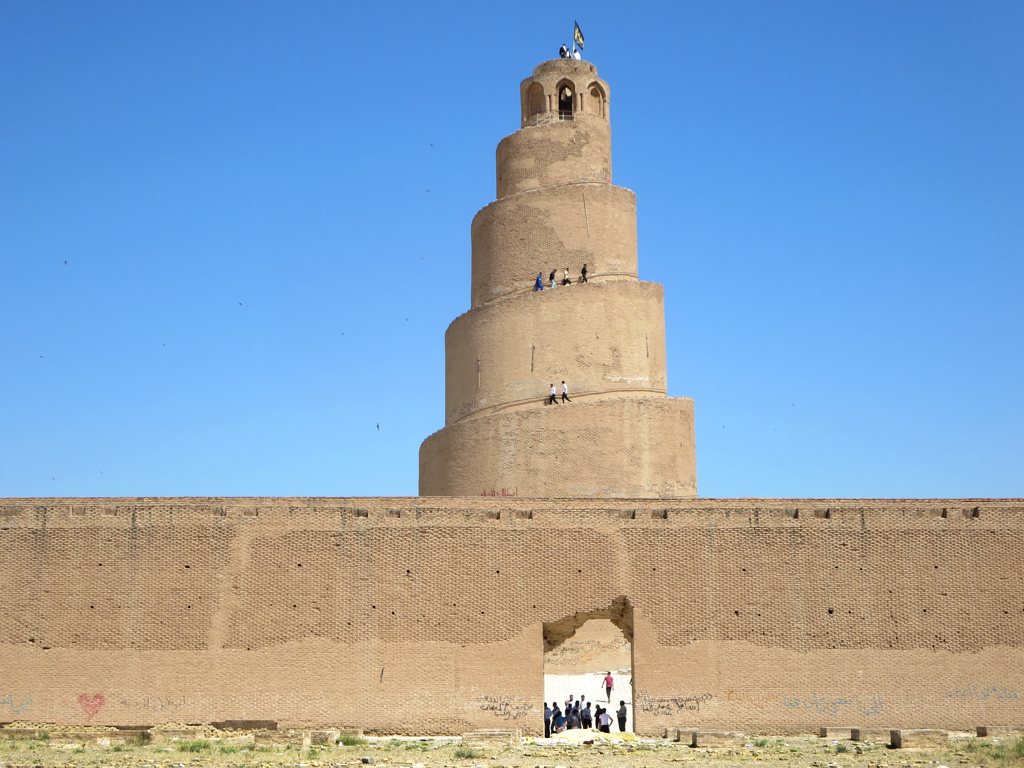
Samarra’s Malwiya Minaret rises from the city’s low skyline like a relic from another age. Built in the ninth century under Abbasid caliph al-Mutawakkil, this spiraling tower was part of the Great Mosque of Samarra, one of the largest Islamic religious complexes of its time. The minaret’s name, Malwiya, means "snail shell" in Arabic—its ascending ramp coils upward in a widening spiral. Unlike later minarets, it wasn’t just for the call to prayer. It was a statement of imperial ambition, visible for miles across the flat Mesopotamian plain.
The tower stands nearly fifty-two meters high. Its base is a massive square platform tapering into a circular shaft. The ramp, wide enough for a rider on horseback, winds around the exterior in five full turns before reaching the summit. A small pavilion once crowned the top, though little remains today. The brickwork, laid in a herringbone pattern, was once covered in stucco decoration. Fragments still cling to the surface where plaster has worn away.
Earthquakes, invasions, and time have left their marks, yet the structure stands.
Samarra was a city of fleeting grandeur. Founded in 836 AD, it replaced Baghdad as the capital—a move driven by political intrigue. For nearly sixty years, it flourished as the center of the Abbasid Caliphate. Palaces, mosques, and gardens lined its streets, fed by the Tigris. The Great Mosque, with its vast courtyard and minaret, was the heart of this vision. By the late ninth century, the capital returned to Baghdad. Samarra shrank, its grand buildings abandoned to the desert winds. The Malwiya Minaret remained.
Today, visiting the minaret is quiet. The ruins of the Great Mosque stretch out in a sunbaked expanse, their outlines blurred by dust. The minaret is fenced off, its base protected by low barriers. You can’t climb the ramp, but even from the ground, the scale is imposing. Bricks, once smooth, now bear cracks and patches of missing plaster. In late afternoon, the minaret casts a long shadow.
Why does the Malwiya spiral? Historians debate its origins. Some see a link to ancient Mesopotamian ziggurats. Others suggest a symbolic ascent toward the heavens. Most minarets of the period were simple. The Malwiya was different—a fusion of engineering, art, and political symbolism. It speaks to a time when the Abbasid Caliphate was at its height, unafraid to experiment.
For those who visit, the minaret is more than an architectural curiosity. It’s a link to a distant chapter of history. The Abbasid era shaped the medieval world through its scholars and poets. Here, in the Iraqi plains, the Malwiya stands as proof that empires are built on stone and mortar. Its survival feels like a small victory—a fragment of the past that refuses to disappear.
Samarra sits on the east bank of the Tigris. The land around it is flat, the horizon endless. In the distance, the golden dome of the Askari Shrine glows in sunlight. The contrast between the ancient minaret and the modern shrine is striking. History layers itself here, visible in every direction.
Samarra remains off the beaten path. Few travelers make the journey. Those who do often find themselves alone with the ruins. The silence is broken only by wind and the cry of a circling bird. It’s a place that invites reflection—not just on the past, but on time itself. The minaret, with its weathered bricks and spiraling ascent, feels like history: grand, enduring, yet fragile.