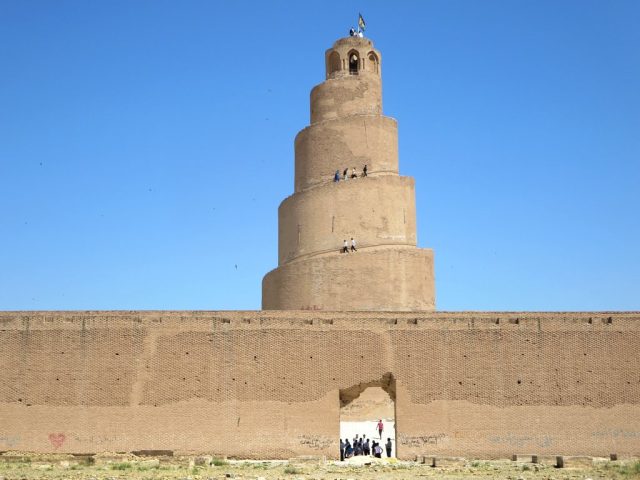
The ruins of Al-Ashaq Palace stand on the eastern bank of the Tigris, a quiet witness to the grandeur of Samarra’s Abbasid past. Built in the 9th century during the reign of Caliph al-Mutawakkil, this sprawling complex was once part of a vast imperial estate that stretched along the river, a retreat for rulers who sought respite from the political intrigues of Baghdad. Today, little remains of its former opulence—crumbling walls, fragments of stucco decoration, and the skeletal outlines of courtyards—but the site still carries the weight of its history, a reminder of an empire that shaped the course of Islamic civilization.
The palace was designed as a private residence, a place where the caliph could escape the formalities of court life. Unlike the Great Mosque of Samarra or the nearby Jawsaq al-Khaqani, which were built for public display, Al-Ashaq was intimate in scale, though no less ambitious in its architectural vision. The layout followed the traditional Abbasid plan, with a central courtyard surrounded by living quarters, reception halls, and service areas. What set it apart was its integration with the landscape—the Tigris flowed just beyond its walls, and terraces likely descended toward the water, offering views of the river’s shifting currents.
The most striking feature of the palace was its decoration. Abbasid artisans were masters of stucco work, and the fragments that survive at Al-Ashaq hint at a once-dazzling interior. Floral motifs, geometric patterns, and intricate arabesques covered the walls, a testament to the era’s love of ornamentation. Some of the designs were so delicate that they seem almost weightless, as if carved from lace rather than plaster. The use of color was equally sophisticated; traces of pigment suggest that the interiors were painted in rich hues of red, blue, and gold, creating a visual symphony that must have been breathtaking in its full glory.
Al-Ashaq was more than just a residence—it was a statement of power. The Abbasid caliphs ruled over an empire that stretched from North Africa to Central Asia, and their palaces were symbols of that authority. Samarra itself was founded in 836 as a new capital, a deliberate move by Caliph al-Mu’tasim to distance himself from the fractious politics of Baghdad. For nearly sixty years, the city flourished as the center of the Islamic world, its streets lined with palaces, mosques, and administrative buildings. Al-Ashaq was one of many, but its location on the riverbank made it particularly significant. The Tigris was the lifeblood of the region, a trade route and a source of water, and controlling its banks was a way of asserting dominance over the land.
The decline of Samarra was as swift as its rise. By the late 9th century, the capital had shifted back to Baghdad, and the once-great palaces of Samarra were abandoned. Over the centuries, the city’s monuments fell into disrepair, their stones reused for other buildings, their decorations looted or eroded by time. Al-Ashaq suffered the same fate, its walls slowly dissolving into the earth. Yet even in ruin, the palace retains a certain dignity. The way the light falls on its remaining arches, the way the wind moves through its empty courtyards—these are the quiet details that make the past feel tangible.
Visiting Al-Ashaq today is a lesson in impermanence. The site is not restored in the way that some ancient ruins are; there are no reconstructed facades or polished walkways. Instead, it exists as it has for centuries—a collection of weathered stones, a few standing walls, and the occasional glimpse of a decorative motif half-buried in the dirt. The absence of crowds makes it easier to imagine the palace as it once was, to picture the caliph walking through its halls or the sound of water from the Tigris lapping against the terraces. It’s a place that demands patience, a willingness to look beyond the obvious and see the layers of history beneath the surface.
The surrounding landscape adds to the sense of timelessness. The Tigris still flows past the ruins, though its course has shifted over the centuries. On the opposite bank, the modern city of Samarra hums with life, its minarets and markets a stark contrast to the silence of the palace. The juxtaposition is striking—the old and the new, the transient and the enduring. Al-Ashaq may no longer be a seat of power, but it remains a place where the past is not just remembered but felt.
For those who take the time to explore it, the palace offers more than just a glimpse into Abbasid architecture. It’s a reminder of how empires rise and fall, how cities are built and abandoned, and how even the most magnificent structures eventually return to the earth. The ruins of Al-Ashaq are not grand in the way that the pyramids or the Colosseum are, but they have their own kind of beauty—one that lies in their fragility, in the way they bear the marks of time without resistance. It’s a place that invites reflection, not just on history, but on the fleeting nature of human achievement.