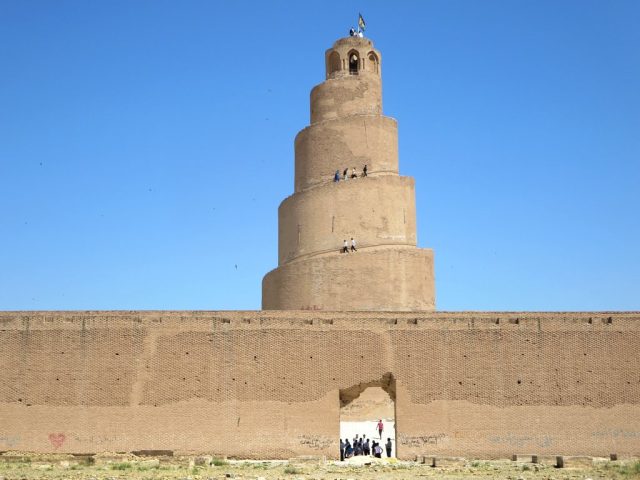
The Great Mosque of Samarra stands on the banks of the Tigris, a quiet witness to the rise and fall of empires. Built in the 9th century under the Abbasid caliph al-Mutawakkil, it was meant to be the centerpiece of a new capital—a city that would outshine even Baghdad. For a brief moment, Samarra was the heart of the Islamic world, a place where scholars, merchants, and soldiers gathered under the shadow of its towering minaret. Today, the mosque is a ruin, but its presence is still commanding, a reminder of a time when this land was the crossroads of civilization.
What makes the mosque unforgettable is its minaret, the Malwiya. Rising nearly fifty meters into the sky, it spirals upward like a giant stone helix, a shape unlike anything else in Islamic architecture. There are no straight lines here, no familiar domes or arches—just a smooth, ascending ramp that once carried the voices of muezzins calling the faithful to prayer. The climb is steep, the steps narrow, but the view from the top must have been worth the effort. Some say the design was inspired by the Tower of Babel, though that’s more legend than fact. What’s certain is that the Malwiya was meant to impress, and it still does.
The mosque itself is a study in contrasts. Unlike later Islamic structures, rich with intricate tilework and geometric patterns, the Great Mosque of Samarra is almost severe in its simplicity. Its walls are made of plain baked brick, its vast prayer hall open to the elements, stripped of the wooden ceiling that once sheltered worshippers. There are no grand colonnades or soaring arches, just space—endless, unadorned space. This austerity was deliberate, a reflection of the early Abbasid style, where grandeur came from scale rather than ornamentation. Walking through the ruins, you can almost hear the echoes of the past, the murmurs of prayers offered centuries ago.
Samarra was never meant to be a backwater. When al-Mutawakkil moved the capital here in 836, he envisioned a city that would rival Baghdad in splendor. The Great Mosque was just one part of a vast urban plan that included palaces, markets, and gardens. For a time, it worked. Samarra thrived, its streets alive with the hum of commerce and the debates of scholars. But empires are fickle, and by the end of the 9th century, the capital returned to Baghdad. Samarra faded, its glory dimming with each passing decade. The mosque, once the center of religious and social life, slowly became a relic.
Visiting the Great Mosque today is a lesson in impermanence. The Malwiya still stands, though its upper section bears the scars of conflict. The rest of the structure is a skeleton of its former self—walls without roofs, courtyards open to the sky. Yet there’s a strange beauty in its decay. The wind blows through the empty prayer hall, carrying with it the weight of history. You can stand at the base of the minaret and imagine the muezzins of old, their voices ringing out over a city that was once the envy of the world. The silence now is different, deeper, as if the stones themselves are holding their breath.
The mosque’s significance hasn’t been forgotten. In 2007, UNESCO recognized it as part of Samarra’s historic ensemble, a testament to its enduring value. But time and war have taken their toll. The Malwiya was damaged in 2005, its once-smooth spiral marred by an explosion. Restoration efforts have since repaired some of the harm, but the scars remain. Still, the spirit of the place endures. It’s not just the architecture that draws people here, but the sense of connection to something larger than themselves—a moment in history when this corner of Mesopotamia was the center of the world.
Samarra is more than just the Great Mosque. It’s a city layered with stories, where the past lingers in the dust and the ruins. The mosque is its most striking feature, but it’s not the only one. Nearby, the remains of Abbasid palaces hint at the opulence that once defined this place. The streets, now quiet, were once bustling with life. Yet it’s the mosque that anchors the city, its minaret a silent sentinel over the Tigris. There are no crowds here, no tourist traps—just the wind, the sun, and the weight of centuries.
For those who come seeking history, Samarra delivers. It’s not a place for quick snapshots or hurried visits. The Great Mosque demands time, invites reflection. You can walk its perimeter, trace the outline of its walls, and feel the passage of time in the worn stones. There’s no grand spectacle here, no modern distractions—just the quiet persistence of the past. In a world that moves too fast, Samarra offers a rare gift: the chance to stand still and listen to the echoes of history.