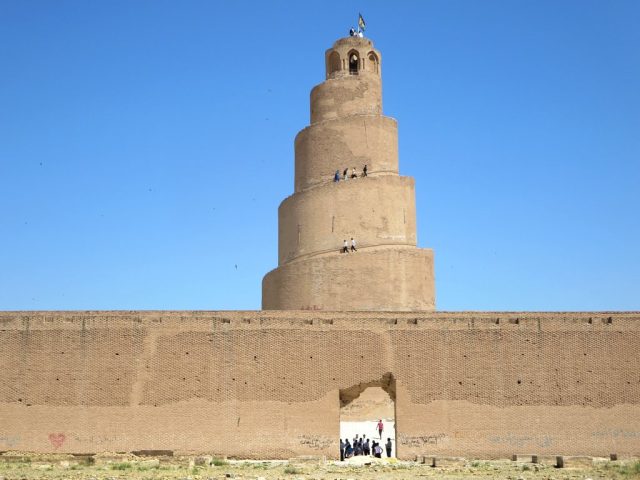
The Al-Askari Mosque in Samarra is one of those rare places where history doesn’t just linger in the air—it presses against you with every step. Built in the mid-ninth century, it wasn’t merely a house of worship but a statement of an empire at its height. Back then, Samarra was the capital of the Abbasid Caliphate, a sprawling metropolis that ranked among the largest cities in the world. The mosque, commissioned by Caliph al-Mutawakkil, was meant to embody the grandeur of Islamic civilization, a monument to power and faith. Today, much of that splendor has faded, reduced to fragments of stone and memory, yet even those remnants carry a weight that’s hard to ignore.
The architecture of the mosque was nothing short of revolutionary for its time. Its most striking feature was the Malwiya Minaret, a spiraling tower that rose over thirty meters into the sky. Unlike anything else in the Islamic world, it began wide at the base and tapered as it ascended, its internal staircase winding upward like a path to the heavens. The minaret stood at the edge of a vast courtyard, surrounded by arcades that could accommodate thousands of worshippers. Time and conflict have taken their toll—the mosque now lies in ruins—but the minaret, though damaged, still stands as a defiant echo of what once was.
Samarra in the ninth century was a city of extraordinary diversity, a melting pot of scholars, poets, and artisans drawn from across the caliphate. The Al-Askari Mosque wasn’t just a place of prayer; it was the heart of public life. Debates raged in its shadow, poetry was recited in its courtyards, and deals were struck in its arcades. The city itself was a marvel, famous for its bustling markets, opulent palaces, and lush gardens. Today, the silence that hangs over the mosque’s ruins makes it difficult to imagine the vibrancy that once filled this space, but the stillness itself feels like a quiet testament to what has been lost.
For Shia Muslims, the Al-Askari Mosque holds profound significance. It is the resting place of two revered imams—Ali al-Hadi and Hasan al-Askari—the tenth and eleventh spiritual leaders of Shia Islam. Despite the devastation wrought by war and terrorism, including the 2006 bombing that destroyed the mosque’s golden dome, the site remains a vital pilgrimage destination. The attacks left deep scars, yet the faithful continue to come, drawn by a devotion that transcends the physical state of the place. The mosque’s ruins are not just relics; they are a living connection to a sacred history.
Architecturally, the mosque was ahead of its time. The Malwiya Minaret, in particular, became a source of inspiration for similar structures across the Islamic world. Even in its current state, it remains one of Samarra’s most recognizable landmarks. The surrounding area, once home to palaces and residential quarters, now lies in ruins, with only foundations and scattered walls hinting at the city’s former glory. Archaeologists continue to sift through the remains, piecing together the story of a place that was once the center of the world.
Samarra and its mosque are not just relics of the past; they are part of Iraq’s present. The city, which once commanded the attention of empires, now moves at a slower pace, but the echoes of its golden age are still palpable. The Al-Askari Mosque, despite its battered state, remains a place of deep meaning for Muslims, particularly the Shia community. It serves as a reminder of how fragile history can be—and how essential it is to preserve its traces, even when all that remains are stones.
Visiting the mosque is like stepping into a different era. There are no crowds here, no tourist traps, just the quiet weight of centuries pressing down on you. You can wander through the ruins for hours, trying to imagine the voices of worshippers filling the air, the courtyard alive with the hum of Friday prayers. Even in its broken state, the place carries an energy that feels almost tangible, as if the past is still whispering just beneath the surface.
The Al-Askari Mosque is more than an architectural monument; it’s a living piece of history. It has survived rises and falls, wars and destruction, yet it endures as a symbol of faith and resilience. For anyone drawn to the history of Islam or simply curious about the ancient world, this place offers something rare—a chance to not just learn about the past, but to feel it. It doesn’t resemble other landmarks because here, history isn’t just recounted; it’s experienced.