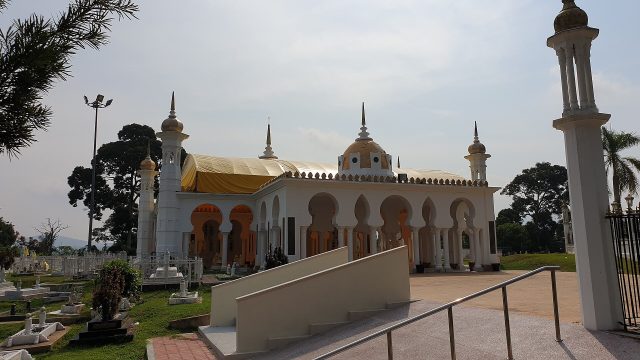
Bukit Chandan is one of those quiet places that reveal themselves slowly, not with grand gestures but with small, unassuming details. Perched on the edge of Kuala Kangsar, this hill feels less like a tourist attraction and more like a natural part of the town’s rhythm. It has always been a vantage point, offering views of the Perak River winding through the landscape and the patchwork of villages beyond. In the 19th century, the sultans of Perak chose this spot for a summer retreat, though little remains of those structures today. What lingers is the sense of continuity—the hill still overlooks the same river, the same fields, the same slow pace of life that has unfolded here for generations.
The gardens that now cover Bukit Chandan are understated, almost accidental in their simplicity. There are no manicured flowerbeds or elaborate monuments, just well-kept lawns, clusters of shade trees, and winding paths that lead upward. Locals treat it like an extension of their neighborhood, a place to start the day with a jog or a quiet moment on a bench, watching the sun rise over the water. On weekends, the hill comes alive in a low-key way—families spread out picnic blankets, children chase butterflies, and groups of teenagers gather near the small fountain, laughing or snapping photos against the backdrop of the river below.
The remnants of the old palace are easy to miss if you’re not looking for them. At the summit, a scattering of stone foundations and crumbling walls is all that’s left of Sultan Idris I’s residence. The ruins are overgrown with grass now, blending into the landscape, but if you crouch down, you can still trace the outlines of rooms and corridors. Nearby, a modest memorial stands—a simple plaque explaining the sultan’s place in Perak’s history. For outsiders, it might not seem like much, but for those who grew up hearing stories of the past, these stones carry weight. Ceremonies are still held here, flowers laid in remembrance, a quiet acknowledgment of what once was.
What makes Bukit Chandan special is its refusal to perform. There’s no forced grandeur, no attempt to impress. The hill is just itself—a place where the air smells of damp earth and distant rain, where the only sounds are the rustle of leaves and the occasional call of a bird. From the top, the view unfolds like a living postcard: the red-tiled roofs of Kuala Kangsar, the slender minarets of mosques, the green fields stretching toward the river. On clear days, the distant mountains rise like a faint blue haze, framing the scene. It’s the kind of view that doesn’t demand admiration; it simply exists, waiting for those who take the time to notice.
There’s no need to plan a visit here. The paths are paved but unobtrusive, fading into dirt trails where the trees grow thicker. About halfway up, a small shelter offers a place to rest, with a vending machine for water if you’ve forgotten your own. The heat can be intense in the middle of the day, but the shade provides relief, and by late afternoon, a breeze often drifts up from the river, carrying the scent of water and damp vegetation. It’s the kind of place where you can wander without a destination, letting the slope of the hill guide you.
Bukit Chandan isn’t the sort of place that makes it onto must-see lists, and that’s precisely why it feels authentic. There are no crowds, no souvenir stalls, no tour guides herding visitors from one spot to the next. Instead, it offers something rarer—a glimpse of how people actually live. You might spend an hour here or half a day, sitting on a bench as the light shifts, or walking the paths without any particular goal. It’s the kind of place that doesn’t ask for your attention; it simply waits, patient and unchanging, while the world moves around it.
In recent years, there have been efforts to draw more visitors to the hill, with improved signage and small upgrades to the paths. So far, though, these changes haven’t disrupted its quiet character. Bukit Chandan remains a place where the past and present coexist without tension—the ruins of the palace a reminder of history, the joggers and picnickers a sign of the life that continues around it. There’s nothing extraordinary about it, and that’s the point. It’s a place to return to when you need a break from the noise, a reminder of the steady, unhurried pace that still exists if you know where to look.