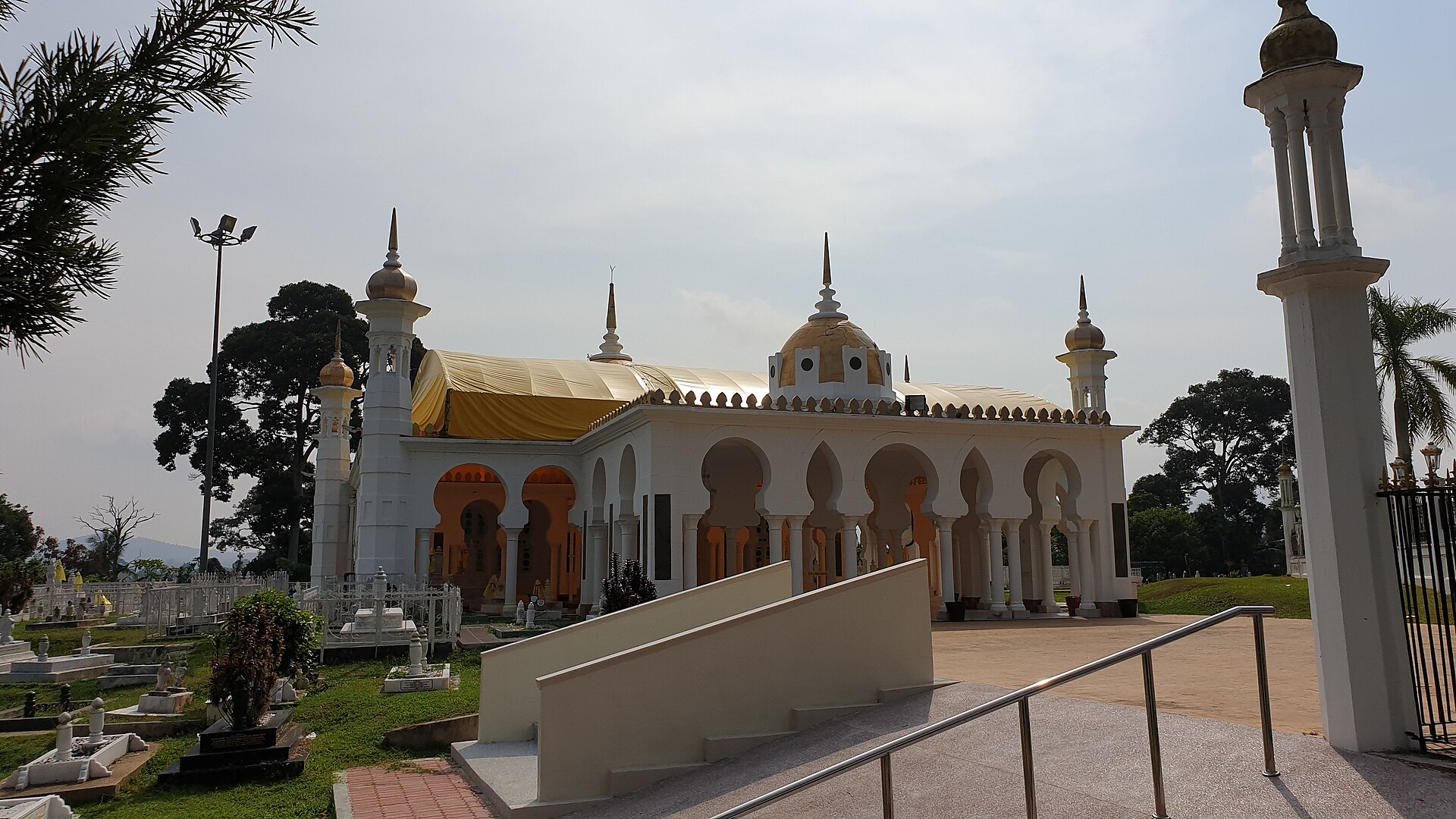
The Royal Mausoleum of Perak is one of those quiet places where Malaysia’s layered history feels almost tangible. Tucked away in Kuala Kangsar, a small town in the northern part of the country, it stands as a resting place for generations of sultans who once ruled the Perak Sultanate. The mausoleum isn’t grand in the way some royal tombs are—there are no towering monuments or gilded domes—but its understated presence carries a weight that goes beyond mere architecture. Surrounded by greenery and the slow-moving Perak River, it exists in a space where time seems to soften, where the past isn’t just remembered but still lingers in the air.
The building itself is simple, reflecting the practical yet elegant style of traditional Malay Islamic architecture. Whitewashed walls, low domes, and arched doorways blend seamlessly into the landscape, as if the structure grew naturally from the earth rather than being imposed upon it. Inside, the light is dim, filtered through lattice windows that cast delicate patterns across the tiled floors. The walls bear Quranic calligraphy, the script flowing in graceful curves, but there’s no ostentation here—just a quiet dignity. The space feels more like a sanctuary than a museum, a place where reverence is measured in silence rather than spectacle.
Perak is one of Malaysia’s oldest sultanates, and its history is deeply entwined with the broader narrative of the Malay Peninsula. Kuala Kangsar became the capital in the late 18th century, when the rulers moved inland from a more vulnerable coastal location. The mausoleum likely took shape around this time, though no one knows exactly when the first sultan was laid to rest here. Over the centuries, dozens of rulers have been buried within its walls, each leaving their mark on Perak’s story—whether through resistance to colonial powers, the negotiation of treaties, or the gradual modernization of the sultanate in the 20th century. Their names may not be widely known outside Malaysia, but within these walls, they remain a living part of the region’s identity.
Visiting the mausoleum isn’t like touring a historical site in the usual sense. There are no guided tours, no plaques explaining each artifact, and certainly no crowds. Instead, it’s a place where you’re left to absorb the atmosphere on your own terms. The only sounds are the occasional murmur of locals paying their respects or the rustle of leaves in the breeze. The absence of tourists makes it feel more intimate, as if you’ve stumbled upon something meant only for those who seek it out. Before entering, visitors remove their shoes, and inside, the expectation is one of quiet reflection—no loud conversations, no flashing cameras. For many Malays, this is a place of pilgrimage, a connection to the lineage that has shaped Perak for centuries.
What makes the mausoleum unusual is that it doesn’t try to explain itself. There are no exhibits, no timelines, no curated displays. The history is there, but it’s woven into the architecture, the calligraphy, the very stillness of the place. For those willing to look, it offers a glimpse into the world of Perak’s sultans—not through grand gestures, but through the small details: the worn tiles underfoot, the way the light slants through the windows at certain times of day, the faint scent of incense that lingers in the air. Nearby, the Istana Kenangan, a former royal residence, adds another layer to the story, its wooden structure a reminder of the sultanate’s more recent past. Together, these sites paint a picture of a world that was both regal and deeply rooted in tradition.
Kuala Kangsar itself is the kind of town that rewards slow exploration. There are no skyscrapers here, no bustling night markets—just narrow streets lined with old shophouses, a handful of historic mosques, and the unhurried rhythm of daily life. The mausoleum is just one piece of the puzzle, but it’s the one that gives the town its quiet soul. It’s a place where history isn’t confined to textbooks or documentaries but lives on in the stones, in the way people still come to pay their respects, in the way the past and present coexist without fanfare.
For travelers who venture beyond Malaysia’s more famous attractions, the mausoleum can be a revelation. Unlike the Petronas Towers or the Batu Caves, it doesn’t demand attention—it simply exists, waiting for those who are curious enough to seek it out. There’s no scripted experience here, no Instagram moments to chase. Instead, it offers something rarer: a chance to step into a different kind of Malaysia, one where the country’s history isn’t just preserved but still breathing. Kuala Kangsar and its royal tombs remind you that Malaysia is more than its modern cities and beaches—it’s a place where the past is never really gone, just quietly waiting to be rediscovered.