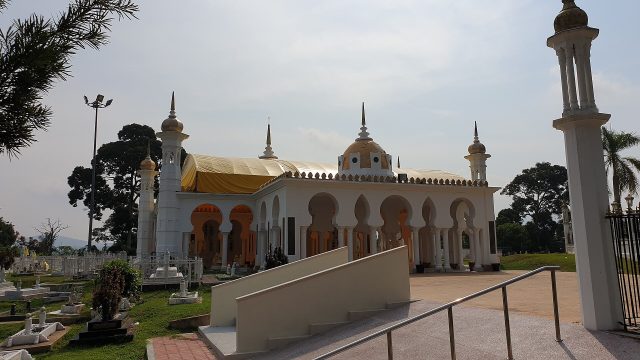
Perched on a gentle hill overlooking the winding Perak River, Istana Kenangan stands as a quiet witness to Malaysia’s royal past. Built in the late 19th century, it was the official residence of Sultan Idris I, one of Perak’s most revered rulers, and remains a working palace to this day. Unlike the grand, ostentatious palaces of other nations, this one feels almost understated—its whitewashed walls and intricate wooden carvings speak of tradition without excess, blending seamlessly into the landscape as if it has always been there.
The architecture of Istana Kenangan is a rare harmony of Malay and colonial influences. The wooden balconies with their delicate latticework, the tall shuttered windows that hint at European design, and the steeply pitched roof typical of local homes all come together in a way that feels both natural and unexpected. Inside, the original interiors have been preserved with care: antique furniture, hand-painted ceilings, and even the sultan’s personal belongings offer a glimpse into the daily life of Perak’s royalty over a century ago. There’s no sense of museum-like stiffness here—just the quiet presence of history, as if the past is still lingering in the air.
Though the palace is still used for official functions, parts of it are open to visitors. Walking through its halls feels like stepping into another era. The throne room, where state ceremonies once took place, retains its solemn grandeur, while the sultan’s private chambers reveal a more intimate side of royal life. A small collection of weapons and household items from the period is displayed with restraint, never overshadowing the sense of place. The audience hall, with its soaring ceilings and heavy chandeliers, is particularly striking—even now, it’s easy to imagine the weight of tradition that once filled this space.
Kuala Kangsar itself is a town that moves at its own unhurried pace. Once the capital of Perak before Ipoh took its place, it has managed to hold onto its quiet charm. There are no crowds here, no tourist traps—just narrow streets lined with old mosques and stilted Malay houses, where the rhythm of life feels untouched by time. Istana Kenangan isn’t just the town’s most famous landmark; it’s the heart of a place that still values its heritage without being trapped by it.
Just a short walk from the palace stands the Ubudiah Mosque, another jewel of Kuala Kangsar. Built in the early 20th century, its golden domes and marble walls offer a striking contrast to the more modest Istana Kenangan. Together, they form a kind of dialogue between different eras and styles, reflecting the region’s layered history. The walk between them is brief, but it’s enough to feel the way the past and present coexist here—effortlessly, without fanfare.
Istana Kenangan isn’t a museum in the traditional sense. There are no guided tours with scripted stories, no crowds jostling for photos. Instead, it’s a place of quiet reflection, where history isn’t just observed but felt. Visitors often remark that the palace doesn’t overwhelm with opulence; rather, it draws you in with its authenticity. The wooden floors creak underfoot, the old chandeliers still cast their soft light, and the views from the windows remain unchanged—no reconstructions, no artificial touches, just the weight of time.
For anyone interested in Malaysia’s history, Istana Kenangan is more than just a stop on a travel itinerary. It offers a rare insight into the world of Malay sultans and the forces that shaped the nation’s identity. Unlike larger museums, where artifacts are often sealed behind glass, here history is tangible. You walk the same corridors as the rulers once did, see the same river views they would have known, and leave with the sense that the past isn’t as distant as it seems.
Kuala Kangsar isn’t a place for rushing. It rewards those who take their time—lingering over a cup of tea in a small café, watching the slow pace of life along the river, or simply sitting in the shade of an old tree. Istana Kenangan isn’t just a monument; it’s part of the town’s living fabric, a reminder that tradition and modernity don’t have to be at odds. That, perhaps, is why it endures—not as a relic, but as something still very much alive.