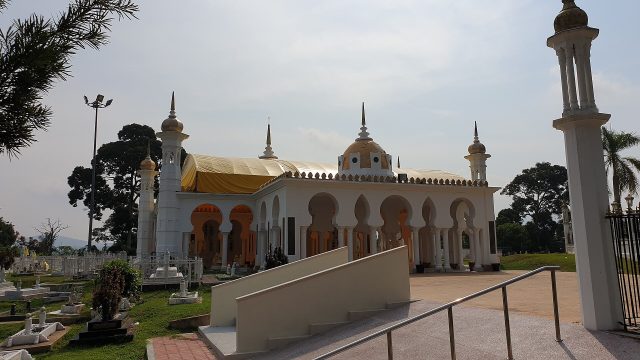
Kuala Kangsar is one of those quiet Malaysian towns where history lingers in the air like the scent of rain on old wooden beams. It doesn’t draw crowds like Kuala Lumpur or Penang, and that’s part of its charm. The streets are narrow, lined with weathered shophouses and mosques whose minarets rise against the tropical sky. Along the Perak River, life moves at an unhurried pace, as if the town has decided there’s no need to rush. And at its heart stands the Perak Sultanate Museum, a place that doesn’t just display history but lets you step into it.
The building itself is a piece of living heritage. Once the Istana Kenangan, the palace of Sultan Idris I, it was built in 1898 when Perak was still a semi-independent sultanate under British protection. The architecture reflects that era of delicate balance—traditional Malay design softened by colonial influences. The wooden pillars are intricately carved, the ceilings high enough to catch the breeze, and the wide verandas invite you to linger. The roof, with its gracefully upturned edges, isn’t just decorative; it’s a practical response to the region’s sudden downpours. Inside, the rooms still feel like they belong to another time, where decisions were made over slow conversations and the weight of tradition was as real as the teak underfoot.
The museum traces Perak’s story from its earliest days to the present, but the focus is on the sultanate’s golden age. The exhibits begin with archaeological fragments—pottery shards, tools, and beads—that hint at the people who lived here long before written records. From there, the narrative unfolds through the rise of Malay kingdoms, the arrival of Islam, and the complex politics of the 19th century. Sultan Idris I, who ruled from 1887 to 1916, is a central figure. His reign was a time of relative stability, when Perak navigated the pressures of British rule while trying to preserve its identity. The museum displays his personal belongings—ceremonial daggers, letters, and photographs—as well as everyday objects that reveal how people lived: woven baskets, silver betel nut sets, and the kind of simple furniture that once filled these very rooms.
One of the most compelling sections is devoted to Malay culture, where the exhibits feel less like artifacts and more like fragments of a way of life. There are textiles with patterns so intricate they seem to tell stories, their threads dyed in deep indigos and rust-reds. The kris daggers, with their wavy blades, are displayed not just as weapons but as sacred objects, each one believed to hold a spirit. Some have hilts carved into the shapes of mythical creatures, their surfaces worn smooth by generations of hands. Nearby, musical instruments like the rebab and gendang hint at the rhythms that once filled village gatherings. It’s easy to imagine these objects in use—passed down through families, handled with care, their meanings woven into daily rituals.
The museum doesn’t just dwell on the past. A separate gallery shows how Perak’s traditions have evolved, with contemporary artworks and photographs documenting the state’s transformation. Old black-and-white images of Kuala Kangsar—dirt roads, wooden bridges, men in songkok hats—sit alongside modern shots of the same places, now lined with cars and concrete. The contrast is striking, but the town’s character hasn’t disappeared. The museum makes that clear: Perak may have become an industrial hub, but its cultural roots run deep. Even the way the exhibits are arranged feels intentional, as if to say that history isn’t something sealed behind glass—it’s alive, changing, and still being written.
What makes the Perak Sultanate Museum special is its lack of pretension. There are no flashy displays or dramatic reenactments, just a quiet, thoughtful presentation of a place and its people. The staff don’t hover, and there’s no pressure to rush. You can take your time with the exhibits, or simply sit on one of the verandas and watch the light shift across the courtyard. Outside, Kuala Kangsar moves at its own pace. The river flows lazily past, the call to prayer echoes from the mosques, and the old wooden houses seem to exhale the scent of centuries. The museum fits naturally into this rhythm, as if it’s always been here, waiting for visitors to slow down and listen.
For anyone curious about Southeast Asia’s layered history, this museum offers something rare: a sense of continuity. It doesn’t claim to have all the answers, but it asks the right questions. How did a small sultanate on the Malay Peninsula maintain its identity amid colonial pressures? How did traditions survive modernization? What does it mean to be Perakian today? The exhibits don’t lecture; they invite you to ponder. And if you walk through the town afterward, the streets feel different. The old palace where the museum is housed, the riverfront where traders once docked, the mosques with their timeworn stones—suddenly, they’re not just scenery. They’re part of a story.
Perhaps that’s why the museum doesn’t feel like a tourist attraction. There are no souvenir stalls or pushy guides, just a place where locals and visitors alike can connect with something real. It’s not about spectacle; it’s about understanding. And in a world where history is often packaged for quick consumption, that’s a rare quality. The Perak Sultanate Museum doesn’t just preserve the past—it lets you touch it, question it, and carry a piece of it with you. That’s more than most museums manage.