Edfu’s market is one of those rare places where time seems to slow, revealing the city in a way few visitors ever see. Unlike the crowded souks of Cairo or Luxor, where tourists and vendors jostle for space, here the pace is unhurried, the atmosphere unforced. This is provincial Egypt as it has been for generations—where trade isn’t just commerce but a way of life. The narrow lanes, shaded by woven palm fronds, carry the scent of spices, fresh bread, and dried herbs. There’s no scripted performance for outsiders; just the quiet rhythm of daily existence, where locals haggle over small change, sip tea in dimly lit stalls, and go about their business as they have for decades.
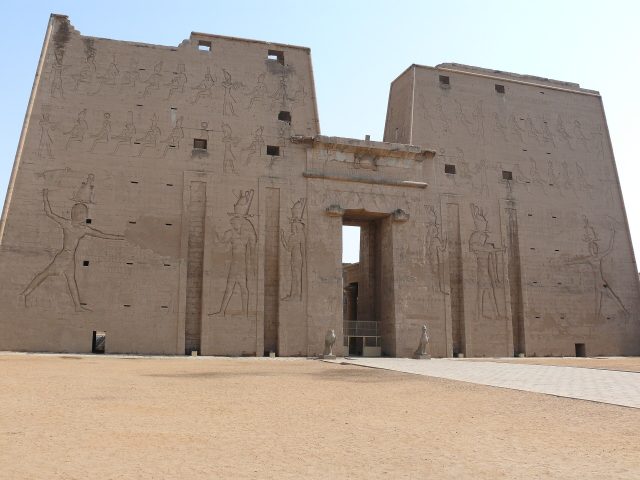
The city itself is best known for the Temple of Horus, a monumental relic of ancient Egypt, but the market operates on its own terms, untouched by the expectations of tourists. It sprawls through Edfu’s old quarter, where mud-brick houses line streets that have barely changed since medieval times. Cars are rare here; instead, donkeys laden with goods amble past, while children dart between the stalls. The market wakes with the sun, humming with activity as farmers arrive with crates of produce and bakers pull loaves from clay ovens. By midday, the energy shifts, settling into a slower, more deliberate cadence that lasts until dusk.
There’s no rigid organization to the market—no neatly labeled sections or tourist-friendly signage. Yet certain patterns emerge. One area is devoted to food: pyramids of dates, pomegranates split open to reveal their ruby seeds, eggplants stacked like dark jewels, and bundles of herbs tied with twine. Nearby, the spice merchants display their wares in open sacks—golden turmeric, earthy cumin, the sharp bite of cardamom—alongside pre-mixed blends for ful medames or molokhia. Further in, bolts of fabric catch the light: rough cotton scarves, linen throws woven by hand, and embroidered textiles in faded indigo. Pottery stalls offer simple clay bowls and copper trays, their surfaces worn smooth by generations of use. The souvenir vendors here are low-key, their wares modest—small scarabs carved from stone, papyrus scrolls with hieroglyphic motifs, beadwork that feels more like a craft than a trinket.
But the market is more than a place to shop. It’s a social hub, where neighbors gather to gossip, share recipes, or debate the price of tomatoes over tiny cups of thick, sweet coffee. In the cramped cafés tucked between stalls, old men hunch over backgammon boards, their moves deliberate, their laughter easy. Women sell homemade pastries from trays balanced on their heads, calling out to passersby in a mix of Arabic and the local dialect. There’s no rush, no pressure to buy—just the steady pulse of community life, where every transaction is also a conversation.
The market’s roots stretch back centuries. Edfu was a trading post long before the Temple of Horus was built, a stopover for caravans moving between Nubia and the Nile Valley. In the Middle Ages, it remained a vital link for pilgrims and merchants, its bazaar a crossroads of goods and ideas. Some traditions persist even now. Bartering still happens—farmers might trade a sack of onions for a handmade basket or a few hours of labor. The layout of the market, with its winding alleys and hidden courtyards, echoes the medieval souks that once thrived across the Islamic world. Yet it’s not frozen in time; plastic crates and fluorescent lights coexist with mud-brick walls and palm-frond awnings, proof that the market adapts without losing its essence.
The architecture is unpretentious, built for function rather than beauty. Stalls are little more than open-fronted rooms with low ceilings, their wares spilling onto the dirt paths. The palm-frond canopies cast dappled shadows, offering respite from the midday sun, while the earthen floors give the place a grounded, timeless feel. In a few spots, weathered stone columns hint at older structures, remnants of a time when the market may have been part of a larger complex. But mostly, it’s a place of impermanence—stalls set up at dawn, taken down at dusk, their temporary nature part of the charm.
For travelers who come to Edfu solely for the temple, the market can feel like a revelation. There are no grand monuments here, no hieroglyphs to decipher—just the quiet authenticity of a place that exists for its own sake. You might leave with a bag of spices, their scents lingering on your clothes, or a few pieces of handmade pottery, their imperfections telling a story. Or you might leave with nothing at all, just the memory of sitting in the shade, watching the world go by. The market doesn’t demand attention; it simply offers a glimpse into the everyday Egypt that most visitors never see—a place where history isn’t just preserved in stone but lived, one transaction, one conversation, at a time.