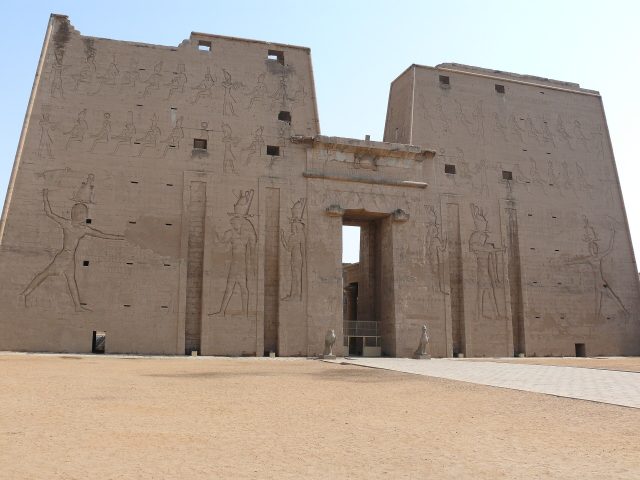
Edfu is a city that lives between two worlds. On one side, there’s the grandeur of the Temple of Horus, its towering columns and intricate carvings drawing visitors from across the globe. On the other, there’s the quiet rhythm of everyday life, where time moves at its own unhurried pace. The Al-Tabai Mosque sits somewhere in between—neither as ancient as the temple nor as modern as the newer parts of town, but very much alive in its own understated way.
Unlike the more famous mosques of Cairo or Luxor, Al-Tabai doesn’t demand attention. It doesn’t appear in guidebooks as a must-see, and that’s precisely what makes it special. The building itself is simple, built from light-colored stone that glows almost white under the harsh Upper Egyptian sun. The minaret is slender, with the traditional balcony where the call to prayer once echoed, though now the sound is more likely to come from a speaker. Inside, the space is open and airy, with high ceilings supported by columns that let in a soft, diffused light. The carpets muffle footsteps, adding to the sense of quiet.
The mosque was built during the Mamluk period, a time when Islamic architecture in Egypt was flourishing, blending local traditions with influences from across the region. By then, Edfu was no longer a capital, but it remained an important religious and commercial hub. The mosque became part of that legacy—a place where merchants and travelers might have paused for prayer or rest, though today it’s mostly locals who come and go. There are no grand relics or ornate decorations inside, just the essentials: prayer niches, wooden panels with Arabic script, and a few old lanterns that have seen generations pass through.
What strikes you most about Al-Tabai isn’t its architecture or history, but the way it fits into the fabric of the city. The surrounding streets are narrow and winding, lined with low houses where life unfolds slowly. Vendors spread their goods on the ground, children play in the shade, and elderly men sit on benches, watching the world go by. This isn’t the Egypt most tourists see, but it’s the one that exists beyond the postcard images. The mosque is part of that reality—a place where people come not for spectacle, but for solace.
Visiting Al-Tabai isn’t about ticking off a sightseeing list. There are no guided tours, no strict visiting hours, just an open door and the quiet invitation to step inside. In the heat of the afternoon, the mosque offers respite from the sun, its courtyard a cool refuge. In the evening, the space comes alive in a different way, as neighbors gather to chat or share news. The call to prayer marks the passage of time, a reminder of the rhythms that have shaped this place for centuries.
Edfu itself is a study in contrasts. The Temple of Horus stands as a testament to ancient glory, while the rest of the city carries on with its own, more modest concerns. Al-Tabai exists in that in-between space, neither as monumental as the temple nor as transient as the modern world creeping in. It’s a place that doesn’t try to impress, but simply endures, serving its purpose for those who need it.
For travelers who stumble upon it, the mosque might feel like a small discovery—a reminder that beauty often lies in the unassuming corners of the world. For the people of Edfu, it’s something far more personal: a place to pray, to rest, to escape the noise of daily life. The wind rustles through the palm trees outside, the shadows lengthen as the sun moves across the sky, and inside, the quiet persists, untouched by the passage of time.