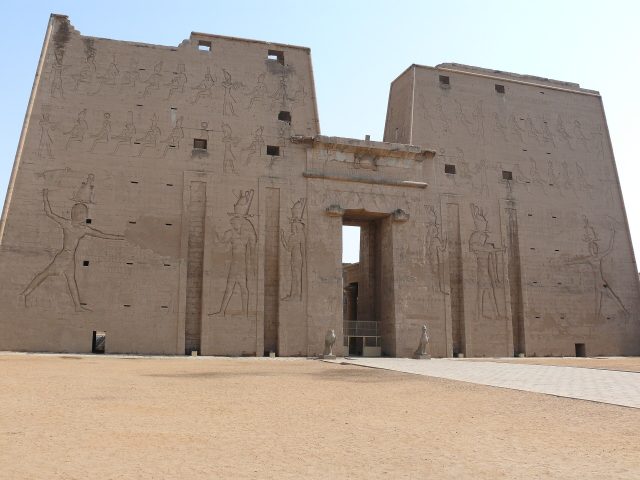
Edfu is one of those places in Egypt that moves at its own pace. Most visitors come for the Temple of Horus, a Ptolemaic structure that dominates the town’s skyline. Its columns and carvings draw crowds, but a short walk from the temple’s entrance, on a quiet side street, is the Edfu Museum. This small space offers a different kind of encounter with the past. Unlike the vast collections in Cairo or Luxor, this museum feels personal, as if the artifacts were gathered for those willing to pause and listen.
The building is modest, blending into the town’s architecture. From the outside, it looks like any other two-story structure in Edfu—sand-colored stone, simple lines. Inside, the space holds objects unearthed in and around the city. Most exhibits relate to the cult of Horus, the falcon-headed god who was both protector and patron of Edfu. Statues, stelae, fragments of reliefs, and everyday items span centuries, from the Old Kingdom to the Roman era. Among them are stone blocks inscribed with hieroglyphs, once part of the temple’s walls, now displayed without glass barriers. The past feels close enough to touch.
The museum’s collection focuses on the details. There are no golden sarcophagi or jewel-encrusted treasures. Instead, you find the smaller things: carvings of Horus in falcon form, their surfaces polished by time; the tools of craftsmen; clay vessels that once held oil or grain. These objects speak of the people who lived, worked, and worshipped in Edfu long before it became a tourist destination. A display of amulets, tiny and unassuming, carries the beliefs of those who wore them. They remind you that history is made by hands that shaped these objects and the lives they touched.
The Edfu Museum is unusual because it keeps its artifacts where they belong. For much of the 20th century, many objects found here were sent to Cairo or sold abroad. Efforts to bring them back began recently. The museum is more than a collection—it’s a reclamation. It tells the story of a town that has always lived in the shadow of its past, yet carries that past forward in its own way. The exhibits ground history in the present, in the streets outside where life continues.
The museum pairs well with the Temple of Horus, just a few minutes’ walk away. The temple, one of the best-preserved in Egypt, is covered in reliefs depicting rituals and battles. But without context, it can feel distant. The museum bridges that gap. Here, you might see fragments of the same carvings that adorn the temple’s walls or learn about the festivals that once filled its courtyards. The temple becomes more than a monument—it’s part of a living tradition.
Edfu resists easy labels. It’s not a resort like Hurghada or a metropolis like Cairo. There are no luxury hotels or souvenir shops. Life moves at its own pace. In the mornings, the smell of baking bread fills the air. Children play soccer in the streets. The museum fits into this rhythm, not as a tourist attraction, but as part of the town’s fabric. Visiting it doesn’t feel like checking off a list—it feels like joining a conversation that’s been going on for centuries.
The museum is rarely crowded. You can stand in front of an exhibit for as long as you like. Local school groups sometimes pass through, their voices bright with curiosity. Watching them, you sense continuity—history isn’t just something that happened long ago, but something still being discovered.
This isn’t a place for blockbuster exhibits. But for those who visit, the museum offers something rare: a chance to engage with history on a human scale. The objects aren’t just relics—they’re witnesses. A chipped statue of Horus, a weathered stela, a humble cooking pot—each carries the weight of a place inhabited for millennia. Sometimes, the most compelling stories are the quiet ones, waiting for those willing to listen.