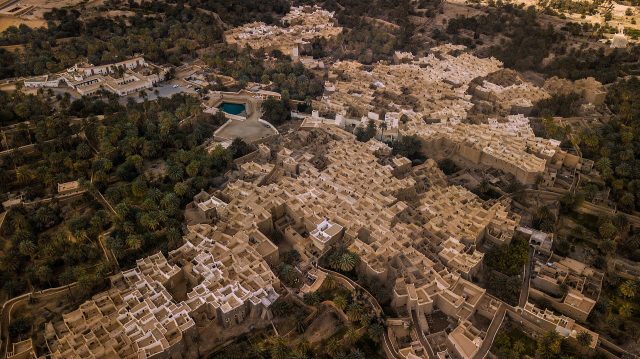
Ghadames is called the pearl of the desert. Its old market is where that name makes sense. The narrow, winding alleys pull you into a rhythm of life unchanged for centuries. The market is the living heart of the old city, where history, culture, and daily life meet.
The architecture here is Ghadames itself—clay and palm wood. Low doorways, arched ceilings, and ochre walls make the market feel like an ancient dwelling. The passageways are so narrow two people can barely pass. Covered walkways block the desert sun, casting soft light over the stalls. The design works: thick clay walls keep heat out in summer and warmth in during winter. For generations, this mattered.
Ghadames was once a key stop on the trans-Saharan trade routes. It connected the Mediterranean to Africa. Caravans carried gold, salt, and spices, linking merchants from Morocco, Tunisia, and Egypt to North African markets. Today, motorbikes and rare travelers replace the caravans, but the market still feels like that era.
What you’ll find here hasn’t changed. Stalls sell dates, olive oil, spices, wool carpets, and leatherwork. The dates from nearby oases are soft and sweet, with a hint of tartness. Olive oil, pressed traditionally, smells of herbs and woodsmoke. Spices like cumin, turmeric, and coriander are sold by weight. Carpets, woven from local sheep’s wool, show Berber geometric patterns.
The market lives because of its people. Elderly men sit on stools, fingers moving over prayer beads. Women in traditional dress haggle quietly. Children dart between stalls, their laughter mixing with conversation. Vendors don’t call out or pressure you. They wait.
Sometimes, you hear a story about a grandfather who traded with merchants from Timbuktu. For a moment, time stops.
Ghadames has its own rhythm. The market has no rush, no forced hospitality. Just conversation, the rustle of fabric, the clink of metal trays, and the scent of fresh bread. If you’re lucky, you’ll see a celebration—a wedding or festival—in the square outside. Music fills the air, women sing, and men dance to drums. The outside world fades.
This isn’t a place for luxury shopping. No high-end boutiques, no multilingual menus, no nightlife. That’s why it’s special. The market is a living piece of the city. Every stone, stall, and vendor carries history. To visit is to step into a world where the past isn’t in museums—it’s in the everyday.
Reaching Ghadames is hard. Libya’s political situation keeps most travelers away. But those who come leave with more than souvenirs. They leave with the sense of having touched a place where time moves differently. The market isn’t just for buying dates or carpets. It’s where you feel the pulse of a city that has endured, unchanged, for centuries.