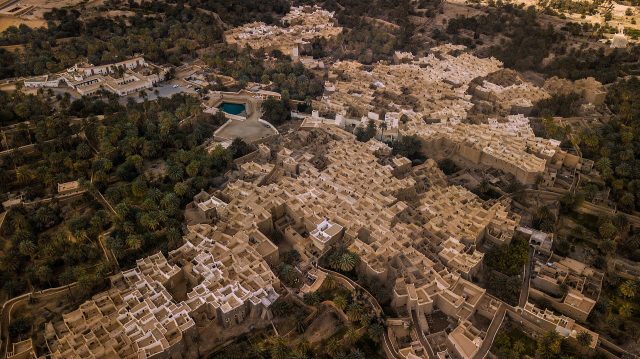
Martyrs’ Square in Ghadames is one of those rare places where time seems to slow, almost as if the weight of centuries has settled into the very air. This desert city, often called the pearl of the Sahara, has long stood as a testament to resilience and tradition, and the square at its heart is more than just an open space—it’s a living record of the past. Here, among the earthen walls and winding alleys, it’s easy to imagine the bustle of merchants, artisans, and travelers who once paused in Ghadames on their journeys across the Sahara. The city has always been a crossroads, a place where stories and goods flowed as freely as the desert winds.
Ghadames itself dates back to Roman times, when it served as a vital stop on the trans-Saharan trade routes. Martyrs’ Square lies in the heart of the old city, surrounded by buildings that appear to have grown from the earth itself. Their walls, made of clay and palm fronds, are perfectly adapted to the harsh climate, blending seamlessly with the landscape. The architecture here isn’t just practical—it’s a masterclass in harmony. Narrow passageways between the houses create natural shade, while flat rooftops double as living spaces when the evening brings relief from the heat. The old city, where the square is located, is a UNESCO World Heritage site, and it’s easy to see why. Ghadames has preserved its unique character, untouched by the rush of modernity. The buildings are constructed without a single nail, their designs passed down through generations, a testament to the ingenuity of those who built them.
For centuries, Ghadames was a thriving hub of commerce, where caravans laden with salt, gold, and exotic goods from sub-Saharan Africa converged before continuing north to the Mediterranean. Martyrs’ Square was likely one of the places where deals were struck, disputes settled, and news exchanged. Today, the echoes of that era linger in the quiet of the square and the labyrinth of alleys leading to it. Walking through them feels like stepping into a different time, where the rhythm of life has remained unchanged for generations. The city’s history isn’t confined to museums—it’s woven into the fabric of everyday life, visible in the worn stones underfoot and the way the light filters through the narrow streets.
Ghadames has seen its share of upheaval. During the Italian occupation in the early 20th century, it became a center of resistance, and Martyrs’ Square may well have been a gathering place for those plotting defiance. There are no plaques or monuments here, no grand declarations of the past—just the quiet persistence of the place itself. The square has witnessed the city’s rise and fall, its periods of prosperity and decline, and yet it endures, much like Ghadames itself. The old city, where the square is located, is slowly emptying as residents move to newer, more modern districts, but those who remain take pride in preserving its traditions. In the summer, when temperatures soar, life on the square slows to a crawl during the day, only to revive as the sun sets. Then, the air fills with the sounds of conversation, laughter, and the scent of local dishes being prepared.
What makes Martyrs’ Square special isn’t just its history—it’s the way that history is still alive. Ghadames has survived wars, shifting empires, and economic hardships, yet it has always found a way to endure. Today, it’s a destination for travelers seeking something beyond the usual tourist trails, though few make the journey. Those who do are rewarded with a glimpse of a city that feels suspended in time. There are no crowds here, no neon signs or souvenir stalls—just the quiet hum of life unfolding at its own pace. The square is a place where the past and present coexist, where the traditions of the Sahara are still very much a part of daily life.
Visiting Martyrs’ Square is less about seeing a landmark and more about experiencing a way of life. The old city of Ghadames is a maze of interconnected homes, where families have lived for generations, their lives shaped by the desert’s rhythms. The square itself is unassuming—just an open space where people gather, talk, and watch the world go by. But that simplicity is part of its charm. It’s a place where you can sit and listen to the stories of the locals, or simply soak in the atmosphere of a city that has remained largely unchanged for centuries. The heat, the silence, the way the light plays on the earthen walls—it all feels like stepping into another era.
Ghadames is a city of contrasts. The old town, with its labyrinthine streets and Martyrs’ Square, feels like a world apart from the newer districts, where modern buildings stand in stark contrast to the traditional architecture. Yet even as the old city empties, its spirit remains. The square is a reminder of what Ghadames has always been: a place of resilience, where life adapts to the harshness of the desert rather than being defeated by it. It’s a city that has seen empires rise and fall, yet has always found a way to carry on.
For those who make the journey, Martyrs’ Square offers something rare—a chance to step back in time and see a way of life that has endured for centuries. It’s not a place for those seeking grand monuments or bustling markets. Instead, it’s a quiet corner of the world where history isn’t just remembered—it’s lived. The square, like Ghadames itself, is a testament to the enduring power of tradition, a place where the past is never far from the present.