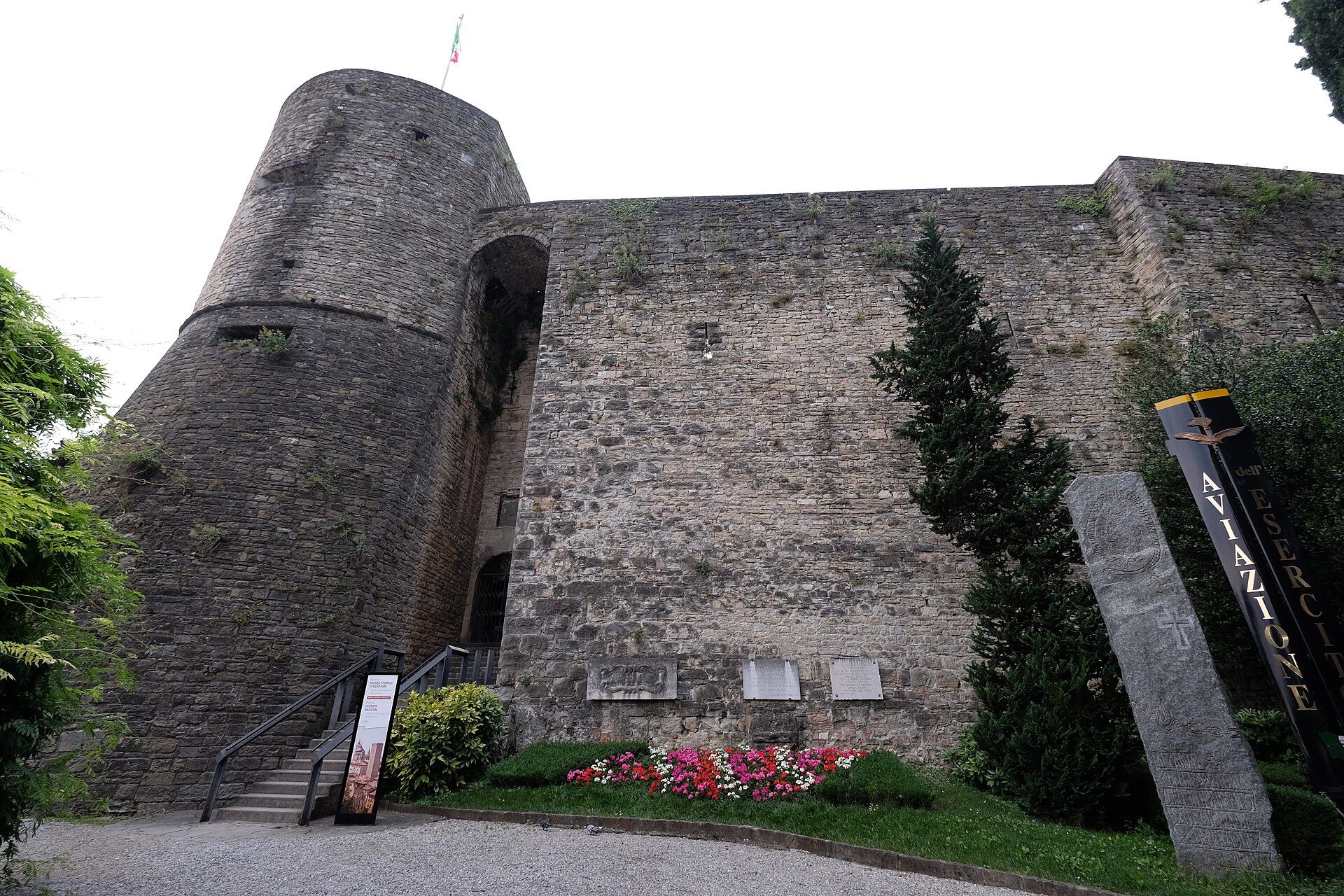
Perched on a hill overlooking Bergamo, the Rocca di Bergamo is more than just a fortress—it’s a silent witness to centuries of history, standing as if frozen in time. From its ramparts, the city unfolds in two distinct halves: the Upper Town, with its labyrinth of medieval streets, stone houses, and ancient churches, and the Lower Town below, a bustling modern contrast. The fortress itself seems to grow naturally from the rock beneath it, its walls so deeply embedded in the hillside that they feel like an extension of the landscape rather than a man-made structure. This seamless integration into the surroundings gives the Rocca a timeless quality, as if it has always been part of the city’s identity.
The origins of the Rocca trace back to the 14th century, when Bergamo was under the rule of the Visconti family of Milan. Built as a formidable defensive stronghold, it was designed to repel invaders and assert control over the region. Thick walls, imposing towers, and deep moats were constructed to intimidate and withstand sieges. Yet, as the centuries passed, the fortress’s role evolved. When Bergamo came under Venetian rule, the Rocca lost its military significance and became a symbol of authority, housing garrisons and administrative offices. By the 19th century, it had been repurposed as barracks and even a prison, reinforcing its reputation as an impenetrable and austere place.
Today, the Rocca serves as an open-air museum, where every stone seems to whisper stories of the past. Walking through its grounds, it’s easy to imagine the fortress in its prime—soldiers patrolling the walls, lookouts scanning the horizon from the towers, and the city humming with life below. The central tower is particularly striking, offering sweeping views of the Alps on clear days. Inside, the fortress’s preserved chambers now host exhibits that delve into Bergamo’s history and the Rocca’s own legacy. Visitors can explore displays of weapons, armor, historical documents, and everyday objects from different eras, but the true draw is the atmosphere. There’s a palpable sense of history here, as if the past lingers in the air.
Architecturally, the Rocca is a blend of medieval grandeur and later modifications. The original structure, with its Gothic-style walls, battlements, and narrow arrow slits, exudes a sense of unyielding strength. Over time, as the fortress’s military purpose waned, its appearance softened. New buildings, windows, and staircases were added, and some walls were dismantled or repurposed. Despite these changes, the Rocca retains its core character—one of resilience and majesty. It’s fascinating to see how the fortress interacts with the city around it: from one angle, it looms over the Upper Town like a guardian, while from another, it blends into the surrounding buildings, almost as if it’s part of them.
For locals, the Rocca is more than a tourist attraction; it’s a cornerstone of their heritage. Throughout the year, the fortress comes alive with festivals, historical reenactments, and cultural events. In summer, open-air concerts fill the air with music, while winter brings Christmas markets that transform the grounds into a festive wonderland. Spring and autumn are especially magical, as the hillside bursts into green or golden hues, making the Rocca appear as if it’s floating above the city. Residents often visit simply to stroll, relax on a bench with a view of the Alps, or enjoy a picnic on the grassy slopes.
Beyond its cultural significance, the Rocca is shrouded in mystery. Legends speak of hidden tunnels beneath its walls, secret passages leading to different parts of the city, and echoes of long-gone prisoners still lingering in the towers. While these stories are difficult to verify, they add a layer of intrigue to the fortress’s already rich history. Even without the tales of ghosts, there’s an undeniable sense of the past here, a feeling that countless lives have intersected within these walls.
What makes the Rocca di Bergamo so compelling is its understated charm. It doesn’t dazzle with the opulence of palaces or the grandeur of cathedrals, but there’s a quiet beauty in its rugged simplicity. A visit here isn’t about rushing from one exhibit to the next; it’s about taking the time to wander, to soak in the views, or to sit with a coffee and watch the light shift over the city. On certain evenings, the fortress becomes a stage for concerts or performances, its ancient walls serving as a backdrop to stories that continue to unfold. It’s a place that invites you to return, not just to see, but to feel the layers of history that have shaped it.