Santa Maria Maggiore sits quietly in Bergamo’s Upper City, where medieval streets narrow into winding paths and stone houses press close together. The basilica doesn’t announce itself with grand gestures—its pale facade, carved with delicate portals, reveals itself slowly, like the turning of an old book’s pages. There’s no overwhelming scale here, no soaring domes or towering spires. Instead, the church feels intimate, almost domestic, as if it grew naturally from the city’s history rather than being imposed upon it.
The story of Santa Maria Maggiore begins in the 12th century, though its origins are softer than the sharp edges of documented fact. Local tradition claims it was built in gratitude after a plague lifted, though no records confirm this. What is certain is that a small church dedicated to the Virgin Mary once stood on this spot. Over the centuries, it was reshaped by time and taste—first in the Romanesque style, then refined during the Renaissance and Baroque periods, until it became the layered, lived-in space it is today.
Unlike Bergamo’s cathedral, San Alessandro, Santa Maria Maggiore was never the seat of the bishop. Yet it holds a different kind of significance. This is where the city’s devotion and artistry have accumulated over centuries, not in grand declarations, but in the quiet details—the way light falls through stained glass, the worn smoothness of a wooden pew, the hush of a side chapel where someone once knelt in prayer. The basilica has always been a place for the people of Bergamo, not just for the clergy.
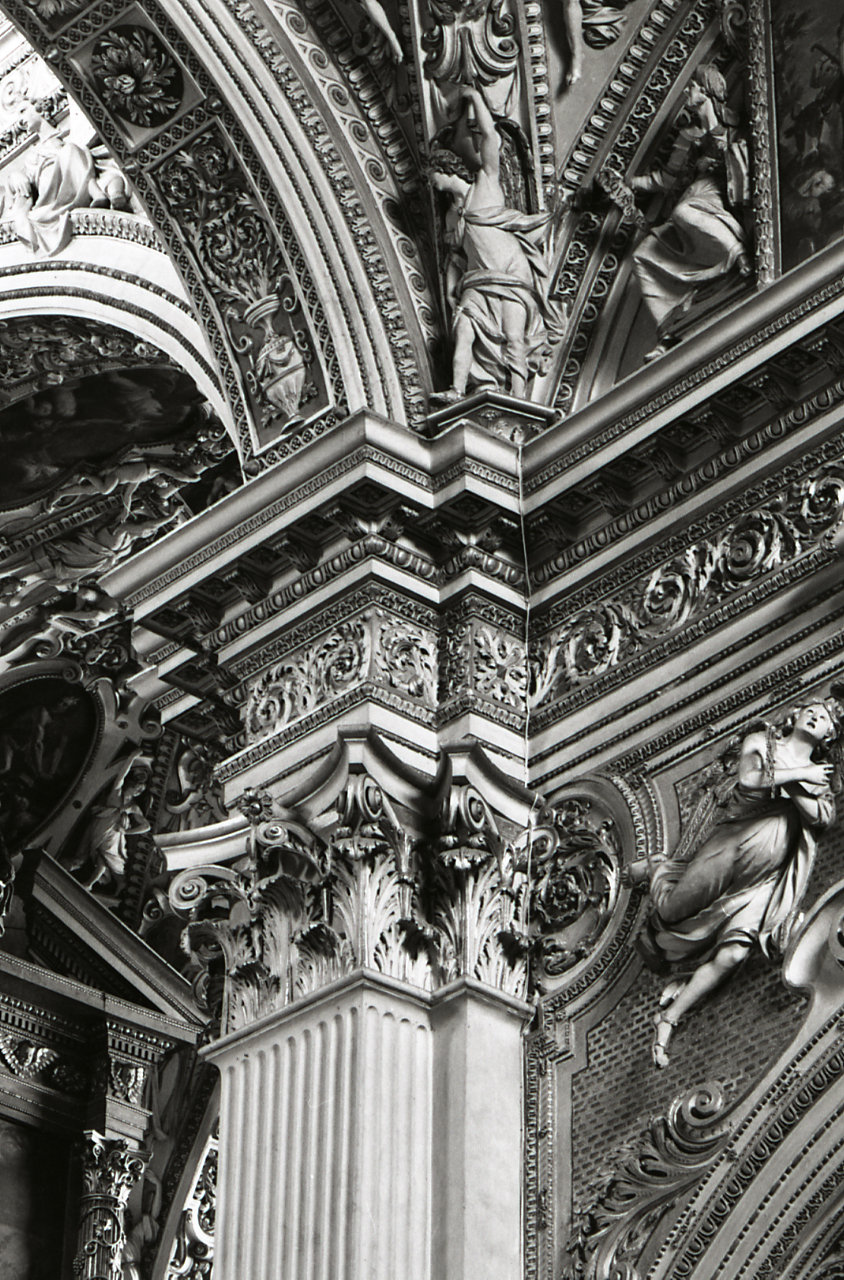
Step inside, and the contrast between the unassuming exterior and the richness within is striking. The main nave gleams with marble and gilding, its ceiling adorned with intricate stucco work of vines and flowers. The most remarkable feature is the 16th-century choir pulpit, a masterpiece of inlaid wood, mother-of-pearl, and ivory. Craftsmen used the technique of intarsia to create the illusion of depth, turning flat surfaces into scenes that seem to recede into space. Nearby stands one of Lombardy’s oldest organs, its pipes still filling the basilica with music during services and concerts.
The walls are a patchwork of frescoes spanning different eras, each layer telling its own story. Among them are works by Giambattista Tiepolo, who painted scenes from the life of the Virgin in the 18th century, collaborating with his son. In the side chapels, you’ll find paintings by Lorenzo Lotto, whose influence on Bergamo’s artistic tradition runs deep. His works here are less about spectacle and more about quiet contemplation, the kind that lingers long after you’ve left the church.
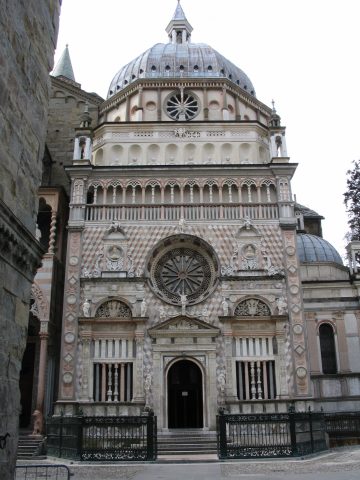
Attached to the basilica is the Colleoni Chapel, built in the 15th century as a mausoleum for the condottiere Bartolomeo Colleoni. The chapel is a study in contrasts—its exterior a fortress-like structure, its interior a riot of colored marble and gold. The dome is covered in frescoes depicting the life of Christ and the saints, while Colleoni’s tomb, a mix of marble and bronze, shows him in full armor, as if standing eternal guard over his own rest. The chapel feels like a separate world, a private monument to power and faith that somehow fits seamlessly into the basilica’s more modest presence.
Bergamo moves at its own pace, and Santa Maria Maggiore is very much a part of that rhythm. On Sundays, the basilica fills with the sound of the organ and the murmur of prayers. In the summer, classical concerts bring the space to life with the music of Vivaldi or Bach, the notes echoing under the vaulted ceilings. Even on ordinary days, there’s a sense of continuity here—people lighting candles in the side chapels, the occasional tourist pausing to take in a fresco, the way the light shifts through the stained glass as the hours pass.
Outside, the square where the basilica stands was once the heart of a bustling medieval market. Now, it’s a place where visitors sip coffee at small cafés, watching the Upper City’s narrow streets unfold around them. From here, you can see the Lower City sprawling in the valley below, framed by the mountains that cradle Bergamo on three sides. If you climb the bell tower, the view stretches even farther, showing how the old city bleeds into the new, how the past and present coexist without fuss.
But the real magic of Santa Maria Maggiore lies in returning to its interior. The outside world fades, and for a moment, it’s just you, the quiet, and the beauty of something that has endured. The light through the windows, the scent of aged wood and incense, the way the centuries seem to settle into the stones—it’s not about grandeur, but about the feeling that some places hold onto something true, something that doesn’t need to shout to be heard.