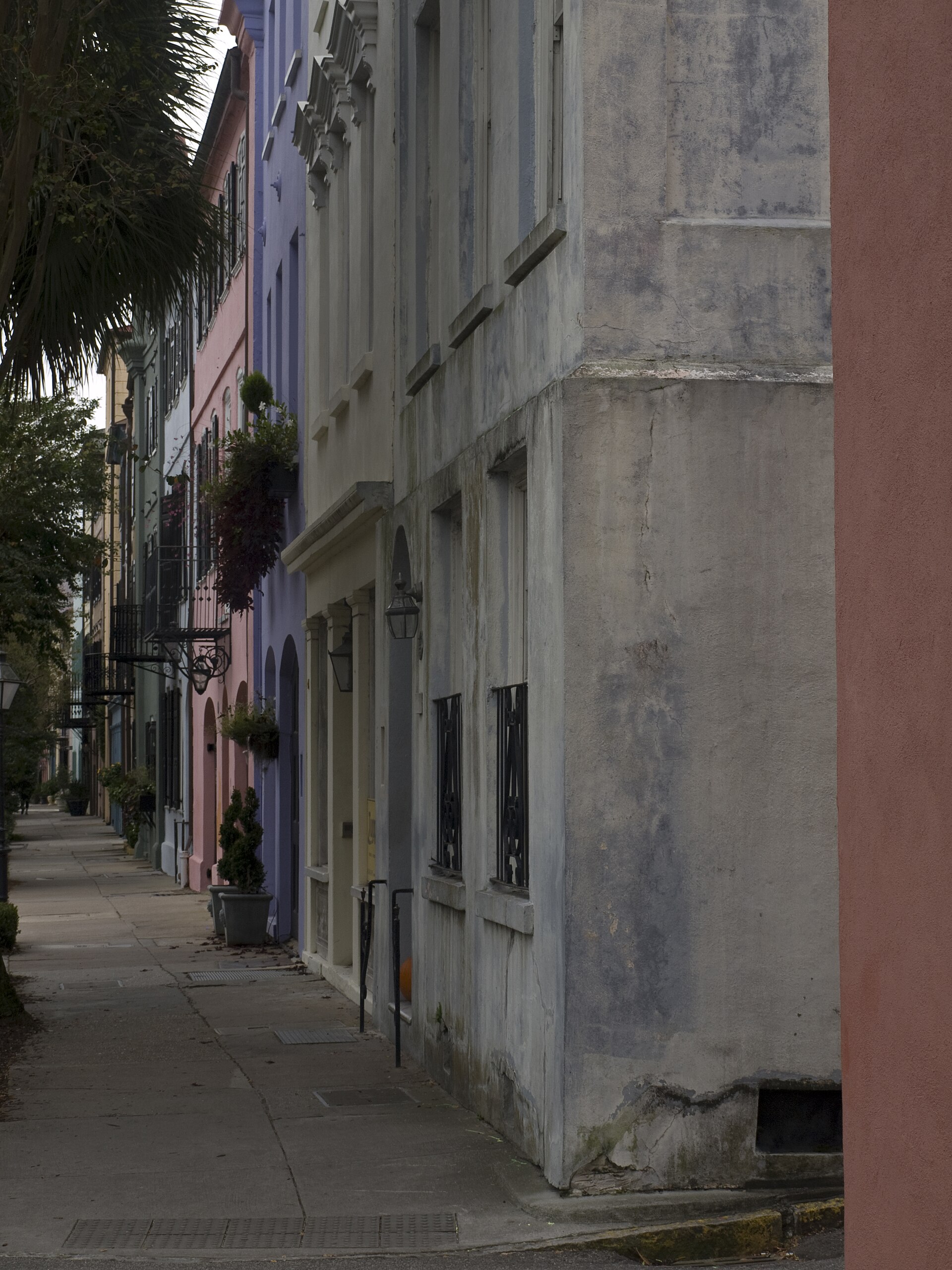
Rainbow Row is one of those places in Charleston that doesn’t announce itself with grand monuments or towering landmarks, yet it lingers in the memory long after you’ve walked past. A stretch of modest, pastel-painted houses lining a quiet street, it might seem unremarkable at first glance—until you realize that the charm lies not in their size or opulence, but in the way they carry the city’s history in their weathered facades. Each house, with its distinct shade of pink, yellow, or mint green, feels like a quiet rebellion against time, a refusal to fade into the background.
These buildings date back to the mid-1700s, when Charleston was one of the wealthiest cities in the American colonies. The merchants and planters who settled here built their homes in the Georgian and Federal styles, designed to suit the Southern climate—high ceilings to trap the heat, wide windows to catch the breeze, and spacious rooms that could accommodate both business and family life. The street was originally part of the city’s commercial heart, with storefronts on the ground floors where goods like rice, indigo, and cotton were traded. Back then, the houses weren’t painted in bright colors; they were practical, built to last, their brick and stucco facades left bare or whitewashed.
By the mid-1800s, Charleston’s fortunes had begun to decline. The Civil War and the Reconstruction era that followed left deep scars on the city. Many of the houses along what would later be called Rainbow Row fell into disrepair, their owners either ruined by the war or forced to abandon them. By the early 20th century, the area had become a shadow of its former self, a place where the once-proud homes of Charleston’s elite now stood neglected, their peeling paint and sagging porches a stark contrast to the city’s faded grandeur. For a time, it seemed inevitable that these buildings would be torn down, another casualty of progress.
Then, in the 1930s, a group of preservationists stepped in. Among them was Susan Pringle Frost, a local woman who had long been advocating for the protection of Charleston’s historic architecture. Frost and others saw potential in these crumbling houses, not just as relics of the past, but as something that could be brought back to life. The idea to paint them in bright, cheerful colors was partly practical—it would make the homes more appealing to potential buyers—and partly symbolic, a way to draw attention to their historical significance. The name Rainbow Row stuck, and slowly, the street began to transform.
Today, Rainbow Row is more than just a collection of pretty houses. It’s a living piece of history, where the past and present coexist in an understated way. Some of the buildings still serve as private residences, while others have been converted into small shops, cafes, or galleries. Walking along the street, you might catch a glimpse of a hidden courtyard, its brick walls draped in ivy, or notice the intricate ironwork on a balcony, a detail that hasn’t changed in over two centuries. The colors of the houses shift with the light—soft and muted in the morning fog, vibrant in the golden hour before sunset—and there’s something deeply satisfying about seeing them stand side by side, each with its own character.
What makes Rainbow Row special is its lack of pretension. Unlike some of Charleston’s more tourist-heavy spots, this isn’t a place where visitors gather in crowds or where history feels staged for effect. Instead, it’s a quiet corner of the city where you can wander at your own pace, pausing to admire the way the sunlight filters through the shutters or to watch a cat nap on a windowsill. In the summer, local musicians sometimes play on the sidewalks, their melodies blending with the hum of everyday life. In the winter, the houses are strung with lights, their colors softened by the glow of holiday decorations.
Over the years, Rainbow Row has become a symbol not just of Charleston, but of the American South itself. The houses have appeared in countless photographs, postcards, and films, often serving as a shorthand for the region’s resilience and charm. There’s something about them that feels inherently Southern—the way they’ve endured hurricanes, economic downturns, and the passage of time, yet still stand proudly, their colors as bright as ever. In a way, they’re a metaphor for Charleston itself: a city that has faced its share of hardships but has never lost its sense of identity.
The preservation of Rainbow Row is taken seriously. The houses are protected by historic preservation laws, which means their exteriors can’t be altered without approval. This has helped maintain the street’s unique character, though it also means that Rainbow Row can sometimes feel frozen in time, a carefully curated snapshot of the past. But that doesn’t make it any less alive. The people who live and work here bring their own stories to the street, ensuring that it remains a dynamic part of Charleston’s fabric rather than a museum exhibit.
If you visit Charleston, Rainbow Row is worth seeking out—not because it’s the most famous or impressive landmark in the city, but because it offers something rarer: a sense of authenticity. There are no grand cathedrals or palatial estates here, just a row of modest houses that have witnessed centuries of change. They don’t tell the story of kings or generals, but of the merchants, artisans, and families who built their lives in this corner of the South. And perhaps that’s why Rainbow Row feels so enduring. It’s not about grandeur or spectacle, but about the quiet beauty of a place that has learned to adapt, to survive, and to remain itself, no matter what.