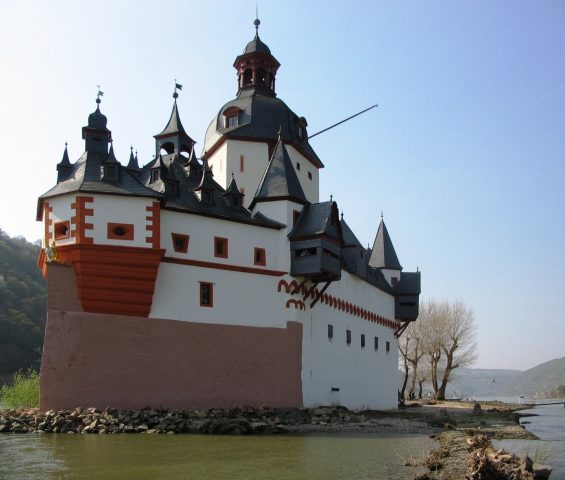
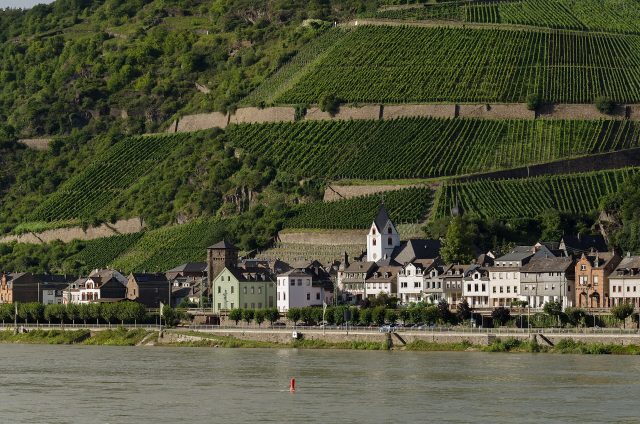
The town hall of Kaub is one of those places that feels suspended in time, a quiet witness to centuries of life along the Rhine. This isn’t just a building where local government business is conducted—it’s a piece of living history, shaped by the merchants, river crossings, and daily rhythms of a small German town. Kaub itself may be modest in size, but its location has always given it weight. Here, the Rhine narrows, its banks rising steeply, making the town a natural stopping point for travelers and traders moving through the valley. For hundreds of years, this stretch of the river was a crossroads, and the town hall stood at its heart.
Built in the 16th century, the building is unassuming in its appearance, which only adds to its charm. Its architecture reflects the practical yet thoughtful style of the era—tall windows let in light, while the sturdy roof, designed to withstand the region’s heavy rains and winters, gives the structure a solid, grounded presence. Inside, the original wooden beams and stone staircases remain, along with spacious halls where the affairs of the town were once decided. Disputes over land, trade agreements, and the sale of wine—Kaub’s most valuable commodity—would have been settled within these walls. The building’s design speaks to a time when functionality didn’t preclude beauty, when craftsmanship was built to last.
Wine has always been central to Kaub’s identity, and the town hall played a role in that tradition. Its cellars once stored barrels of local vintages, while the ground floor hosted markets where growers sold their harvest. Even now, walking past the building, it’s easy to imagine the scene centuries ago—the murmur of merchants haggling, the clatter of carts arriving with goods, the clink of glasses during festivals. The Rhine’s steep slopes are still covered in vineyards, and Riesling remains the region’s signature wine. The town hall, in its quiet way, connects visitors to that legacy, a reminder of how deeply wine is woven into the culture here.
Over the centuries, the town hall’s purpose has shifted with the times. In the Middle Ages, it was a place of justice and commerce, where deals were struck and disputes resolved. Later, as Kaub became part of Prussia in the 19th century, the building retained its administrative role, even as the town’s autonomy diminished. Today, it houses municipal offices, but parts of the building remain open to the public. Some rooms display old documents, maps, and photographs that trace Kaub’s evolution—from a medieval trading post to a modern, if still small, community. These glimpses into the past aren’t curated like a museum exhibit; they feel like fragments of a story still being told.
War has left its mark on the town hall, as it has on the town itself. During the Thirty Years’ War in the 17th century, Kaub found itself in the path of marching armies, and the building offered shelter to locals. In the 19th century, French soldiers occupied it during the Napoleonic Wars. And in the 20th century, though Kaub suffered bombings during World War II, the town hall survived. These layers of history aren’t immediately visible, but they’re there—in the worn stone steps, the patched walls, the quiet resilience of a structure that has seen conflict and peace alike. It’s a reminder of how fragile stability can be, and how places like this carry the weight of memory.
The materials used to build the town hall tell their own story. The stone was quarried locally, from the same hills that rise along the Rhine, while the wooden beams came from oak trees that once lined the riverbanks. These choices weren’t just practical; they rooted the building in its surroundings, making it feel like a natural extension of the landscape. Even now, amid newer construction, the town hall doesn’t fade into the background. Instead, it stands as a focal point, drawing the eye and inviting closer inspection. There’s a sense of continuity here, a connection to the land that’s rare in places built for convenience rather than permanence.
Kaub moves at a different pace than the rest of the world. There’s no rush here, no sense of urgency. The town hall, with its weathered facade and quiet presence, seems to encourage visitors to slow down, to take in the details—the way the light falls on the stone, the sound of the Rhine lapping against the shore, the distant hum of a barge making its way upriver. In summer, the square in front of the building comes alive with small concerts and festivals. In winter, it’s lit by the warm glow of Christmas lights. For locals, the town hall is more than just a building; it’s a symbol of home, a place that holds the stories of generations. For visitors, it offers a chance to step into those stories, to feel the rhythm of a town that has endured by adapting, not by changing entirely.
The Rhine has always been more than a river—it’s a source of inspiration, a muse for artists and writers who have tried to capture its essence. The town hall of Kaub has appeared in paintings and engravings, its modest silhouette set against the dramatic backdrop of vineyards and castles. These images evoke a sense of timelessness, a world where life unfolds at the speed of the river’s current. Standing on the bank today, looking up at the town hall, it’s not hard to imagine the scenes of centuries past—the farmers bringing their grapes to market, the boatmen unloading cargo, the townspeople gathering for celebrations or to hear news from afar. The details may have changed, but the spirit remains.
Visiting the town hall isn’t like touring a grand monument. There are no crowds, no guided scripts, no pressure to see everything in a hurry. Instead, it’s an opportunity to experience the quiet persistence of a place that has seen history unfold without fanfare. If you’re curious, locals might share a story or two about the building’s past, or point out a detail you’d otherwise miss. You can climb to a viewpoint for a sweeping view of the Rhine, or simply sit on a bench outside, watching the light shift over the water. In moments like these, Kaub and its town hall leave an impression that lingers—not because they’re loud or flashy, but because they feel real, like a piece of the past that refuses to fade.