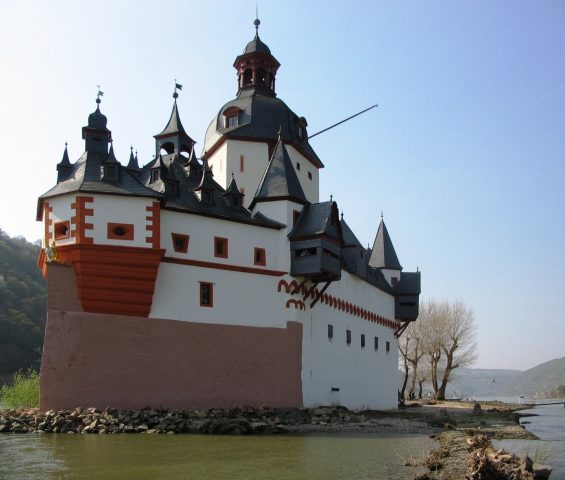
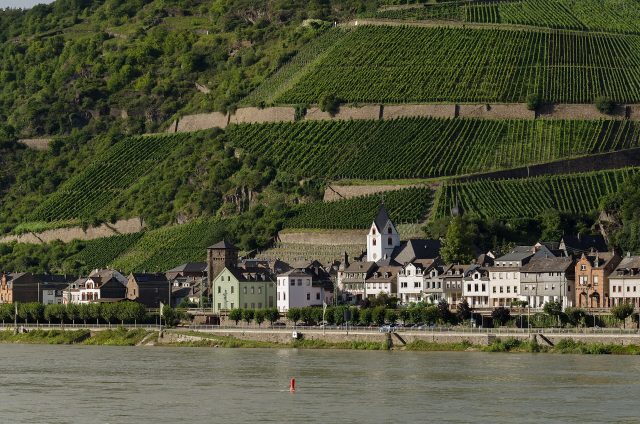
St. John’s Evangelical Church stands on a hill above the Rhine. From here, you see the river and the vineyards along its banks, a view unchanged since the Middle Ages. The church isn’t large, but it holds the weight of centuries in its stones. The past lingers in the cool air of the nave, in the sunlight through the stained glass, in the echoes of footsteps on worn stone.
The first records of the church date to the 12th century, though its origins are likely older. In those days, the Rhine was a trade route, and Kaub was a small but strategic settlement. The church was part of the town’s defenses—a Romanesque structure built to withstand raids. Over time, it was expanded, but the thick walls and narrow windows remain, especially in the lower sections where the masonry feels solid and unyielding.
The most striking feature is its Gothic choir, added in the 14th century. It rises from the older Romanesque base, its pointed arches and slender columns reaching upward. The stained glass casts a soft glow over the interior, turning the stone warm. Faded frescoes cling to the walls of the choir—scenes from the life of Christ and the saints, painted in a style that feels distant yet human. The details are worn, but the intent is clear: this was a place meant to inspire.
The Renaissance altar is restrained. Its wooden carvings are gilded but not ornate. The central panel depicts John the Baptist, surrounded by scenes from his life. It stands slightly off-center, as if the church shifted around it over the years. Nearby, the pulpit bears the coats of arms of local noble families. This was where the town gathered, where alliances were acknowledged, where daily life met the sacred.
In the 18th century, the church gained its Baroque bell tower. The tower’s slender form is visible from the river, a landmark for boats. The bells ring rarely, but when they do, their sound carries across the water. Inside, a small viewing platform lets you look out over the Rhine. From here, the river feels closer, the vineyards more orderly, the cliffs of the Lorelei a hazy presence on the horizon.
The walls hold other stories—those of the people buried beneath its stones. Tomb slabs are set into the floor and walls, their inscriptions worn away. A few names remain, along with dates from the 16th or 17th century: merchants, priests, minor nobles. These markers are easy to overlook, but they belong to the generations who lived and died in Kaub.
Today, St. John’s is still an active parish church. It welcomes visitors without fanfare. There are no crowds, no guided tours, no gift shops. You can sit on a wooden bench and let your eyes wander—the light on the altar, the outlines of the frescoes, the texture of the stone. Outside, the Rhine flows past, carrying barges and pleasure boats, while the vineyards change color with the seasons.
Kaub isn’t a place that demands attention. It’s small, the kind of town most travelers pass through without stopping. But that’s why St. John’s feels genuine. It has survived fires, floods, and time because it was needed. People still come here to pray, to reflect, or simply to sit in the stillness.