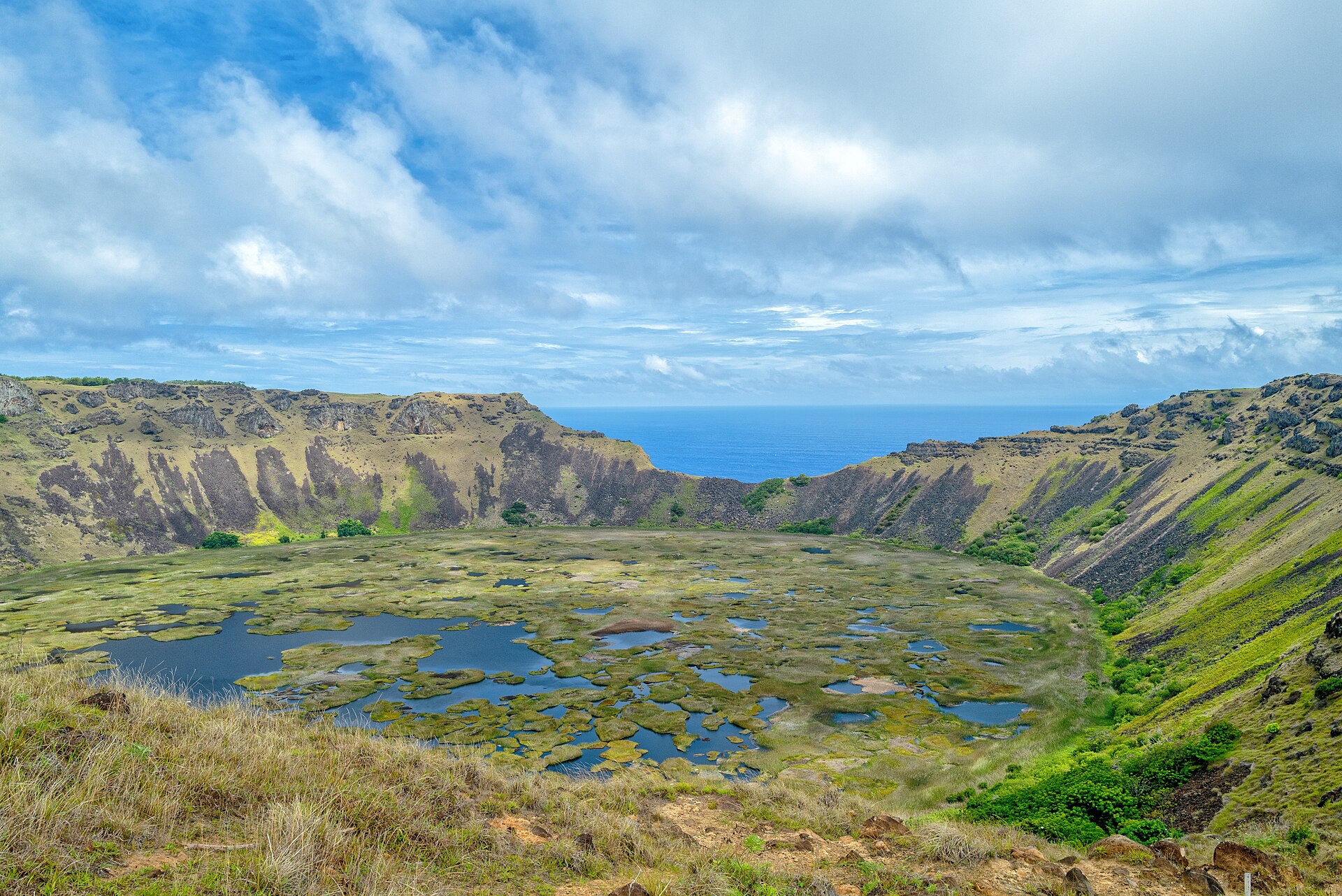
Rano Kau is one of those rare places where the past feels almost tangible, as if the weight of history hasn’t faded with time. Perched on the southwestern edge of Easter Island, this extinct volcano rises abruptly from the landscape, its slopes covered in a tangle of greenery that spills into a vast crater. The still waters at its center mirror the sky, creating an illusion of depth that stretches beyond the confines of the caldera. From the rim, the view is disorienting in the best way—the endless Pacific Ocean blurs into the horizon, while below, the crater’s bowl cradles a world apart, sheltered from the winds that sweep across the island. It’s easy to see why the Rapa Nui people once considered this a sacred place, where the boundaries between the earthly and the divine felt thin.
The volcano wasn’t just a landmark; it was a lifeline. For centuries, Rano Kau sustained the island’s inhabitants in ways that went beyond its dramatic scenery. The crater held one of the few reliable sources of fresh water on an island where drought was a constant threat. Archaeological evidence shows that the Rapa Nui cultivated crops along its slopes, building stone terraces that still cling to the hillsides like ancient scars. These weren’t just random plots of land—they were carefully engineered to maximize water retention and soil fertility, a testament to the ingenuity of a people who had to adapt to an unforgiving environment. The water from the crater didn’t just quench thirst; it made agriculture possible, turning this place into the island’s beating heart.
But Rano Kau’s significance goes deeper than survival. Just beyond its rim lies Orongo, the ceremonial village that was once the stage for one of the most enigmatic rituals in Rapa Nui culture: the birdman competition. Each year, representatives from the island’s clans would gather here, their fates tied to a grueling test of endurance and luck. The challenge was simple in concept but brutal in execution: climb down the sheer cliffs of the volcano, swim through treacherous waters to the small islet of Motu Nui, and return with the first egg of the sooty tern. The winner’s clan would gain temporary control over the island’s resources, and their leader would be elevated to a near-mythical status. The stone houses of Orongo, perched precariously on the crater’s edge, still bear silent witness to these rituals, their low doorways and curved roofs designed to withstand the howling winds that funnel through this part of the island.
The architecture here is a study in practicality, born from necessity rather than aesthetics. The Rapa Nui built without mortar, fitting volcanic rock together with such precision that many structures have survived earthquakes and centuries of neglect. The houses in Orongo are particularly striking—low, almost burrow-like, with narrow entrances that force visitors to crouch as they step inside. The design wasn’t arbitrary; it was a response to the island’s harsh climate. The thick stone walls kept interiors cool during the day and retained warmth at night, while the small windows minimized exposure to the relentless wind. Even the placement of the village, tucked into the lee of the crater, was deliberate, offering protection from the elements. These weren’t just homes; they were shelters in the truest sense, built to endure.
Today, walking the path to Rano Kau feels like stepping into a living museum. The trail winds through tall grasses and shrubs, their sharp scent lingering in the air. Along the way, the remnants of old stone walls and platforms emerge from the vegetation, their purpose long forgotten but their presence undeniable. The climb isn’t strenuous, but it’s deliberate, each step drawing you further into the island’s past. By the time you reach the crater’s edge, the modern world feels distant, replaced by a quiet that’s almost unsettling in its depth. The view from the top is worth every bit of the effort—the vastness of the ocean, the jagged coastline, the way the light plays across the water. But it’s the crater itself that commands attention, its still waters holding secrets that no amount of research has fully uncovered.
The caldera isn’t just a geological feature; it’s a self-contained ecosystem. The lake at its center is fed by underground springs, its waters home to rare plants and microorganisms that have adapted to this isolated environment. The reeds along the shore, known locally as totora, were once vital to the Rapa Nui, used for everything from boat-building to thatching roofs. On calm days, the water’s surface is so still it becomes a perfect mirror, reflecting the sky in a way that makes the boundaries between earth and heaven feel fluid. When the wind picks up, the illusion shatters, the water rippling like something alive. It’s a reminder that even in this remote corner of the world, nature is never truly at rest.
There’s a peculiar stillness to Rano Kau, a sense that time moves differently here. It’s the kind of place where you can imagine the Rapa Nui gathering at dawn, watching the sun rise over the crater’s rim, or performing rituals under the vast, unblinking sky. The modern world feels far away, not just in distance but in spirit. As the day wears on and the light softens, the shadows stretch long across the slopes, and the air takes on a golden hue. It’s in these moments that the past feels closest, as if the island’s ancient inhabitants might step out from behind the rocks at any moment. The silence isn’t empty; it’s full of echoes.
What makes Rano Kau truly special is its ability to make you feel small—not in a way that diminishes, but in a way that connects. Standing on the edge of the crater, it’s impossible not to reflect on the fragility of human existence, on how quickly civilizations can rise and fall, and on how nature quietly preserves their stories long after they’re gone. Unlike some of the island’s more famous sites, Rano Kau isn’t overrun with visitors. There are no crowds here, no tour buses, no rush to snap the perfect photo. Instead, there’s space to think, to wander, to sit quietly and listen to the wind as it moves through the grass. It’s a place that demands more than just a glance, rewarding those who take the time to really see it.
In the end, Rano Kau isn’t just a destination; it’s an experience. It doesn’t offer easy answers or neatly packaged history. Instead, it presents a landscape that’s as much about questions as it is about facts—a place where the past isn’t just remembered but felt. Whether you’re tracing the outlines of an ancient stone house, watching the light shift across the crater’s waters, or simply sitting in silence, the volcano has a way of lingering in your thoughts long after you’ve left. It’s a reminder that some places aren’t just seen; they’re experienced, and that the most powerful travel moments are often the ones that leave you with more questions than answers.