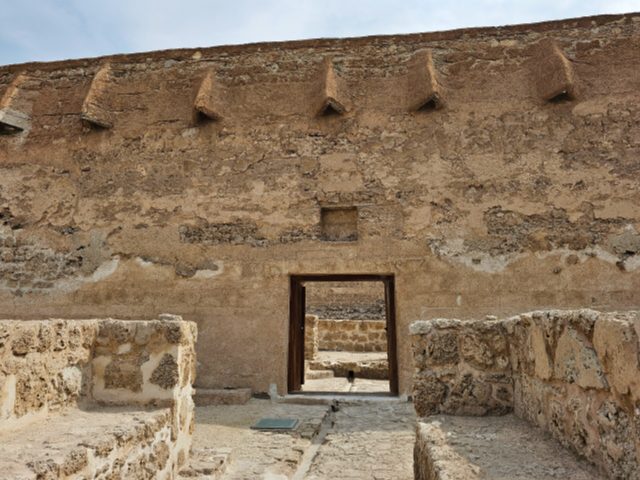
Perched at the edge of Muharraq Island, where land meets the waters of the Persian Gulf, Qal‘at Bū Māhir stands as it has for centuries. Its low stone walls, bleached by sun and salt, mark the boundary between history and the sea. The fort once served as a defensive outpost and customs checkpoint, where goods from across the Gulf passed through its gates. Today, its weathered ruins remain, a trace of the time when Muharraq was Bahrain’s center.
The fort’s architecture is plain and practical. Thick walls of local limestone, narrow arrow slits for defenders, and a modest inner courtyard show its military purpose. There are no towers or carvings—just stone shaped by time and tide. The elements have worn it down, leaving a surface only decades of exposure could create.
Qal‘at Bū Māhir’s history is tied to Muharraq’s rise. In the 18th and 19th centuries, when the island was the seat of the Al Khalifa dynasty, the fort protected the capital. Merchants, diplomats, and warriors passed through its gates. Lookouts watched for sails on the horizon. Later, as Bahrain’s politics changed, the fort’s role faded, but it remained a symbol of the nation’s endurance.
Now, the fort is quiet. No crowds, no guides—just waves and gulls. Walking through its courtyard, you might hear the echoes of traders, the creak of carts, the flicker of torches. It has never been turned into a museum. It doesn’t try to impress. It simply stands, a piece of the past that hasn’t disappeared.
Beyond the fort, Muharraq’s old quarter spreads out. Narrow alleys wind between houses with wooden doors, small mosques, and spice shops. Qal‘at Bū Māhir sits at the edge of this world, where land meets water. Climb onto the walls at sunset. The sea turns gold. In the distance, Manama’s skyline rises—a contrast between old and new.
There are no entry fees or barriers. Visit anytime. Sit on the stones. Listen to the waves. Watch the light change over the gulf. No signs explain what you’re seeing. That lets you decide what the fort means to you. For some, it’s just an old ruin. For others, a link to history. For locals, a reminder of their past.
Bahrain has begun to protect sites like Qal‘at Bū Māhir. The fort hasn’t been restored—doing so would erase its age. But it hasn’t been left to crumble either. It’s kept as it is, a fragile but lasting piece of history. Plans for informational displays or a visitor center may come later. For now, the fort stays unchanged: a quiet place where the past is still present.
If you come to Muharraq, don’t hurry past the fort. Walk to it first. Sit on its walls. Watch the sea. Let the stillness settle. There’s nothing staged here—just wind, sun, and stone. Places like Qal‘at Bū Māhir don’t tell stories. They let you feel them.