The Pro-Cathedral of Our Lady of Grace in Praia is one of those places that doesn’t demand attention but lingers in the mind long after you’ve left. Tucked away in the heart of Cape Verde’s capital, it stands on Avenida Andrade Corvo, where life moves at the unhurried pace of an island accustomed to the rhythm of the ocean. The building itself is modest, its size belying its significance—not just as a place of worship, but as a quiet anchor for the Catholic community across the archipelago. Its history is woven into the fabric of Cape Verde itself, a testament to the island’s colonial past and its gradual evolution into an independent nation.
Construction began in the mid-19th century, when Cape Verde was still under Portuguese rule. At the time, Praia was emerging as the administrative center of the islands, and the cathedral’s arrival was more than a matter of faith—it was a statement of colonial authority. The architecture reflects the understated style of the era: clean lines, minimal ornamentation, yet with a sense of quiet dignity. The façade, painted in soft hues, resists the harsh glare of the tropical sun, while the slender bell tower, though unassuming, still manages to catch the eye from a distance.
Inside, the cathedral is even more restrained than its exterior suggests. There are no grand frescoes or gilded altars like those found in European churches. Instead, simple wooden pews line the nave, the walls are whitewashed, and a handful of statues stand in quiet reverence. Among them, the figure of Our Lady of Grace holds a place of honor, her presence a focal point for the faithful. Light filters through tall, narrow windows, casting a gentle glow that softens the space, making it feel almost suspended in time. Even the sounds of the city outside seem to fade, muffled by the thick walls, as if the world beyond moves at a different pace.
Over the years, the cathedral has witnessed key moments in Praia’s history. During colonial times, it served as a place of worship for Portuguese officials and the local elite. After Cape Verde gained independence in 1975, it remained a gathering place for the island’s Catholic community. Today, it’s not just a religious site but a piece of the city’s cultural heritage. On major holidays like Christmas and Easter, the cathedral comes alive with hymns and the murmur of prayers, drawing even those who don’t regularly attend services. For a few hours, the building becomes a center of shared experience, a reminder of the traditions that bind the island together.
One curious detail is that the cathedral has never been formally consecrated as a full cathedral, despite functioning as one. Cape Verde’s Catholic Church operates under unique circumstances—there’s no permanent bishop’s seat, and the Pro-Cathedral of Our Lady of Grace serves as a temporary diocesan center. This reflects the broader reality of the archipelago: small in size but significant in its role as a spiritual hub for the region. Here, faith intersects with local customs, creating a blend of traditions that feels distinctly Cape Verdean.
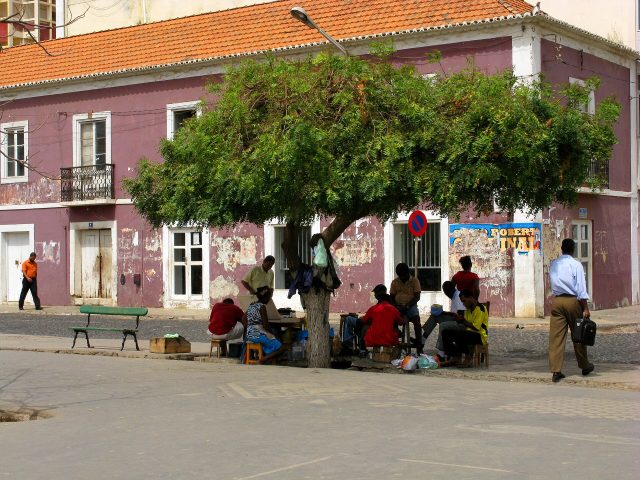
The area around the cathedral is a snapshot of old Praia, where time seems to move more slowly. Narrow streets wind past buildings with peeling plaster, small shops sell local goods, and the air carries the scent of salt from the nearby ocean. The cathedral fits seamlessly into this landscape, not as a grand monument but as a natural part of the city’s rhythm. It doesn’t seek to impress; it simply exists, a quiet presence that has watched the city grow and change over the decades.
For visitors, the cathedral isn’t a must-see attraction in the traditional sense. There are no crowds, no guided tours, no rush to take in every detail. Instead, it offers a moment of respite—a place to sit, to breathe, to absorb the atmosphere. The faint scent of incense mingles with the salty breeze drifting in from the coast, and if you’re lucky, you might catch the tail end of a service or see locals stopping by to pray or simply rest in the cool interior. It’s a space where the outside world feels distant, where the weight of history is palpable but unobtrusive.
The Pro-Cathedral of Our Lady of Grace isn’t the kind of place that makes it into glossy travel magazines. It doesn’t dazzle with opulence or demand hours of exploration. Yet that’s precisely what makes it special. It stands as a quiet witness to Cape Verde’s past, a place where the island’s history isn’t recounted through dates and facts but felt through the subtle details—the play of light on whitewashed walls, the murmur of voices in prayer, the way the air seems to still when you step inside. In a world that often moves too fast, it offers a rare sense of timelessness.