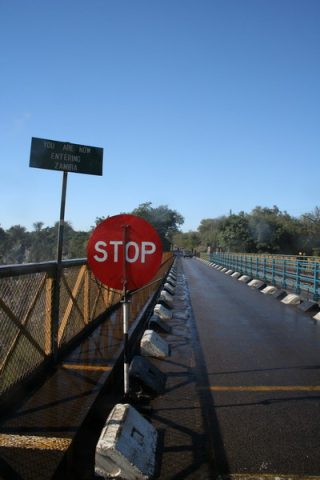
Chirundu isn’t just a border crossing between Zambia and Zimbabwe—it’s where roads, rivers, and the stories of two countries converge. Here, on the banks of the Zambezi, the line between nations isn’t just drawn on a map; it’s something you feel. On one side, the steady hum of trucks and cars; on the other, the quiet of the savanna, broken only by the calls of birds and the river’s murmur. The border post itself is a small outpost of order in the wild—a handful of administrative buildings, customs offices, a couple of cafes, and basic lodgings for travelers caught between countries. But the real draw is the bridge over the Zambezi, a steel link between two worlds that’s as much a symbol as it is a road.
The history of Chirundu is tied to the colonial ambitions of the early 20th century, when British authorities carved roads through southern Africa. This stretch of the Zambezi became a critical junction, a place where goods and people paused before moving deeper into the continent. The bridge, built in 1939, was part of a grand vision—a transport corridor stretching from Cape Town to Cairo. Back then, Chirundu was little more than a cluster of buildings for officials and travelers, but it carried the weight of that larger dream. Today, the remnants of that era are few: a scattering of functional buildings, the occasional faded photograph in a local archive. Yet the place still carries the echo of a time when borders weren’t just divisions but gateways to the unknown.
The architecture here is unassuming, built for purpose rather than beauty. Low concrete and brick buildings, painted in muted tones, blend into the landscape, their blandness broken only by the constant movement of people and vehicles. The most striking structure is the bridge itself, known locally as Chirundu Bridge. A sturdy steel construction with massive piers anchored in the riverbed, it’s low but strong enough to bear the weight of heavy trucks rumbling across the continent. At dusk, when the lights flicker on, the bridge transforms into a glowing serpent slithering over the water, a fleeting moment of poetry in an otherwise utilitarian place.
For most travelers, Chirundu is just a checkpoint—a place to show a passport, get a stamp, and move on. But those who linger, even briefly, notice something more. This is where languages collide: English, Shona, Ndebele, Tonga, and sometimes Portuguese, spoken by the mix of Africans, tourists, and truckers passing through. The roadside cafes serve simple meals—nshima with vegetables, fried fish from the Zambezi, or ginger tea to shake off the fatigue of a long drive. If you’re lucky, you might spot elephants on the opposite bank, drawn to the river at dusk, indifferent to the rumble of engines.
Chirundu is also where two economies meet. A significant portion of the goods moving from South Africa and Botswana into the Democratic Republic of Congo and beyond passes through here. The bridge becomes a slow-moving procession of trucks, their drivers waiting as customs officers pore over paperwork, sometimes holding up traffic for hours. For locals, this is a living. Some sell food and drinks, others offer car repairs or guide confused travelers through the queues. During the rainy season, when the river swells and roads flood, the pace slows even more, turning the border post into an impromptu open-air market.
But the heart of Chirundu is the Zambezi itself. The river flows wide and slow here, a natural divide between nations. In the dry season, the water recedes, leaving sandy banks where fishermen cast their nets or families gather for a moment of rest. When the rains come, the river turns fierce, its currents churning, making the bridge above seem fragile by comparison. On the far side, the landscape shifts into national parks—Lower Zambezi on the Zambian side, Mana Pools on the Zimbabwean—where wildlife still roams freely. Chirundu is the threshold to that world, a place where the wild begins.
For those driving through Africa, Chirundu is an unavoidable stop, but it’s also a chance to feel the continent’s pulse. There are no grand attractions here, no polished tourist experiences. Instead, there’s the raw, unfiltered rhythm of life on the move: the chatter of vendors, the idle wait of truckers, the occasional burst of laughter from a roadside stall. It’s Africa without the gloss, messy and real. And if you’re there at sunset, when the sky over the Zambezi turns shades of orange and violet, the border fades away. For a moment, it’s just you, the river, and the quiet beauty of a place that exists between worlds.