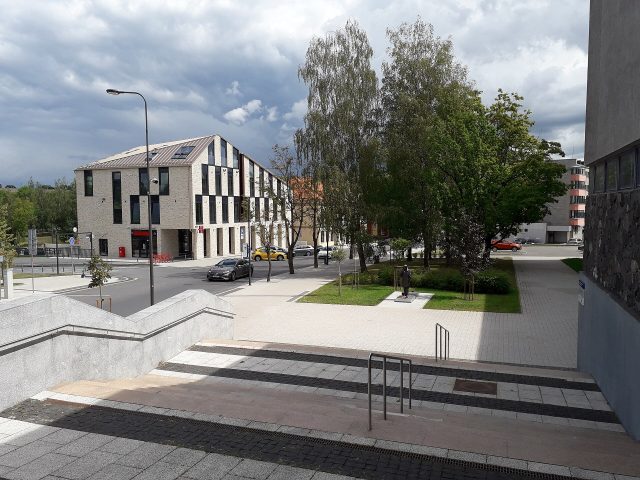
Freedom Square in Panevėžys is one of those places where the city breathes at its own unhurried pace. It’s where the main streets converge, where people gather for errands or simply to pass the time, and where the rhythm of daily life unfolds without pretension. Unlike the bustling squares of larger cities, there’s no rush here—just a quiet, steady pulse that feels both timeless and alive. By evening, the square transforms into a natural vantage point, offering a quiet view of the small-town life that defines this part of Lithuania.
The architecture of Freedom Square tells a story of gradual evolution rather than grand design. At its heart stands the town hall, built in the mid-20th century, its clean lines and symmetry reflecting the influence of Soviet modernism. Yet it doesn’t feel out of place—more like a natural chapter in the city’s history. Surrounding it are older buildings, their facades bearing the marks of pre-war eras, some still adorned with decorative details that hint at Panevėžys’ past as a center of trade and craftsmanship. The mix of styles isn’t deliberate; it’s simply what happens when a place grows organically over time.
The square hasn’t always looked the way it does today. In the 19th century, this was the site of a bustling market, a hub of activity in a town that served as an important stop between Riga and Vilnius. Back then, the square wasn’t just a marketplace—it was a meeting point for travelers, merchants, and locals alike. Over the years, the market was relocated, and the space was reimagined as an open plaza, eventually becoming the civic heart of Panevėžys. Like many public squares across the region, it was renamed during the Soviet era, only to reclaim its original name—Freedom—after Lithuania regained independence.
Nowadays, the square serves as more than just an administrative center. It’s a place where people come to stroll, meet, or simply take a moment for themselves. In summer, benches appear, inviting visitors to sit and watch the world go by. When winter arrives, the square transforms into an ice rink, a favorite spot for locals to gather and skate. During warmer months, small fairs occasionally set up here, offering everything from fresh produce to handmade crafts. Sometimes, street musicians add their voices to the mix, their melodies blending with the hum of passing cars and the murmur of conversations.
What makes Freedom Square special is its lack of pretension. There are no grand fountains or towering monuments here—just the quiet beauty of everyday life. The old lampposts, the worn paving stones, the trees planted decades ago—all of it contributes to an atmosphere that feels lived-in and genuine. It’s not the kind of place that demands attention, but it’s the kind that lingers in your memory long after you’ve left.
The square changes with the hours, reflecting the different rhythms of the day. Mornings are quiet, with only a few people hurrying past on their way to work or school. By midday, students from the nearby university start to appear, their presence adding a touch of youthful energy. As evening falls, the square comes alive—people head to cafes, take leisurely walks, or simply enjoy the cool air. On weekends, families with children fill the space, turning it into a lively gathering spot.
Freedom Square isn’t the kind of place that impresses at first glance. It doesn’t need to. Its charm lies in its understated authenticity, in the way it quietly accommodates the flow of daily life without trying to be anything more than it is. You won’t find crowds of tourists here, nor will you stumble upon carefully curated attractions. Instead, it offers something far simpler: a place to sit on a bench, watch the world go by, or take a slow walk without any particular destination in mind.
In many ways, Freedom Square embodies the spirit of Panevėžys itself—a city that doesn’t strive to be the most famous or the most glamorous, but one that remains an essential part of Lithuania’s story. It’s a place where history isn’t preserved in grand monuments but woven into the fabric of everyday life. And perhaps that’s what makes it worth visiting: not for what it shows you, but for how it makes you feel.