St. Peter and Paul’s Church in Panevėžys is one of those places that doesn’t immediately demand attention but lingers in the memory long after you’ve left. Tucked away in the heart of the city, it stands on a quiet square surrounded by low, unassuming buildings that have witnessed decades of local life. From the outside, the church appears modest—whitewashed walls, a simple gabled roof, and a clock tower that has marked time for generations of townspeople. Yet step inside, and the contrast is striking. What seems plain on the exterior unfolds into something far more intricate and profound.
The story of this church begins in the 17th century, when Panevėžys was a small but strategically important trading town in the Grand Duchy of Lithuania. The first wooden church on this site was built in 1614, though it suffered repeated damage from fires and wars. The current structure, designed in the late Baroque style, rose in the mid-18th century during a period of relative stability and economic growth. Architects of the time didn’t just aim to create a place of worship; they sought to build a symbol of endurance, something that could withstand the uncertainties of history. The result was a building that has outlasted empires and ideologies, standing firm through centuries of change.
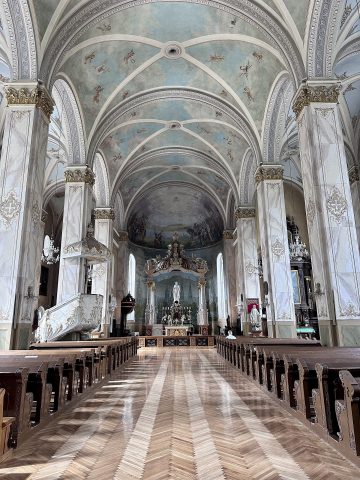
Inside, the church reveals its true character. The high vaulted ceilings, adorned with delicate stucco work and painted biblical scenes, draw the eye upward, creating a sense of grandeur. Massive columns support the galleries, while the play of light through the windows adds depth to the space. The main altar is particularly striking—a dark, ornate structure with gilded details that seem almost theatrical. Figures of saints, angels, and apostles appear caught in mid-movement, their expressions softened by the shifting shadows. In the side chapels, older icons still hang, some dating back to the church’s earliest years, their faded colors hinting at the passage of time.
Beyond its religious significance, St. Peter and Paul’s has always been a cultural anchor for Panevėžys. Over the centuries, it housed books, manuscripts, and sacred relics, and during times of war, it often served as a refuge for locals. In the 19th century, when Lithuania was part of the Russian Empire, the church faced persecution as authorities sought to curb Catholic influence. Yet the congregation held fast to its traditions. During the Soviet era, the building was repurposed—used as a warehouse, an archive, and even a concert hall—but it never lost its spiritual essence. Today, it has been fully restored to its original purpose, once again a place of worship and reflection.
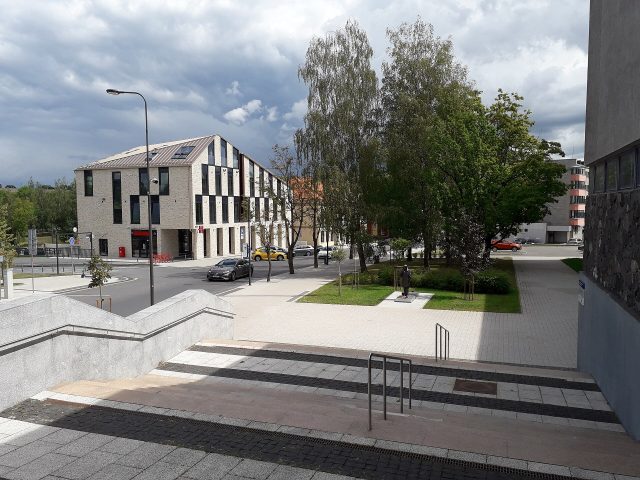
The square in front of the church is one of the few spots in Panevėžys where the past feels tangible. Cobblestone paths wind between low, tiled-roof houses, and small cafés spill onto the pavement in warmer months. The area comes alive during festivals, with open-air concerts and markets filling the air with music and chatter. In winter, strings of lights and a decorated tree transform the square into a cozy gathering place. A short walk from here leads to the Nevėžis River, which cuts through the city, its banks lined with parks where people stroll year-round.
St. Peter and Paul’s is more than just a historical monument; it’s a living testament to Panevėžys’s resilience. It has weathered wars, political upheavals, and economic hardships, yet remains a constant presence in the city’s life. Visitors today include not only the faithful but also those curious about the past, drawn by the quiet atmosphere and the sense of continuity. Inside, the hush of the nave offers a rare moment of stillness, even when the city outside is bustling.
If you find yourself in Panevėžys, it’s worth stopping by, even if only for a few minutes. You don’t need to be religious to appreciate the beauty of the space—the way light filters through the stained glass, the soft echoes of an organ during a service, or the worn wooden pews that have supported generations of worshippers. On certain days, the church becomes part of the city’s rhythm, hosting events like traditional song festivals or Christmas concerts. In those moments, it feels especially alive, a reminder of why this place matters so deeply to those who call Panevėžys home.