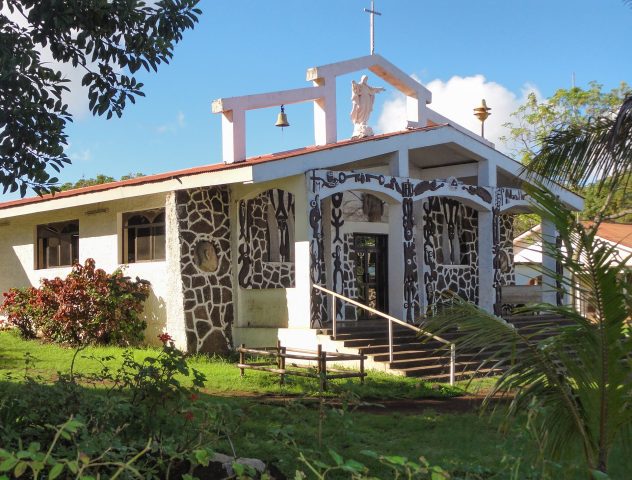
Hanga Roa’s Plaza Policarpo Toro is where the pulse of Easter Island slows just enough to let you feel its rhythm. Tucked in the heart of the island’s only town, this small square doesn’t announce itself with grand monuments or tourist crowds. Instead, it quietly gathers the threads of daily life—locals chatting under the shade of trees, children darting across open spaces, and the occasional visitor pausing to watch the unhurried flow of island time. The square isn’t large, but it’s the kind of place where everything converges: the streets leading to the sea, the whitewashed church, the little shops selling handwoven baskets and carved wooden figures. A bench beneath the trees offers the perfect spot to sit and absorb the scene, where the past and present blend without fanfare.
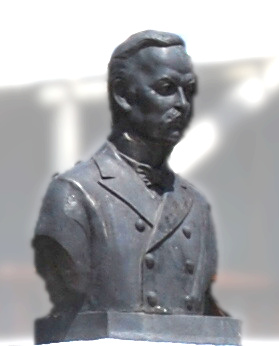
The square takes its name from Policarpo Toro, a Chilean naval officer whose role in the island’s history remains as layered as the place itself. In 1888, Toro negotiated the annexation of Rapa Nui to Chile, an act that still sparks debate among the island’s people. Some view him as a figure who shielded the island from more aggressive colonial powers; others see him as a symbol of lost autonomy. The square doesn’t take sides. Instead, it reflects the duality of modern Rapa Nui—where Chilean governance and Rapanui identity coexist, sometimes uneasily, but always with a sense of resilience. The name on the plaque is familiar to everyone here, yet the conversations around it are as varied as the island’s own story.
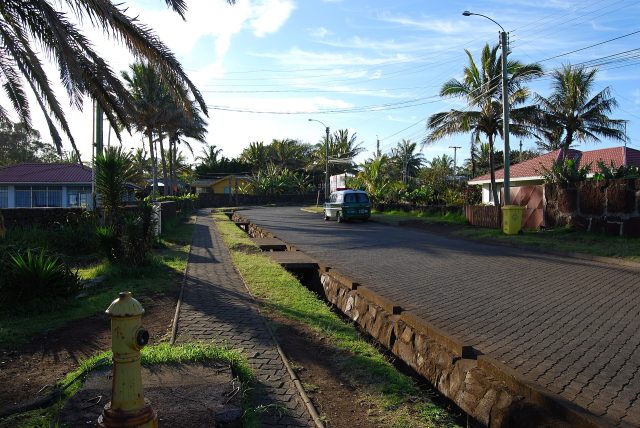
The architecture surrounding the square is unassuming but telling. Most buildings are single-story, their bright facades softened by wooden shutters that rattle in the wind. Many date back to the mid-20th century, when the island began opening to the outside world, though their design carries echoes of older traditions. There are no grand colonial mansions or sleek modern structures—just modest homes, small businesses, and the occasional government office, like the municipal building nearby. Once the administrative heart of the island, it now handles the practical matters of a community that has long since learned to adapt. The simplicity of the buildings doesn’t diminish their significance; each one holds a piece of the island’s evolution.
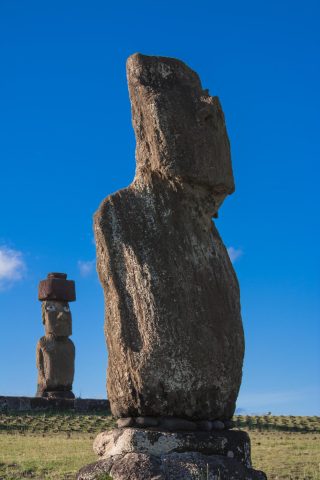
At the center of the square stands a statue of Policarpo Toro, erected a century after the annexation. The sculpture is understated—a full-length figure of the officer gazing toward the ocean, as if contemplating the waves that brought him here. There’s no pomp in the monument, no heroic flourishes, just a quiet acknowledgment of a moment that reshaped the island’s fate. Locals pass by without ceremony, sometimes pausing to sit on the low wall around the statue, checking their phones or chatting with neighbors. For visitors, the statue is a reminder that Rapa Nui’s history isn’t just about the moai and ancient legends. The events of the last 150 years—colonialism, migration, cultural shifts—are just as much a part of the island’s identity.
The square comes alive in the evenings, when the heat of the day gives way to a cooler, softer light. Families stroll along the paths, stopping to buy fresh empanadas or grilled fish from vendors who set up small stands near the edges. On weekends, the air fills with music, laughter, and the scent of woodsmoke from open grills. During festivals like Tapati, the square transforms into a stage for traditional dances, drumming, and competitions that celebrate Rapanui culture. Even if you don’t understand the language, the energy is infectious. The celebrations aren’t put on for tourists; they’re a natural extension of the island’s communal spirit, and everyone is welcome to join in.
For those just arriving, Plaza Policarpo Toro is a natural starting point for exploring Hanga Roa. From here, it’s a short walk to the Museo Antolín Hernández, where exhibits on Rapanui history and artifacts offer context to the island’s past. The ocean is just as close, its waves crashing against the volcanic rocks where ancient settlements once stood. Nearby cafés serve dishes that reflect the island’s blend of influences—fresh tuna ceviche, grilled lobster, or *po’e*, a sweet bread made from plantains and pumpkin. The food is simple but deeply tied to the land and sea, just like everything else on Rapa Nui.
What makes the square special isn’t its size or its monuments, but the way it captures the essence of the island without trying. There’s no tourist kitsch here, no staged performances for visitors. Instead, it’s a place where life unfolds at its own pace—where a grandmother might scold a grandchild for running too fast, where fishermen stop to share news of the day’s catch, where the sound of the ocean is never far away. Even a short time spent here, watching the ebb and flow of people, leaves a lasting impression. Hanga Roa isn’t just a destination; it’s a living community, and the square is its quiet heart.
The name Policarpo Toro may be Chilean, but the spirit of the square is unmistakably Rapanui. It’s in the way the wind carries the scent of frangipani from the trees, in the easy laughter of children playing tag, in the way the light softens as the sun dips below the horizon. The island’s history is complex, its future uncertain, but in this small corner of Hanga Roa, life goes on with a steadiness that feels timeless. Whether you’re a traveler passing through or someone who calls Rapa Nui home, the square offers a moment of connection—one that lingers long after you’ve moved on.