Batalha’s Praça do Município is where the town quietly unfolds its character, offering a glimpse into the unhurried rhythm of provincial life while still carrying the weight of Portugal’s history. There’s no rush here, no crowds jostling for space—just the easy pace of a place that has seen centuries pass without losing its sense of self. The square sits at the heart of Batalha, its cobblestones worn smooth by generations of footsteps, market stalls, and evening gatherings. It’s the kind of spot where you can imagine locals lingering over coffee, debating the day’s news, or simply watching the light change as the sun dips behind the rooftops.
The architecture around the square tells a story of gradual evolution, each building adding its own layer to the town’s identity. The most striking structure is the town hall, built in the 18th century, its facade a study in restrained elegance. Tall windows framed in stone, a wrought-iron balcony, and the city’s coat of arms above the entrance all hint at Batalha’s past significance. This wasn’t always a quiet backwater—during the Middle Ages, it was a strategic stronghold, and later, a center of religious and cultural life thanks to the nearby monastery. The town hall stands as a quiet reminder of that legacy, a symbol of continuity in a place where history feels close enough to touch.
Beside the town hall, the Church of the Holy Spirit offers a more intimate counterpoint. Built in the 17th century, it lacks the grandeur of the monastery but makes up for it with a warmth that feels almost domestic. The exterior is simple, but inside, time has left its mark: a carved altar, faded frescoes, and wooden pews darkened by age. The church is still very much a part of daily life here, and on Sundays, the square fills with the sound of bells, their peal drifting over the rooftops like a call to pause and reflect.
Praça do Município isn’t just a collection of buildings—it’s a living part of the town. In the summer, small markets spring up, selling everything from local olive oil and cheese to fresh bread and wine. Sometimes a musician sets up near the fountain, playing fado or an old Portuguese folk tune, and for a moment, the square becomes a stage. In winter, the square transforms for Christmas, strung with lights and the scent of roasted chestnuts drifting from street vendors. It’s the kind of place where life unfolds in small, unhurried moments, where the past and present coexist without fanfare.
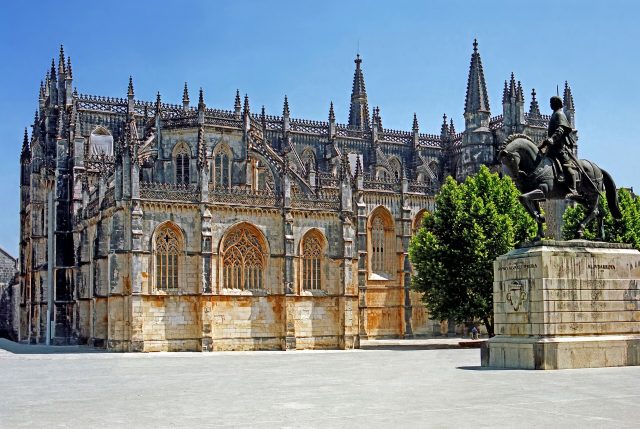
Batalha’s history is deeply tied to Portugal’s, and this square has played its own quiet role in that story. It was here, in 1385, that King João I announced the victory at the Battle of Aljubarrota, a turning point that secured the country’s independence from Castile. The square looked different then, but it was still the heart of the town, where people gathered to hear news that would shape their future. Today, a statue of João I stands nearby, but the square itself carries the memory of that moment in its atmosphere—less in monuments than in the way the light falls on the cobblestones or the way the wind moves through the trees.
The pavement beneath your feet is a detail worth noticing. Like many Portuguese towns, Batalha’s square is paved with traditional black-and-white mosaic patterns, their geometric designs adding a subtle rhythm to the space. The patterns here are simple, but they give the square a timeless quality, as if the stones themselves are holding onto the stories of those who’ve walked them. There’s always a bench in the shade of the town hall or the church, a quiet spot to sit and watch the town go by.
Batalha isn’t a place for grand gestures or flashy attractions. It’s quieter than that, more understated, and that’s precisely what makes Praça do Município so appealing. There’s no need for spectacle here—the square exists as it always has, offering a moment of stillness in a world that often moves too fast. If you visit, don’t rush straight to the monastery. Take a little time first to wander the square, duck into a café for a coffee or a glass of local wine, and let the town reveal itself on its own terms. That’s when you’ll see Batalha not as a tourist might, but as someone who’s been welcomed into its everyday rhythm.