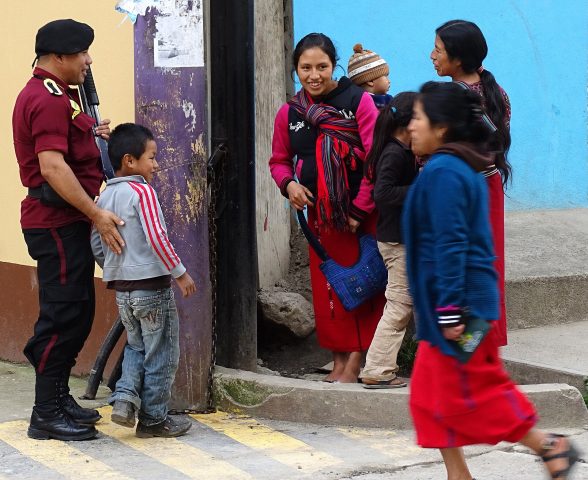
Constitution Square in Huehuetenango is where the city breathes at its own unhurried pace, never quite still but never in a rush. Tucked into the highlands of western Guatemala, this is the kind of place that doesn’t announce itself with grand monuments or polished tourist attractions. Instead, it’s a space shaped by the people who use it every day—the vendors setting up their stalls at dawn, the elderly men debating politics on the benches, the children darting between the trees on their way home from school. The square doesn’t try to impress; it simply exists, a quiet stage for the rhythms of local life.
Huehuetenango itself is a city with deep colonial roots, founded as a Spanish stronghold in the rugged highlands, and its central square has always been the heart of the community. Over the centuries, it has witnessed markets, religious processions, and the slow evolution of a town that grew from a colonial outpost into a regional hub. The name Constitution Square came later, a nod to Guatemala’s independence and the country’s efforts to define itself beyond its colonial past. It was here that people gathered during moments of political upheaval, where celebrations spilled into the streets, and where the daily business of life carried on even in turbulent times. The buildings around the square still bear traces of that history, though many have been repaired or altered over the years. Some date back to the 19th century, their facades weathered but still standing, a testament to the city’s resilience.
The architecture here is unassuming, the kind you find in many mid-sized Guatemalan towns. Low-slung buildings with terracotta roofs line the square, their wooden shutters and wrought-iron balconies hinting at a time when such details were both practical and decorative. The municipal building is the most formal structure, its columns and flag giving it a sense of official dignity, though it’s far from imposing. Nearby, the church stands as a classic example of colonial-era design—thick walls, small windows, and a facade that prioritizes function over ornamentation. Inside, the altars and religious icons have been preserved with care, their age evident in the faded paint and worn wood. It’s not a place that draws crowds of visitors, but for those who step inside, there’s a quiet sense of continuity, a connection to the generations who have prayed here before.
The square changes with the hours, each part of the day bringing its own character. Mornings belong to the vendors, who arrive from nearby villages with baskets of fruit, bundles of herbs, and handmade pottery. By midday, the activity slows, the heat driving people indoors or into the shade of the old trees that have stood here for decades. The afternoons bring a different energy—schoolchildren in uniform, women returning from the market with bags of groceries, men lingering over newspapers or games of dominoes. As evening falls, the square takes on a softer mood. The streetlights flicker on, casting a warm glow over the cobblestones, and if it’s rained, the puddles reflect the lights like scattered mirrors. This is when the place feels most alive, not with noise or spectacle, but with the easy familiarity of people who know each other’s routines.
For locals, Constitution Square is more than just a central landmark; it’s where the threads of the city’s life intersect. It’s where you meet friends, hear the latest news, or stumble upon a small festival celebrating the town’s patron saint. During such events, the square transforms—food stalls appear, music plays from portable speakers, and children chase each other with balloons. There’s no grand spectacle, just the simple joy of a community coming together. Even on ordinary days, the square serves as a gathering point, a place where people pause to chat, argue, or simply watch the world go by.
The square has also been a witness to darker moments in Guatemala’s history. During the country’s civil war, it was a site of protests and public gatherings, a place where people voiced their fears and demands. Some of the older buildings still bear faint traces of that era—graffiti long faded, bullet holes patched over, or plaques commemorating events that younger generations might not even notice. For those who lived through those years, the square is a reminder of both struggle and solidarity. Older residents sometimes share stories of how people would gather here to exchange news from the front lines or offer support to neighbors in need. It’s not a history that’s immediately visible, but it lingers in the way people move through the space, in the unspoken understanding of what this place has seen.
What makes Constitution Square special is its lack of pretension. There are no grand fountains, no manicured gardens, no Instagram-worthy backdrops. It’s not a place designed for tourists, and that’s precisely why it feels authentic. Here, you can sit on a bench and watch the city unfold at its own pace—vendors packing up their stalls, stray dogs napping in the sun, the occasional sound of a marimba drifting from a nearby café. The rhythm is slow but not sleepy, the kind of place where time seems to stretch just enough to let you catch your breath. If you’re looking to understand the real Huehuetenango, the one that exists beyond guidebooks and postcards, this is where you’ll find it.
In recent years, there have been subtle efforts to modernize the square without erasing its character. New benches have been added, pathways repaved, and the old trees pruned to keep them from overgrowing. But the changes are careful, almost hesitant, as if the city knows that too much alteration could strip the place of its soul. Locals tend to view these updates with a mix of approval and wariness, aware that this square is more than just a public space—it’s a piece of their history. The challenge is to keep it functional for the present without losing the layers of meaning that have accumulated over time.
If you ever find yourself in Huehuetenango, take a moment to linger in Constitution Square. Don’t rush past it on your way to somewhere else. Sit down, order a coffee from one of the nearby cafés, and watch how the day unfolds. You might not see anything extraordinary by conventional standards, but that’s the point. This is a place where life happens in its most unfiltered form—messy, ordinary, and deeply human. It’s not the Guatemala of travel brochures, but it’s the one that locals know and love, the one that endures long after the tourists have moved on.