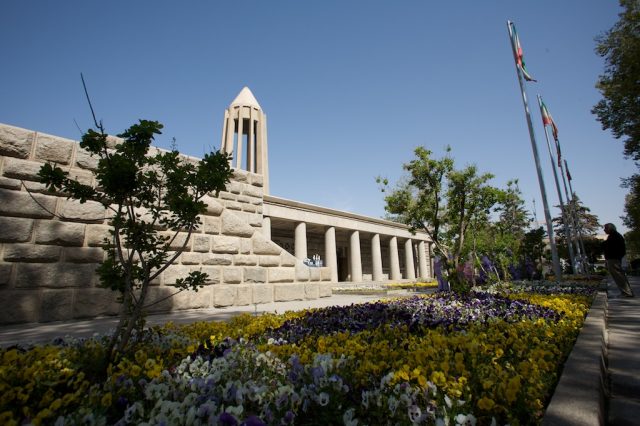
Imam Khomeini Square in Hamadan is the kind of place where the city reveals itself slowly, without fanfare or the usual tourist trappings. It doesn’t have the grandiosity of other Iranian city centers, where everything is designed for spectacle and scale. There are no towering fountains, monumental arches, or gleaming mosques demanding attention. Instead, the square breathes with the rhythm of everyday life, shaped by history and the unhurried pace of Hamadan—one of the oldest continuously inhabited cities in the world, where every stone seems to carry the weight of centuries.
Hamadan has long been called the cradle of Iranian civilization, and for good reason. It was the capital of the Median Empire, a key center of the Achaemenid dynasty, and later a vital stop on the Silk Road. Imam Khomeini Square, though relatively modern, sits on land that has seen kings, merchants, and scholars pass through over millennia. Around it, layers of history remain visible—ancient tombs, medieval caravanserais, Persian gardens, and Ottoman-era structures. The square itself feels like a meeting point of these eras, where the present quietly settles into the old cityscape without overshadowing it.
The architecture here is understated, almost modest, but that simplicity has its own charm. The low-rise buildings, clad in pale stone, don’t try to impress; instead, they blend seamlessly with the surrounding streets. At the center, a small park with trees and benches offers shade from the midday sun. In summer, the square stays cool, while in winter, when snow blankets the city, it becomes a quiet, white expanse where few people venture. On those days, time seems to slow down, as if the square exists in its own gentle rhythm, separate from the rest of Hamadan.
This isn’t just a place to walk through—it’s a living part of the city. Mornings bring vendors setting up stalls with fresh fruit, spices, and local sweets. Hamadan is famous for its raisins and nuts, and the square is one of the best places to taste them. By midday, the air fills with voices—people haggling, sipping tea in tiny shops, or simply sitting on benches, watching the world go by. In the evening, when the heat subsides, families, students, and elderly locals gather here. Some bring chessboards, others just stroll, enjoying the cooler air.
Nearby, a few notable sites add depth to the square’s character. The mausoleum of Avicenna, the renowned philosopher and physician, stands in a modern yet unobtrusive design that fits naturally into the city. Not far away is the tomb of Esther and Mordechai, figures from the biblical Book of Esther, revered by both Jews and Muslims. These places remind visitors that Hamadan has always been a crossroads of cultures and faiths, where different traditions have coexisted for centuries.
Hamadan is a city of contrasts, and Imam Khomeini Square reflects that perfectly. On one hand, there’s the unmistakable sense of antiquity—the same narrow alleys, the same clay walls, the same distant mountains that have watched over the city since the days of the Median kings. On the other, there’s the pulse of modern life, unfolding without much concern for the past. Here, you might see an elderly man in traditional dress walking alongside a teenager in jeans and headphones, or a woman in a chador chatting on her smartphone. It all feels natural, as if these differences have always been part of the city’s fabric.
Winter transforms Hamadan into a quiet, almost storybook town. Snow covers the rooftops, the trees, and the domes of mosques, turning Imam Khomeini Square into a scene from a bygone era. On those days, there’s nothing better than sipping hot tea with cardamom, paired with fresh bread from a nearby bakery. In summer, the square empties by midday as the temperature climbs, but by evening, it comes alive again. Locals know that the best time to be here is at sunset, when the golden light softens the buildings and the air fills with the scent of jasmine and warm bread.
This isn’t a square that tries to be a tourist attraction. There are no flashy entertainments, no souvenir shops, no architectural marvels designed to impress. Instead, it’s a place for those who want to experience the real Hamadan—not the polished, curated version, but the city as it is. You can sit on a bench, listen to the conversations around you, watch the distant mountains, and begin to understand why this city has remained one of Iran’s most important places for thousands of years. After all, not every square can claim to stand at the intersection of so many eras and lives.