The Avicenna Mausoleum in Hamadan is more than just an architectural landmark—it’s a place where history, science, and culture converge in quiet reverence. Here lies the final resting place of one of the most brilliant minds of the medieval world, a man whose legacy still resonates across continents. Known in the West as Avicenna and in the East as Ibn Sina, he was a polymath whose influence stretched far beyond his lifetime. A physician, philosopher, poet, and astronomer, his works became foundational texts in both medicine and philosophy, shaping intellectual thought for centuries. His *Canon of Medicine* was studied in European and Middle Eastern universities long after his death, a testament to his enduring impact during an era when much of the world was still emerging from the shadows of the Dark Ages.
Hamadan itself is one of Iran’s oldest cities, a place where trade routes, cultures, and ideas have intersected for millennia. Nestled in the Zagros Mountains, it has been a crossroads of civilizations—home to the Elamites, Medes, and Persians before becoming a center of Islamic scholarship. It was here, in this city of layered history, that Avicenna spent his final years, serving at the courts of local rulers while continuing his scholarly pursuits. The mausoleum stands on the site where, according to tradition, he was buried in the early 11th century. Though the exact details of his death remain uncertain, historians agree that Hamadan became his final home, a place where his memory would later be honored in stone.
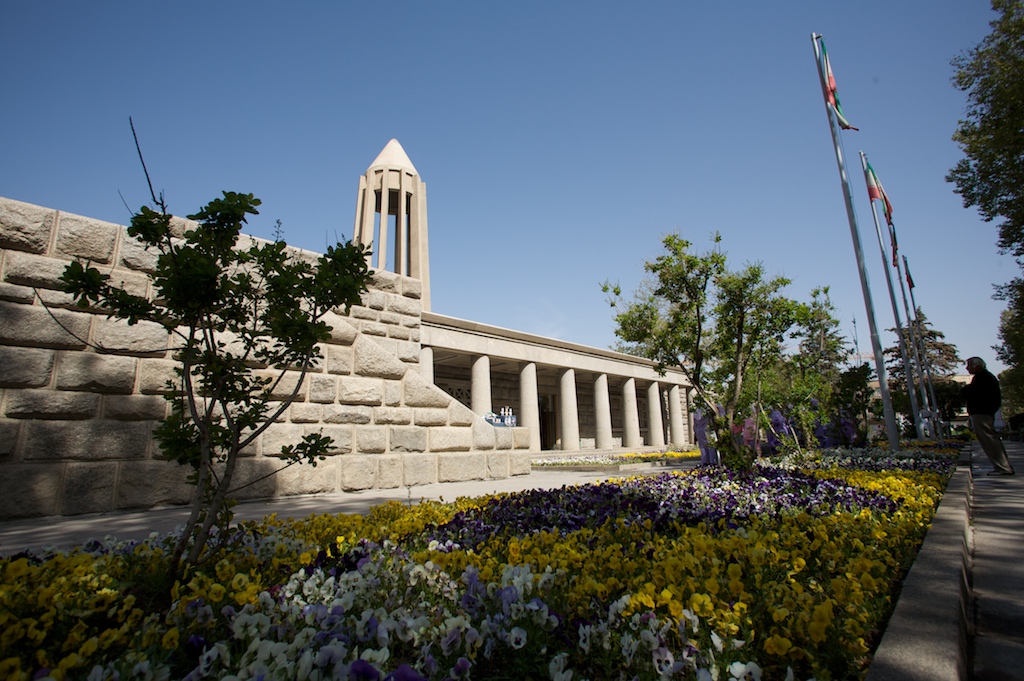
The current structure of the mausoleum is a relatively modern creation, built in the mid-20th century during a period when Iran, like many nations, sought to reclaim and celebrate its cultural heritage. Designed by architect Hooshang Seyhoun, the building is a thoughtful blend of traditional Persian aesthetics and contemporary design. The centerpiece is a towering, slender spire that evokes the form of a minaret but without religious connotations. Its clean lines and geometric precision reflect the harmony and balance so characteristic of Persian art. Surrounding the mausoleum is a small park, a peaceful space where visitors can wander beneath the shade of trees, the quiet broken only by the occasional rustle of leaves or distant murmur of the city.
Inside, the mausoleum is arranged to honor Avicenna’s life while immersing visitors in the intellectual world he inhabited. At the heart of the chamber lies a white marble sarcophagus, its simplicity contrasting with the richness of the knowledge it represents. Display cases line the walls, showcasing manuscripts and books that trace his life and works. Pages from the *Canon of Medicine* appear in both Arabic and Persian, their intricate calligraphy a reminder of the care with which knowledge was once preserved. Illustrations depict scenes from Avicenna’s life—his travels, his studies, his debates with other scholars—offering glimpses into an era when books were rare treasures and learning was a labor of devotion. The small library within the mausoleum holds rare editions of his works, a quiet invitation to those who wish to delve deeper into his ideas.
The mausoleum is more than a monument to one man; it’s a living symbol of how ideas can transcend time and borders. The atmosphere here is one of quiet reflection, drawing not just tourists but also locals—students reading beneath the trees, scholars engaged in discussion, or simply those seeking a moment of respite from the bustle of the city. For the people of Hamadan, the mausoleum is a point of pride, a tangible connection to a figure who embodies the city’s legacy as a center of learning. It’s a place where the past feels present, where the weight of history is balanced by the lightness of curiosity.
Avicenna’s influence extended far beyond the Islamic world. His works were translated into Latin, Hebrew, and Syriac, becoming bridges between cultures at a time when knowledge was often confined by geography. The mausoleum in Hamadan stands as a reminder of this interconnectedness—a place where visitors from different backgrounds can find common ground in the pursuit of understanding. For some, it’s a site of pilgrimage, a chance to pay respects to a man whose ideas shaped their fields. For others, it’s a source of inspiration, a testament to the power of intellect and perseverance. And for many, it’s an opportunity to reflect on how a single life can ripple through centuries, altering the course of human thought.
Hamadan itself is a city that rewards exploration. Its labyrinthine alleys, vibrant bazaars, and ancient mosques offer a glimpse into Iran’s layered past. Yet it’s the Avicenna Mausoleum that gives the city its deeper resonance. It serves as a reminder that Hamadan was not just a commercial hub but a beacon of knowledge, a place where scholars, poets, and philosophers once gathered. In an age where the spread of information and the challenges of scientific progress are once again at the forefront of global discourse, Avicenna’s life and work take on renewed significance. His legacy teaches that true knowledge is not merely the accumulation of facts but the relentless pursuit of understanding the world in all its complexity.
Visiting the mausoleum is best in spring or autumn, when Hamadan’s climate is at its most pleasant. The park surrounding the structure bursts into color, the air filled with the scent of blooming flowers and fresh greenery. The city, too, comes alive during these seasons—bazaars hum with activity, cafes serve steaming cups of tea alongside traditional dishes, and locals welcome visitors with warmth. A trip to the mausoleum can easily be paired with a stroll through Hamadan’s historic center, where remnants of its past—ancient tombs, medieval madrasas, and caravanserais—stand as silent witnesses to the passage of time. Together, they transform a visit into something more than sightseeing; it becomes a journey through the ages, where every stone and street corner whispers stories of those who came before.