Chaitén’s main square is where the town quietly gathers, not with grand gestures, but with the easy rhythm of daily life. Tucked between low wooden houses painted in soft blues and yellows, it feels more like a living room than a public space. There are no towering monuments or ornate fountains, just a few benches, a scattering of trees, and the occasional café table where someone lingers over coffee. In the evenings, locals drift in to chat, watch the light fade over the nearby river, or simply sit without hurry. It’s the kind of place where time moves differently—slower, softer, as if the rest of the world has agreed to wait.
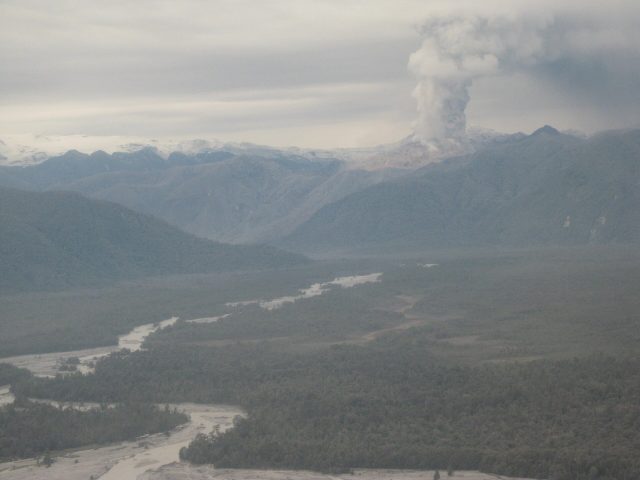
The square’s history mirrors the town’s own modest origins. Chaitén began in the mid-20th century as a practical settlement, built to support the timber and fishing industries that still define the region. Back then, the square was little more than an open patch of ground where vendors set up stalls and children kicked soccer balls between errands. Over the decades, it grew into the heart of the town, lined with small shops and homes, though it never lost its unassuming character. Even after the 2008 volcanic eruption forced an evacuation, the square was one of the first places people returned to, as if its quiet presence was proof the town still stood.
The buildings around the square are simple, built for endurance rather than beauty. Wooden facades, often weathered by wind and rain, are painted in muted tones that blend into the landscape. There’s no grand architecture here—just sturdy, functional structures designed to withstand Patagonia’s harsh climate. In the center stands a small pavilion, used for occasional gatherings: a weekend market, a local band playing folk songs, or a festival where the whole town turns out. It’s nothing elaborate, but on those days, the square becomes the stage for whatever passes as a celebration in Chaitén.
This isn’t a place that draws crowds. Chaitén sits far from Chile’s well-trodden tourist routes, too remote and too quiet to be a destination in itself. But that’s precisely what makes the square special. It doesn’t try to impress visitors or put on a show. It exists for the people who call this town home, for those who understand that life’s richness isn’t measured in landmarks but in small, ordinary moments—a shared joke with a neighbor, the smell of fresh bread from the bakery, the sound of children playing in the distance. There’s no rush here, no need to perform. Just the steady, unremarkable pulse of a place that knows its own worth.
The square is at its loveliest in spring, when the few trees along its edges burst into bloom, their delicate flowers a soft contrast to the rugged Patagonian backdrop. Summers are cool, even on sunny days, thanks to the ocean’s proximity and the ever-present mountain breeze. Winters bring a thin layer of snow, turning the square into a hushed, white space where the town seems to pause, holding its breath until the thaw. Locals joke that the best place to be in winter is by the fire, but those who venture out often find themselves drawn to the square anyway, as if checking to see that the world is still there.
What makes Chaitén’s square more than just a patch of ground is the way it holds the town’s stories. It’s where the past and present overlap—the old-timers who remember when the square was just dirt, the younger generation who’ve returned after years away, the occasional traveler who stumbles upon the town by accident. There’s no grand narrative here, no dramatic history. Just the quiet accumulation of everyday life, the kind that doesn’t make headlines but somehow matters more. It’s the kind of place that doesn’t reveal itself immediately. You have to sit for a while, watch the light change, listen to the murmur of voices, before you begin to understand why this unassuming square feels like the center of something real.
For those who pass through Chaitén, the town itself might blur into memory—a stop on a longer journey, a name on a map. But the square lingers. Not because it’s beautiful in any conventional sense, but because it feels honest. There’s no pretense, no attempt to be anything other than what it is: a place where people live, not perform. In a world that often values spectacle over substance, Chaitén’s square is a reminder that the most meaningful places aren’t always the ones that shout the loudest. Sometimes, they’re the ones that simply let you be.