Chaitén’s Church of Santiago Apóstol stands on a low hill in the center of town, a quiet presence that has watched the city change around it for over a century. Built in the early 1900s, its wooden structure is a classic example of southern Chilean architecture—practical, unassuming, and perfectly suited to the landscape. The steep-pitched roof, simple lines, and modest bell tower don’t demand attention, yet they fit so naturally into the surroundings that the church feels less like a building and more like an extension of the land itself.
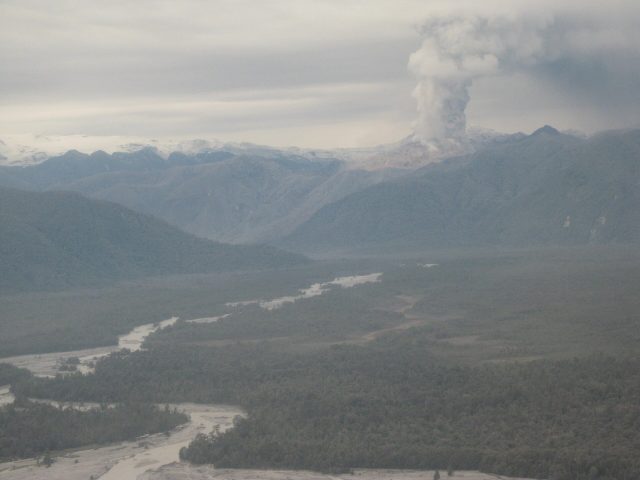
Chaitén has always been a place where survival is never guaranteed. In 2008, the nearby Chaitén volcano erupted with such force that the entire town was evacuated in a matter of hours. Ash blanketed the streets, rivers of mud reshaped the landscape, and for a time, it seemed the city might disappear entirely. The church survived, though not unscathed—its walls bore the marks of the disaster, and the damp, corrosive air left its traces. When residents began to return, many buildings were torn down or rebuilt, but the church remained. Perhaps because it had always been more than just a place of worship. In a town where earthquakes, fires, and floods have been part of life for generations, it was here that people gathered in times of crisis, where they marked the milestones of their lives, and where they found a sense of continuity when everything else felt uncertain.
Inside, the church is warm and uncluttered. Wooden pews line the nave, their surfaces worn smooth by decades of use. The altar is low and simple, adorned with a few icons and a crucifix, nothing more. Light filters through narrow windows, casting a soft glow on the walls, which bear the faint layers of paint applied over the years. There’s no grandeur here, no ornate carvings or gilded details, but the space feels lived-in, as if the quiet prayers and whispered conversations of a hundred years still linger in the air. In small towns like Chaitén, the church has always been the heart of the community. It’s where children were baptized, where couples exchanged vows, where families said their final goodbyes. Even those who didn’t consider themselves religious would stop by—to sit in silence, to talk with a neighbor, or simply to feel the weight of something enduring in a place where so much else had been lost.
The architecture reflects the realities of life in Patagonia. Wood has always been the material of choice here, where forests stretch for miles and stone is scarce. The church was built without a single nail, its beams joined by wooden pegs and interlocking joints, a technique that makes the structure surprisingly resilient. The roof is covered in shingles, thin wooden slats that shed rain and withstand the relentless winds that sweep through the region. The facade is adorned with subtle geometric patterns, a nod to the European traditions brought by settlers, but the overall effect is one of sturdy simplicity. It’s the kind of building that doesn’t fight the elements but works with them, as if to say: no matter what comes, it will stand.
Today, Chaitén is still recovering. Some streets remain empty, their houses abandoned or half-rebuilt, but the church continues to serve its purpose. On Sundays, a small congregation gathers for mass, joined occasionally by travelers who stumble upon the town by chance. On weekdays, the building is quiet, the only sound the creak of floorboards underfoot. Outside, a small park surrounds the church, offering a place to sit and look out over the town. From this vantage point, you can see how Chaitén clings to the edge of the bay, how the mountains fade into the horizon, and on clear days, how the volcano looms in the distance—a reminder of the forces that nearly erased this place from the map.
The Church of Santiago Apóstol isn’t a monument in the traditional sense. There are no famous artworks inside, no architectural innovations to marvel at. What makes it special is its ordinariness. It’s a place where the past isn’t preserved behind glass or explained on plaques but lived, day after day, in the same way it always has been. Here, time moves differently. The outside world might rush by, but within these walls, the rhythm is slower, steadier. It’s the kind of place where you don’t need to search for meaning—you just have to sit, listen, and let the quiet settle in. In a town that has faced so much upheaval, the church stands as a reminder that some things endure, not because they’re indestructible, but because they’re needed.