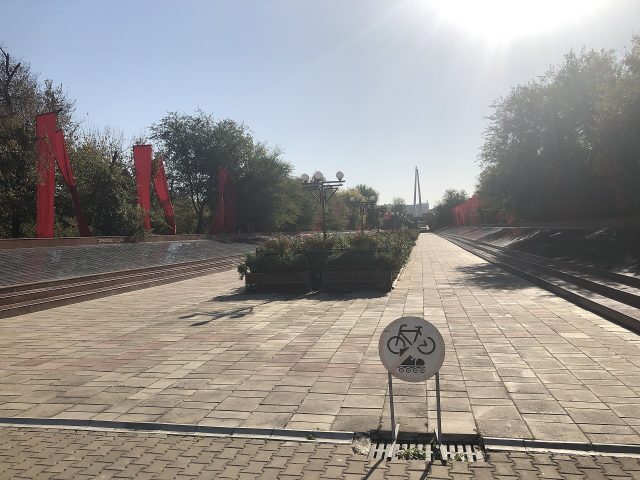
Almaty Adam Square is one of those places in Shymkent where the city’s pulse feels strongest. It’s not a grand monument or a meticulously designed public space, but rather a living part of the urban fabric where history, daily life, and modern rhythms intersect. Here, people rush to work, meet friends, or simply wander, watching the day unfold at its own unhurried pace. The square doesn’t demand attention—it simply exists, absorbing the energy of those who pass through.
The name translates to Golden Man, a reference to one of Kazakhstan’s most significant archaeological discoveries. In 1969, a burial mound in the steppes revealed the remains of a Saka warrior, adorned in a suit of gold that became a symbol of the region’s ancient nomadic culture. The square, named in his honor, serves as a quiet reminder of Shymkent’s layered past. This is a city that has stood at the crossroads of empires—the Silk Road’s trade routes, the traditions of nomadic tribes, the Soviet era’s urban planning, and now, the rapid changes of the 21st century.
Though not large, the square’s location makes it a natural gathering point. It’s an ideal starting point for exploring the city, with the old bazaar nearby, where vendors sell spices, dried fruits, and freshly baked bread. Small cafes offer plates of beshbarmak or steaming cups of tea, while just beyond the square, parks and museums invite longer visits. During the Soviet years, this was one of the city’s main public spaces, hosting parades, celebrations, and political rallies. Some of that era’s influence remains in the wide walkways, fountains, and imposing buildings that now share the space with modern shops and offices.
At the center of the square stands a bronze statue of the Golden Man, depicted as a warrior in full regalia, bow in hand. The sculpture isn’t just a tribute to the archaeological find—it’s an attempt to capture the spirit of the ancient steppe nomad, a figure that embodies courage and a deep connection to Kazakh heritage. Locals and visitors often pause here, some to take photos, others to sit on the benches and watch the world go by.
As evening falls, the square transforms. The fountains light up, casting reflections on the pavement, while the scent of grilled meat and freshly brewed tea drifts from nearby eateries. There’s no overwhelming bustle of a big city, nor is it the quiet of a small town. Instead, the sounds of passing cars, conversations, and music from the cafes blend into a familiar urban hum. This is where Shymkent’s daily life plays out in plain sight.
The square hasn’t always looked the way it does today. Over the decades, it has served different roles—a marketplace, a transport hub, a public gathering spot—each change reflecting the city’s own evolution. Shymkent has never been static, yet it has always carried its history forward, and Almaty Adam Square is a small but telling example of that continuity.
For visitors, the square offers a glimpse into the city’s character without the polish of tourist attractions. There are no pushy guides or overpriced souvenirs, just the chance to observe how Shymkent lives. You might stop at a small shop for a loaf of bread, buy a bundle of dried apricots from a street vendor, or simply sit on a bench, watching people of all ages pass by. It’s an unfiltered slice of local life.
In recent years, the square has also become a venue for festivals and events. In summer, local musicians perform on temporary stages, while in winter, an ice rink sometimes appears, drawing families and skaters. These gatherings reinforce the square’s role as more than just a thoroughfare—it’s a place where the city comes together.
Almaty Adam Square isn’t a landmark that impresses with grandeur or architectural innovation. Instead, it’s a space where the past and present coexist effortlessly. Here, history isn’t confined to museums or plaques; it’s woven into the fabric of everyday life. For those who take the time to notice, the square reveals Shymkent not as a dot on a map, but as a city with a story—one that’s still being written.