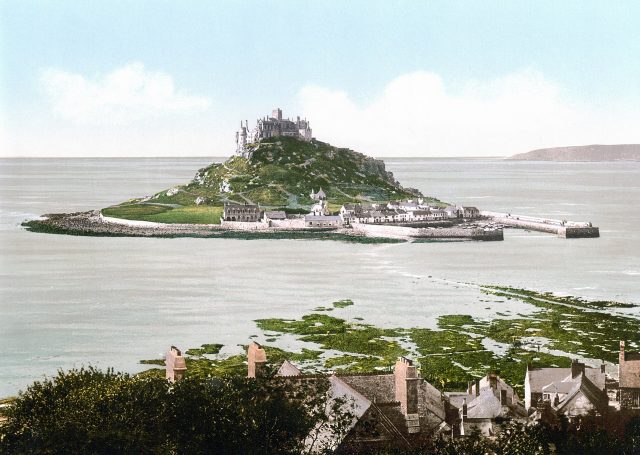
Marazion is one of those quiet corners of England where the land meets the sea without fanfare.
Tucked away on the southwestern coast, it’s a place that doesn’t announce itself. No neon signs, no crowded promenades—just a long stretch of sand curling around the bay. The beach here isn’t polished. It shifts with the rhythms of the ocean. At low tide, the sand unfolds in wide, damp expanses, dotted with shallow pools where small crabs dart and tiny fish flicker beneath the surface. When the water returns, it narrows the shore to a thin ribbon between the rocks and the waves.
Centuries ago, Marazion was a port. Ships unloaded wine, wool, and other goods here. Locals built vessels and cast their nets into the waters. The harbor’s importance faded, but traces of its past linger in the weathered stone quays jutting from the water and the street names that still whisper of maritime traditions. The town carries the weight of its history lightly, like a well-worn coat. The connection to the sea isn’t something you see so much as feel—a quiet, enduring presence.
The beach at Marazion doesn’t fit the postcard ideal. The shore is a mix of grit and pebbles, and the tide sometimes leaves behind tangles of seaweed or fragments of old fishing nets. In summer, families build sandcastles, while fishermen perch on the rocks with their lines. Winter empties the beach. The wind skitters across the sand, and gulls wheel overhead. On those days, the place feels almost private.
The town itself is unassuming. Most of the buildings are two or three stories tall, built from local stone with steep roofs and narrow windows. Many date back to the Victorian era, when Marazion became a retreat for visitors seeking fresh air and quiet. Guesthouses sprang up, and trees were planted along the seafront. Today, those buildings have a worn-in look, their age showing in faded paint and crooked shutters. They don’t try to be modern. They simply exist, as they have for generations.
Beyond the town, the landscape rises into rolling hills covered in heather and fern. From the higher ground, the view opens up across the bay. On clear days, the water shimmers like liquid silver. Locals often come here at dawn or dusk, when the sky bleeds into shades of pink and violet. These walks are a ritual, as much a part of life here as afternoon tea.
Marazion isn’t a place for those seeking excitement. There are no amusement parks, no flashy bars. A handful of quiet cafés serve fresh seafood. A few small shops sell local crafts. An old lighthouse stands on the rocks. It still operates, its beam cutting through the dark on foggy nights. It was once a lifeline for ships navigating treacherous waters.
This is a place where time slows down. You can come here with a book, a flask of tea, or nothing at all. The gulls will cry overhead, the wind will tug at your hair, and the sea will keep its endless conversation with the shore.
Marazion won’t change much. It will stay modest, unhurried. In a world that moves too fast, places like this are becoming scarce. They remind you that some things don’t need to keep up with the times: the sea, the sand, the rocks, the wind carrying the scent of salt and seaweed. If you ever need to step outside the noise, this is where you come—to stand on the shore and watch the horizon.