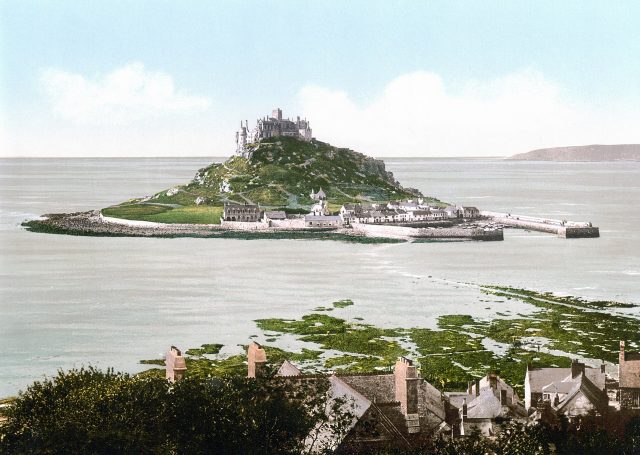
Perched on a gentle rise above the quiet village of Marazion in Cornwall, St Mawer’s Church feels like a place where time has quietly settled. Its sturdy stone walls and simple lines stand as they have for centuries, a modest yet striking presence against the soft contours of the surrounding hills. Built in the twelfth century, the church carries the unmistakable marks of Norman influence—thick walls, narrow windows, and a rounded arch over the entrance that speaks of an era when faith and fortification often went hand in hand. Inside, the space feels unexpectedly open, the light filtering through stained glass to cast a quiet glow over the worn wooden pews and ancient stonework.
The history of St Mawer’s is woven into the fabric of Marazion itself. In medieval times, the church was more than just a place of worship; it was the heart of the village, where people gathered not only for services but for meetings, disputes, and even the occasional market. Over the centuries, the building has seen changes—repairs, additions, and restorations—but its original character has endured. The fifteenth-century tower, added later, gives the church a more imposing silhouette and has become a local landmark, visible from the winding roads that lead into the village.
Step inside, and the interior reveals a quiet beauty. The wooden pews, dating back to the Victorian era, lead the eye toward the altar, where intricate carvings add a touch of craftsmanship to the otherwise plain surroundings. One of the oldest features is the Norman font, carved from local stone, its surface smoothed by centuries of use. On the walls, faint traces of medieval frescoes remain, their faded colours and patterns hinting at the church’s past splendour. Though time has worn them down, these fragments offer a glimpse into how the space might have looked in its prime, when every surface told a story.
St Mawer’s is deeply rooted in Cornwall’s cultural and spiritual traditions. The region’s Celtic heritage runs deep, and even after the arrival of Christianity, many local customs evolved rather than disappeared. The church’s patron saint, St Mawer, is still celebrated here, with festivals that draw both locals and visitors eager to experience a slice of authentic Cornish life. During these events, the church comes alive with music, singing, and the scent of traditional foods, a reminder of how faith and community have long been intertwined in this corner of England.
Beyond the church, the landscape of Marazion is one of rolling hills and open skies. The views stretch across valleys and distant ridges, especially striking in spring and summer when the countryside is lush and green. Walking the footpaths that crisscross the area, it’s easy to see why this place has drawn people for centuries. The church itself seems to sit at the centre of it all, a quiet anchor in a landscape that has changed little over time. Locals often come here not just for services but to walk, reflect, or simply enjoy the peace of the surroundings.
Despite its age, St Mawer’s is far from a relic. Services are still held regularly, and on weekdays, the doors are usually open to visitors. Stepping inside, you might hear the soft strains of an organ if the local choir is practising, or the murmur of voices as someone lights a candle. In these moments, the church feels alive, its ancient stones holding not just the weight of history but the echoes of the present. It’s a place where the past isn’t just preserved—it’s still being lived.
For those with an interest in architecture, St Mawer’s offers a fascinating study in how styles and eras overlap. Norman arches stand alongside later Gothic details, while Victorian pews share space with medieval frescoes. Each element tells a part of the story, from the rough-hewn stones of the original construction to the careful restorations that have kept the building standing. Even the small imperfections—the cracks, the worn edges—add to its charm, a reminder that this is not a museum piece but a living part of the community.
Marazion and its church are a reminder of Cornwall’s quieter side, where life moves at a slower pace, shaped by the land and the sea. There are no crowds here, no rush—just the steady rhythm of tides, seasons, and traditions. St Mawer’s isn’t just a landmark; it’s part of the landscape, as much a feature of the hills as the stone walls that crisscross the fields. To visit is to step into a place where history isn’t just something you read about but something you can feel, whether you’re wandering the village lanes, sitting in the church, or listening to the stories of those who call this place home. It’s the kind of spot that lingers in the memory, a quiet invitation to pause and listen.