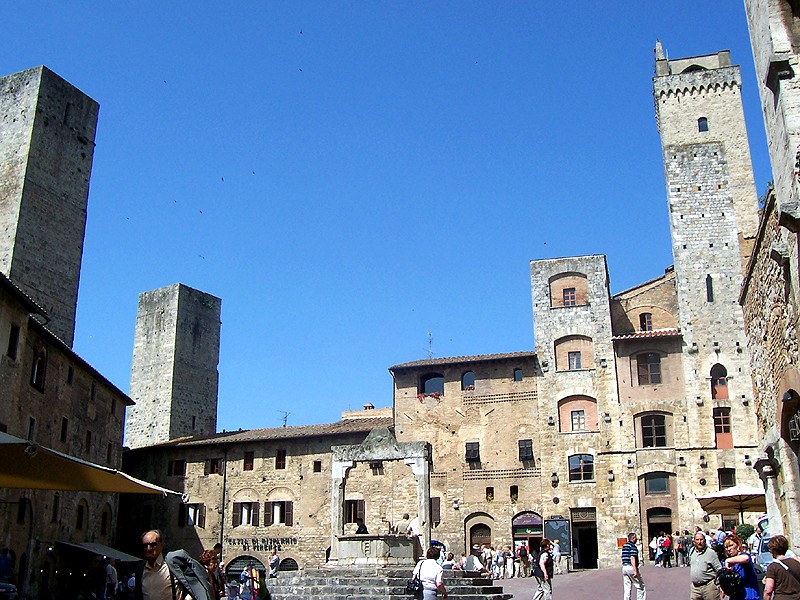
San Gimignano’s Piazza della Cisterna is one of those rare places where the past doesn’t just linger—it feels alive. Tucked between the town’s famous medieval towers, the square unfolds like a quiet stage set for a story that hasn’t quite ended. Its name comes from the old well that once stood at its center, a vital source of water for the town centuries ago. Though the well is long gone, the square retains the same sense of timelessness that draws visitors from all over, as if the stones themselves remember the footsteps of merchants, nobles, and ordinary townspeople who once gathered here.
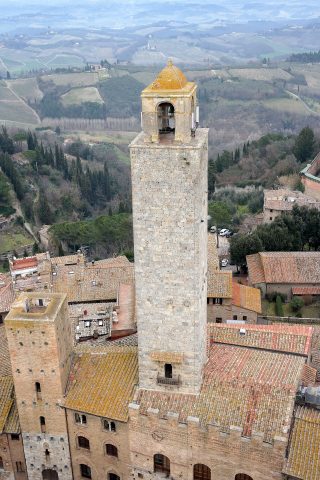
The shape of the piazza is an uneven triangle, its cobblestones worn smooth by centuries of use. The slight slope of the ground gives it an unassuming charm, as if the square has settled comfortably into its own skin over the years. In the Middle Ages, this was the heart of San Gimignano’s daily life—where traders haggled over goods, festivals spilled into the streets, and wealthy families competed to build the tallest towers, each one a declaration of power and prestige. Today, those towers still dominate the skyline, and the piazza remains the best place to take them in, their weathered stone silhouettes framing the sky like the pages of an old manuscript.
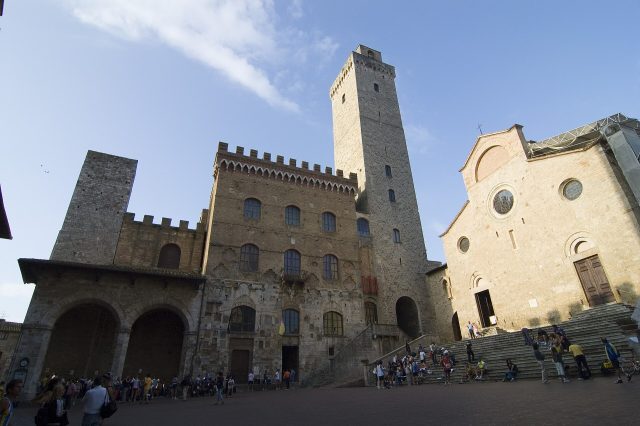
The buildings around the square are a study in understated elegance. Most date back to the 13th and 14th centuries, their facades a mix of simple lines and delicate details—arched windows, carved doorways, and walls of local stone that glow golden in the sunlight. Palazzo Razzi stands out with its faded frescoes and the remnants of noble coats of arms, a quiet reminder of the families who once ruled here. Nearby, the former monastery-turned-town hall adds another layer to the square’s history, its presence a testament to how the town has adapted over time without losing its character.
What makes Piazza della Cisterna special isn’t just its architecture, but the way it still functions as a living part of the town. Mornings here are peaceful, with locals going about their routines before the first tourists arrive. By midday, the square comes alive—cafés open their doors, vendors set up stalls, and the scent of espresso and fresh bread drifts through the air. In the evening, as the sun dips behind the towers, the piazza softens into a warm, amber light, and the crowds thin out, leaving behind a sense of quiet intimacy. It’s easy to imagine that this is how it might have looked centuries ago, when the day’s work was done and the town settled into the rhythm of the night.
The little details are what give the square its soul. The old-fashioned streetlamps that flicker on at dusk, the stone benches where you can sit and watch the world go by, the occasional musician playing a lute or guitar—these are the things that make the piazza feel real, not just a postcard come to life. During festivals, the square transforms entirely, filling with the sounds of medieval music, the smells of spiced wine and roasted chestnuts, and the sight of people in period costumes. Even on ordinary days, there’s a sense of continuity here, as if the past and present are gently overlapping.
For most visitors, Piazza della Cisterna is the natural starting point for exploring San Gimignano. From here, narrow alleys branch off toward the town’s other landmarks—the grand Piazza del Duomo, the quiet church of Sant’Agostino, the towering remains of the old fortress. But you don’t need to go far to feel the town’s history. Just sitting at one of the café tables with a coffee, watching the light change on the stone facades, is enough to understand why this place has endured. The towers, the well, the worn cobblestones—it all tells a story, one that doesn’t need grand gestures to be compelling.
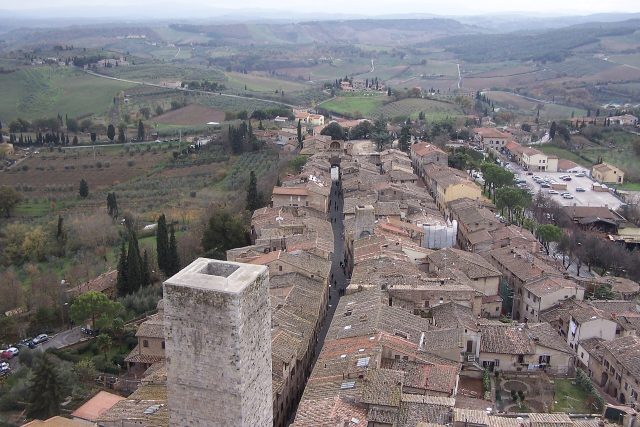
San Gimignano is often called the "Town of Fine Towers," and nowhere is that more evident than here. From the piazza, you can see several of the most famous ones—Torre Grossa, the tallest, rising above the rest; Torre dei Salvucci, once part of a fierce rivalry between noble families; and Torre del Diavolo, its name hinting at darker legends. Each tower has its own history, tied to the ambitions and conflicts of the families who built them. Today, they stand as silent witnesses to a time when wealth and power were measured in height, their presence a reminder of how much—and how little—has changed.
Beyond its historical significance, Piazza della Cisterna is simply a place where life unfolds at its own pace. There’s no rush here, no urgency—just the slow, steady rhythm of a town that has learned to savor its own existence. In summer, the square bakes under the Tuscan sun, while in winter, it’s softened by holiday lights and the occasional dusting of frost. No matter the season, it remains a place that invites you to linger, to step out of time for a little while and let the weight of history settle around you like an old, familiar coat. It’s the kind of place you leave with the quiet certainty that you’ll return, not because you have to, but because you want to.