Petřín Tower stands on a hill above Prague, a quiet monument to an era when engineering ambition met a romantic vision of the world. Built in the late nineteenth century, it was inspired by the Eiffel Tower but tailored to Prague’s own character—not as a bold statement of progress, but as a gift to the city, offering a new perspective from above. Prague had always been a city of towers, yet this one felt different. Light and delicate, almost woven from air and metal, it didn’t impose itself on the skyline. Instead, it invited visitors to climb and see the city from a height that felt both familiar and unexpected.
The hill itself, Petřín, has long been a favorite retreat for Praguers. Even before the tower was built, it was a place of quiet, removed from the bustle of the streets below. Reaching it is part of the experience. You can walk up through the shaded paths of the park, where the air is cooler and the sounds of the city fade into birdsong. Or you can take the funicular, a charming relic from the early twentieth century that glides upward almost imperceptibly. As it ascends, the rooftops of Malá Strana unfold below, the Vltava curves lazily through the city, and the silhouettes of bridges emerge one by one. The tower waits at the top, its spiral staircase winding upward or, for those who prefer, a modern elevator installed later to make the climb easier.
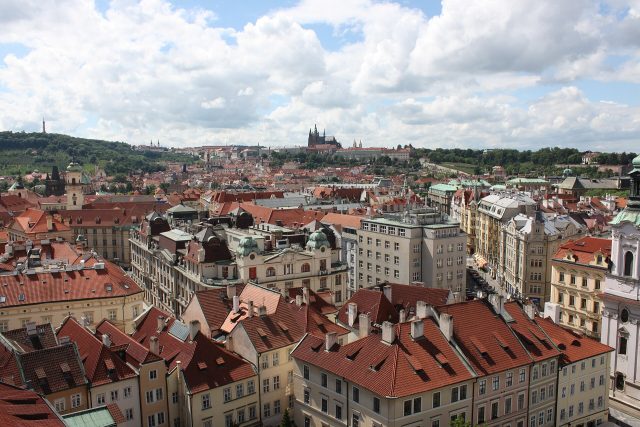
At just sixty meters tall, Petřín Tower is modest compared to other landmarks of its kind. But that’s part of its appeal. From the observation deck, Prague spreads out like a living map. The river divides the city, its banks lined with Gothic spires, Baroque domes, and the occasional modern intrusion. On clear days, the view stretches to the surrounding hills, and in winter, when the air is crisp, the horizon seems to go on forever. Unlike the crowded squares and bridges below, the tower offers space to linger, to watch the light shift across the rooftops without the press of other visitors.
The tower was originally conceived not just as a viewpoint but as a scientific outpost. Its base housed a meteorological station, and later, a small planetarium was added. Today, those functions have faded, though traces remain—a few weathered plaques on the facade marking temperature and pressure, occasional exhibitions inside. At the foot of the tower, a café serves coffee and pastries, a place to catch your breath after the climb. There was once a restaurant here too, but now it’s more of a pit stop than a destination, a quiet corner to gather your thoughts before heading back down.
The architecture is simple, almost austere, yet it has a certain grace. The metal framework, clad in iron sheets, gives the structure a sense of lightness, while the narrow slit windows echo the fortifications of medieval castles. The base rests on a stone plinth that blends seamlessly into the hillside, as if the tower grew from the earth itself. Around it, the park unfolds with fountains, sculptures, and winding paths leading to other curiosities, like the Mirror Maze, built around the same time as the tower. The maze is a playful diversion, its distorted reflections drawing laughter from children and adults alike, a reminder that even in a city steeped in history, there’s room for whimsy.
Petřín Tower doesn’t demand attention the way Prague Castle or Charles Bridge do. It doesn’t need to. Its charm lies in its understated presence, a place that exists not for the crowds but for those who seek it out. There are no long lines here, no jostling for the best view. Instead, there’s a sense of solitude, of being alone with the city as it reveals itself in layers—rooftops, spires, the slow curve of the river. It’s a place where Prague feels less like a postcard and more like a living, breathing place, one that changes with the light and the seasons.
The tower wears each season differently. In spring, when the park bursts into tender green, it feels like part of the landscape, a natural extension of the hill. In autumn, its iron silhouette stands out against the golden foliage, a stark contrast to the warm tones below. Winter transforms the climb into a small adventure, the funicular creaking upward through the snow, the observation deck offering a view of the city wrapped in white. But summer evenings might be the best time to visit, when the lights along the bridges and embankments flicker to life and the sky above Prague turns shades of pink and violet.
Over the decades, the tower has witnessed wars, revolutions, and the slow march of time, yet it remains much as it was when it first opened. Repairs and reinforcements have been made, but its essence hasn’t changed. Perhaps that’s because there’s nothing superfluous about it—no ornate flourishes, no grand declarations. It simply does what it was meant to do: lift people above the city and let them see it anew. And in that simplicity, there’s a quiet magic, a reminder that sometimes the most memorable places aren’t the ones that shout the loudest, but the ones that wait patiently for you to find them.