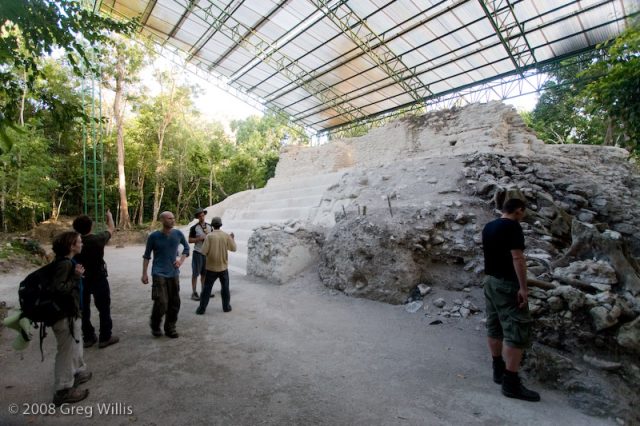
The Petén Basin isn’t just a stretch of land in northern Guatemala—it’s the living heart of the ancient Maya world, where time moves differently. Here, in the dense jungles of the Petén department, history and nature intertwine so completely that every step feels like a brush with the past. Towering ceiba trees shade crumbling pyramids, their roots slowly reclaiming the stone, while howler monkeys roar in the distance like echoes of a civilization that once thrived here. The air is thick with the scent of damp earth and tropical blooms, and the silence is broken only by the rustle of leaves or the distant call of a toucan. This is a place where the past isn’t just remembered; it’s still present, breathing through the ruins and the land itself.
Stretching across Guatemala, Mexico, and Belize, the Petén Basin holds some of the most significant Maya sites in the world. Tikal, the most famous among them, rises from the jungle like a lost city of giants, its temples piercing the canopy as they have for over a thousand years. But Tikal is only the beginning. Nearby, Yaxhá sits beside a shimmering lake, its reflections doubling the ruins in the water. Uaxactún, where archaeologists first uncovered the Maya’s advanced understanding of astronomy, offers a quieter glimpse into their scientific achievements. And then there’s El Mirador, a sprawling pre-classic city whose massive pyramids predate even Tikal, hinting at a civilization that was already sophisticated long before the rise of other great Maya centers. Each site tells a different story, yet together they form a mosaic of a culture that mastered mathematics, architecture, and time itself.
The jungle here is alive in ways that feel almost deliberate. In the wet season, the forest becomes a sea of green, rivers swell over their banks, and the air hums with the sound of frogs and insects. The dry season brings a different kind of stillness, the trees shedding leaves like old skin, revealing glimpses of ruins hidden just beyond the trail. For the local Maya communities, many of whom trace their ancestry back to these lands, the jungle is more than a backdrop—it’s a living inheritance. They know its secrets: which plants heal, which paths lead to hidden cenotes, and which spirits still linger in the shadows. Some still use ancient trails to navigate the forest, their knowledge passed down through generations, a quiet resistance against the erasure of time.
Yet the Petén Basin isn’t frozen in the past. It’s a place where ancient traditions and modern challenges collide. The region is home to one of the last great tropical forests in Central America, a fragile ecosystem teeming with jaguars, scarlet macaws, and countless species found nowhere else. National parks like Maya Biosphere Reserve and Tikal work to protect this biodiversity, but the threats are real. Illegal logging, poaching, and expanding farmland carve into the wilderness, while climate change alters the rhythms of the forest. Local communities and conservation groups walk a tightrope, trying to balance tourism with preservation, development with tradition. It’s a struggle that plays out in the quiet of the jungle, where every fallen tree and every new road tells a story of what’s at stake.
To visit the Petén Basin is to step into a world where the past and present coexist. Flores, a small island town on Lake Petén Itzá, serves as the gateway to this region. Its cobblestone streets wind past pastel-colored houses, where laundry hangs from balconies and the scent of coffee drifts from open doorways. Life here moves at its own pace, unhurried by the demands of the outside world. From Flores, travelers set out on journeys to the ruins—some for a day, others for weeks. Local guides, often descendants of the Maya themselves, lead the way, sharing stories of kings and warriors, of rituals performed on these very stones. Their voices bring the ruins to life, turning a visit into something deeper than sightseeing. It’s not just about seeing the past; it’s about feeling it.
But the Petén Basin is more than ruins and jungle. It’s also a place where the Maya culture is still alive, woven into the fabric of daily life. In villages around Flores and Santa Elena, women weave intricate textiles on backstrap looms, their patterns as old as the pyramids themselves. Markets overflow with handmade pottery, wooden masks, and bundles of herbs used in traditional medicine. The air is rich with the smell of burning copal incense, a scent that has filled Maya temples for centuries. Some communities still practice ancient ceremonies, their shamans calling on the spirits of the earth and sky. And then there’s the food—dishes like *pepian*, a rich stew thickened with pumpkin seeds, or *tamales* wrapped in banana leaves, recipes that have been passed down through generations. To taste them is to taste history.
What makes the Petén Basin unforgettable isn’t just its grandeur or its beauty, but the way it makes you feel small in the best possible sense. Standing atop Temple IV in Tikal, the jungle stretches endlessly in every direction, a sea of green that swallows the horizon. The wind carries the cries of parrots and the distant rumble of thunder, sounds that have echoed here for millennia. In that moment, it’s impossible not to wonder about the people who once stood in this same spot, who built these temples and carved their stories into stone. The Maya are gone, but their world isn’t. It lingers in the ruins, in the trees, in the stories still told around fires at night. The Petén Basin doesn’t offer easy answers, but it does something rarer: it makes you ask the right questions. About time, about legacy, about what it means to leave a mark on the world—and what happens when the world eventually reclaims it.