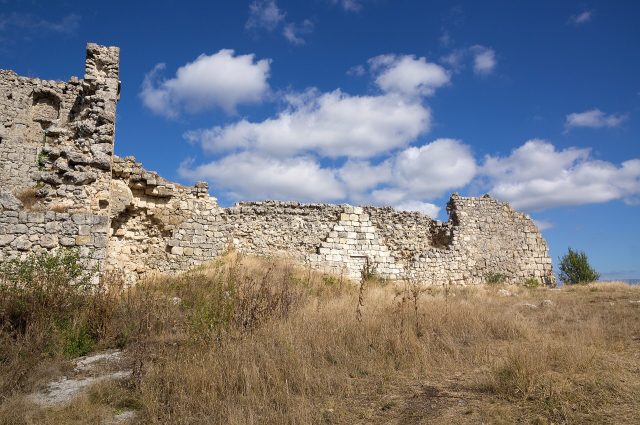
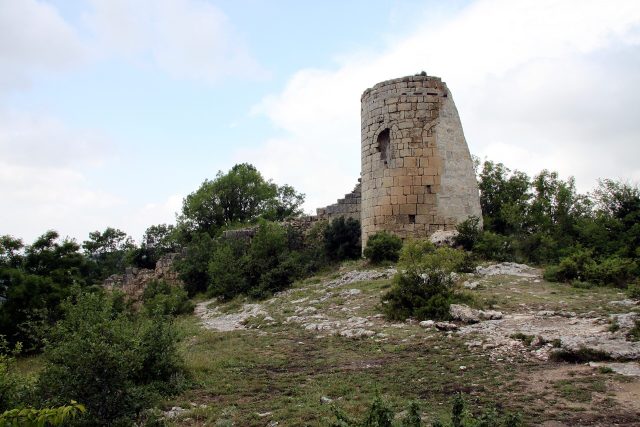
Perched on a limestone plateau in Crimea, the cave city of Eski-Kermen feels like a place where time has paused rather than passed. Unlike the grand ruins of more famous historical sites, this fortress carved into rock doesn’t announce its presence with towering columns or polished marble. Instead, it waits quietly, half-hidden among the trees and cliffs, as if inviting only those who truly seek it. The approach through the forest is part of the experience—each step forward peels back another layer of the modern world, until all that remains is the wind, the stone, and the faint echoes of a life that once thrived here.
Eski-Kermen, which translates to Old Fortress, was founded in the 6th century as a Byzantine stronghold in a region that was then a crossroads of empires. The choice of location was deliberate. The plateau’s sheer drops on three sides made it nearly impregnable, while the fourth was fortified with ditches and walls. Inside, the inhabitants didn’t just build structures—they sculpted them directly into the rock. Over three hundred caves served as homes, storerooms, churches, and stables, their interiors carefully designed with niches for lamps, sleeping platforms, and even drainage systems. Some of these spaces still bear traces of their original purpose, like the faint remains of frescoes or the grooves worn into the stone by centuries of use.
One of the most striking features is the Church of the Three Horsemen, named for a now-fragmented mural depicting three mounted saints. The image, though faded, hints at the city’s role as both a spiritual and military center. The church wasn’t just a place of worship but a symbol of unity for a community that had to be self-sufficient in a volatile frontier. The Byzantines, who ruled here for centuries, left behind more than just architecture—they embedded their culture into the very stone, from the layout of the streets to the way the caves were ventilated. Even the water supply was ingeniously managed, with cisterns carved into the rock to collect rainwater.
By the 13th century, Eski-Kermen’s story took a violent turn. Mongol invasions swept through Crimea, and the fortress, like many others, was sacked and abandoned. Unlike cities that were rebuilt, this one was left to the elements. For hundreds of years, it stood empty, its caves slowly filling with earth and its walls crumbling under the weight of time. It wasn’t until the 19th century that archaeologists rediscovered the site, though much of it remains unexcavated. This gives Eski-Kermen a rare quality—it feels less like a finished exhibit and more like a work in progress, where every visit might reveal something new.
What makes this place special isn’t just its history, but the way it makes that history feel tangible. There are no crowds here, no guides shouting over one another, no souvenir stalls cluttering the path. Instead, there’s space to wander, to sit on a ledge and watch the light shift across the valley, or to step into a cave and imagine the hands that once lit a fire in the same spot. The silence isn’t oppressive; it’s companionable, as if the past is holding its breath, waiting for you to listen.
The best time to visit is early morning, when the mist still clings to the slopes below and the first sunlight spills over the plateau. At that hour, the ruins feel almost alive, as if the city’s former inhabitants have just stepped away and might return at any moment. The air is cool, the stones damp with dew, and the only sounds are the rustling of leaves and the occasional cry of a bird. By evening, the light turns golden, casting long shadows that make the caves look deeper and the cliffs more dramatic. It’s easy to lose track of time here, to forget that the world beyond the plateau even exists.
Eski-Kermen isn’t the kind of place you visit for a quick photo opportunity or a checklist of sights. It’s for those who appreciate the quiet weight of history, who want to walk where others have walked centuries before, and who understand that some stories are best told without words. The fortress doesn’t demand attention—it earns it, slowly, through the details: the worn steps leading to a cave, the way the wind whistles through the rock formations, the sense of isolation that makes the past feel just a little closer.
For all its remoteness, the site isn’t difficult to reach, though it does require a bit of effort. The path winds through a forest, and the final ascent to the plateau is steep in places. But the reward is worth it—a view that stretches across the valley, where the landscape looks much as it must have centuries ago. There’s a humility to Eski-Kermen, a sense that it has endured not by being the grandest or the most famous, but by simply being itself. It doesn’t need to shout to be heard; it only needs someone willing to listen.