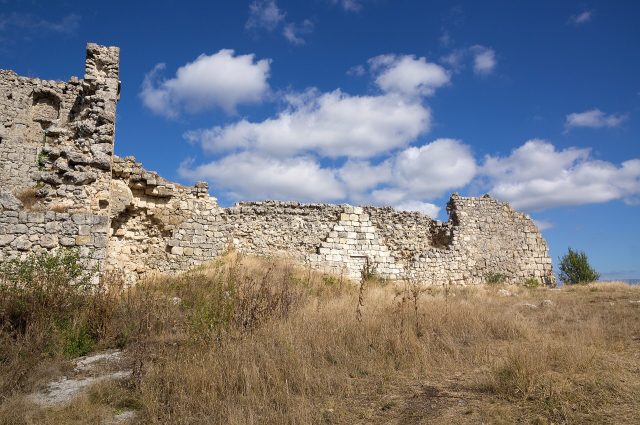
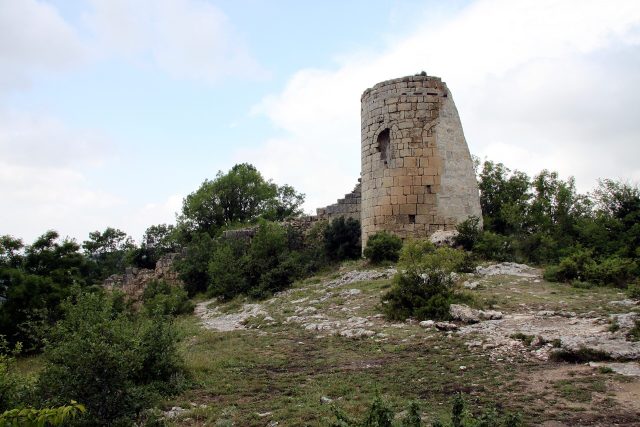
The basilica in the Chufut-Kale ravine is one of those rare places where history doesn’t just feel present—it lingers in the air like an unspoken memory. Perched on the edge of what was once a formidable medieval fortress, the ruins of this early Christian church stand as a quiet witness to centuries of change. Built during the Byzantine era, likely between the 6th and 7th centuries, it is among the oldest surviving Christian structures in Crimea. The walls, assembled from local limestone, bear the marks of time: uneven rows of stone, weathered corners, and crumbling masonry that seem to whisper of the people who once gathered here in prayer. Even in its ruined state, the basilica carries an undeniable weight, as if the very stones remember the voices that once filled its space.
Chufut-Kale itself is a place layered with history. The fortress-city emerged in antiquity but rose to prominence in the Middle Ages, when it became a key stronghold of the Crimean Khanate. Over the centuries, it was home to diverse communities—Muslims, Karaites (a small ethnic group practicing a distinct form of Judaism), and, before them, the Byzantine Christians who built this very basilica. The church serves as a reminder that long before the arrival of Islam or the Karaite settlement, these lands were part of the Christian world. The Byzantines left behind more than just fortifications; they established a cultural and religious presence that endured even as empires shifted around them.
The architecture of the basilica reflects the early Byzantine style, with its characteristic three-nave layout and an apse facing east, as was customary in Christian tradition. Inside, the space was once divided by columns, though only their bases remain today. The floor, likely once adorned with mosaics, has long since vanished, leaving only the bare earth beneath. Yet even in its current state, the structure holds a certain dignity. It’s not the grandeur of the building that strikes you, but the sense of continuity—the way it has endured through conquests, neglect, and the slow march of time.
What makes the basilica particularly fascinating is how it survived the ebb and flow of religious and political change. After the Byzantines lost control of Crimea, the church was likely abandoned or repurposed. By the time Chufut-Kale became a Karaite center in the Middle Ages, the basilica had long ceased to serve its original function. It may have been used as a storeroom or workshop, though no records confirm this. Still, its presence in the cityscape ensured that the past was never entirely erased. Even as new communities took root, the old stones remained, a silent testament to what came before.
Today, Chufut-Kale is an open-air museum, and the basilica is one of its most compelling sights. The path leading to it winds through rocky terrain and the remnants of ancient walls, offering glimpses of the landscape that once shaped the fortress’s defenses. When you finally reach the plateau, the view opens up to the rolling foothills of Crimea, dotted with juniper and low-growing oak. The air is crisp, carrying the scent of wild herbs and sun-warmed stone. Unlike more crowded tourist sites, the basilica feels remote, almost forgotten. There are no guided tours here, no crowds—just the quiet hum of the wind and the occasional call of a bird echoing through the ruins.
Though the basilica has long been in disrepair, it hasn’t been left entirely to the elements. Archaeologists occasionally work here, carefully uncovering new sections or documenting findings. Small restoration efforts take place from time to time, aimed at preserving what remains rather than reconstructing what’s been lost. This approach feels right—the ruins retain their authenticity, their raw connection to the past. There’s something honest about a place that hasn’t been polished for tourists, where the passage of time is still visible in every crack and crevice.
For anyone with an interest in Crimean history, the basilica is a must-visit. It bridges different eras—Byzantine, Golden Horde, Ottoman—each layer adding to the story of this land. Here, you can sense the overlapping destinies of the people who once called this place home: Christians, Muslims, Karaites, all leaving their mark in different ways. Yet the site doesn’t overwhelm you with information. There are no plaques, no audio guides, just the ruins themselves, inviting you to piece together the past on your own terms. That’s part of what makes it so memorable—it doesn’t explain itself. It simply exists, allowing you to sit with the silence and let the history unfold in your own mind.
Of course, Chufut-Kale is more than just the basilica. The plateau is scattered with other remnants of its past: Karaite prayer houses, medieval mausoleums, the outlines of old residential quarters. But the basilica gives the place its soul. It’s a reminder that history isn’t a straight line—it’s a web of connections, some visible, others buried beneath the surface. The past doesn’t vanish; it lingers, waiting for the right moment to resurface.
If you find yourself here, take your time. Sit on the stones, listen to the wind, watch the light filter through the gaps in the walls. You might begin to understand why this place feels alive in a way that polished monuments often don’t. It’s not just a ruin. It’s a fragment of history that still breathes.