Sigulda is a town where the Gauja River has carved its way through sandstone cliffs over millions of years, leaving behind a landscape of deep valleys, caves, and quiet forests. Among these natural formations, Gutmanis Cave stands out—not just for its size, but for the stories it holds. It’s the largest cave in the Baltics, a place where the walls seem to whisper with centuries of human presence, from ancient rituals to modern-day visitors tracing their fingers over carved names and dates.
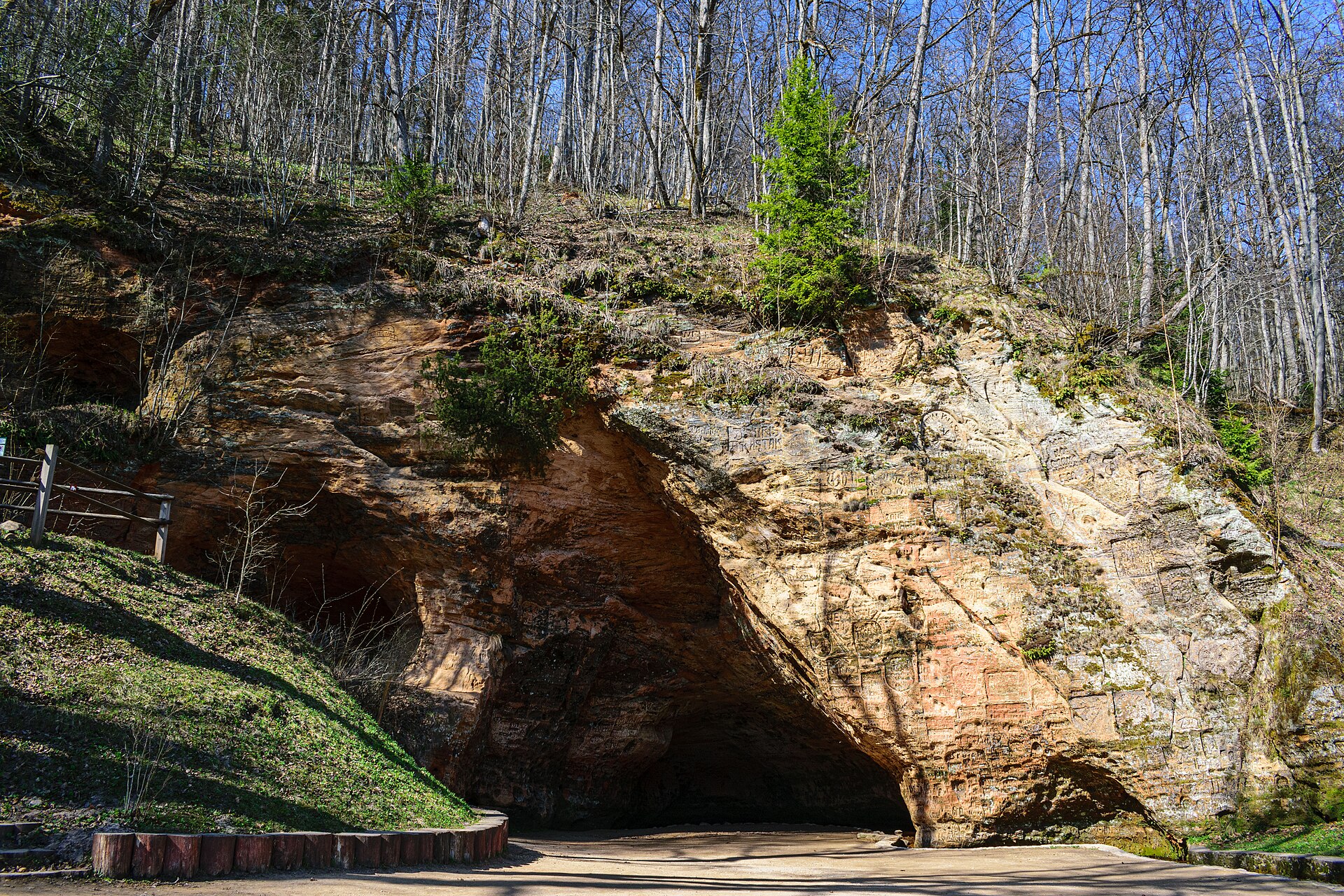
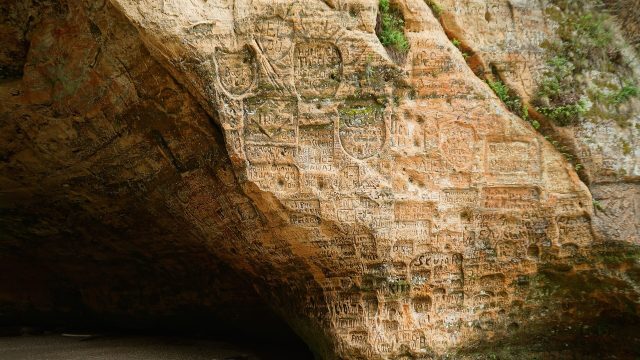
The cave itself is modest in appearance, more like a deep overhang than a cavernous underground chamber. Its entrance is framed by the reddish-brown sandstone that defines the region, worn smooth by time and water. Inside, the air feels cooler, the light dimmer, the silence broken only by the occasional drip of water from the ceiling. The walls are covered in inscriptions—some dating back to the 17th century, others more recent—left by travelers, lovers, and locals who felt compelled to leave their mark. The oldest known carving reads 1668, though the cave’s history likely stretches much further back.
Local legend ties Gutmanis Cave to the story of the Rose of Turaida, one of Latvia’s most enduring folktales. According to the tale, a young woman named Maija, known as the Rose of Turaida, was betrayed by a rival suitor and met a tragic end in the 17th century. Some versions say she was lured to the cave, others that her grave lies nearby. The cave’s association with the story has made it a place of quiet reflection, where visitors sometimes leave flowers or small tokens in her memory. Whether the legend is true or not, it adds a layer of melancholy to the cave’s atmosphere, as if the sandstone itself remembers the sorrow of the past.
The cave’s name comes from a 17th-century healer, Gutmanis, who was said to have used the spring water that flows from its depths for medicinal purposes. The water still trickles from the cave’s ceiling, collecting in a small pool before joining the Gauja River below. Locals once believed it had healing properties, and some still come to drink from it or fill bottles to take home. The spring is one of the reasons the cave has been a gathering place for so long—people have always been drawn to water, especially when it emerges from the earth in such a dramatic setting.
Geologically, Gutmanis Cave is a remnant of the Gauja’s ancient work. The river once flowed at a higher level, gradually eroding the sandstone to create the cliffs and caves we see today. The cave isn’t deep—just about 19 meters at its furthest point—but its size isn’t what makes it special. It’s the way it feels like a threshold between the everyday world and something older, something that existed long before towns or roads. The sandstone is soft enough to carve, which is why so many visitors over the centuries have left their names, initials, or messages. Some of the inscriptions are elaborate, others just a hasty scratch, but together they form a kind of accidental archive of the people who have passed through.
The area around the cave is part of Gauja National Park, Latvia’s oldest and largest national park. The park was established in 1973 to protect the unique landscape of the Gauja Valley, with its forests, rivers, and sandstone outcrops. Walking to Gutmanis Cave is part of the experience—you follow a path that winds along the river, past cliffs and through stands of pine and birch. In autumn, the trees turn gold and russet, and the air smells of damp earth and fallen leaves. In winter, the cave’s entrance can be dusted with snow, and the river below might be partially frozen. Even in summer, the cave remains cool, a respite from the sun.
There’s no grand entrance fee or visitor center here, just a simple path leading to the cave. That lack of commercialization is part of its charm. You’re not stepping into a curated attraction but a place that has existed for millennia, largely unchanged. The cave is free to enter, though in recent years, efforts have been made to protect the inscriptions from further damage. Some of the older carvings are fading, worn away by time and the elements, and there’s a quiet understanding among visitors not to add new ones. The cave’s future depends on balancing access with preservation, ensuring that it remains a place where people can still feel that connection to the past.
For many Latvians, Gutmanis Cave is more than just a natural landmark—it’s a piece of cultural identity. It appears in literature, art, and music, a symbol of the country’s deep ties to its landscape. The cave is often visited alongside nearby Turaida Castle, another site steeped in history, where the ruins of a medieval fortress overlook the Gauja Valley. Together, they tell a story of Latvia’s past, from the Livonian Order to the legends of the Rose of Turaida. But Gutmanis Cave feels more personal, more intimate. It’s a place where history isn’t just something you read about but something you can touch, where the past is etched into the very walls.
Visiting the cave doesn’t take long—most people spend no more than half an hour inside—but it’s the kind of place that lingers in your mind. Maybe it’s the coolness of the air, the sound of water dripping, or the sight of those old inscriptions, some barely legible, others still sharp and clear. Maybe it’s the weight of the stories that have accumulated here over the centuries, or the way the light filters in from the entrance, casting long shadows on the sandstone. Whatever it is, Gutmanis Cave has a way of making you pause, of making you feel like you’re standing in a place where time moves a little differently. It’s not just a cave; it’s a quiet witness to the passage of generations.