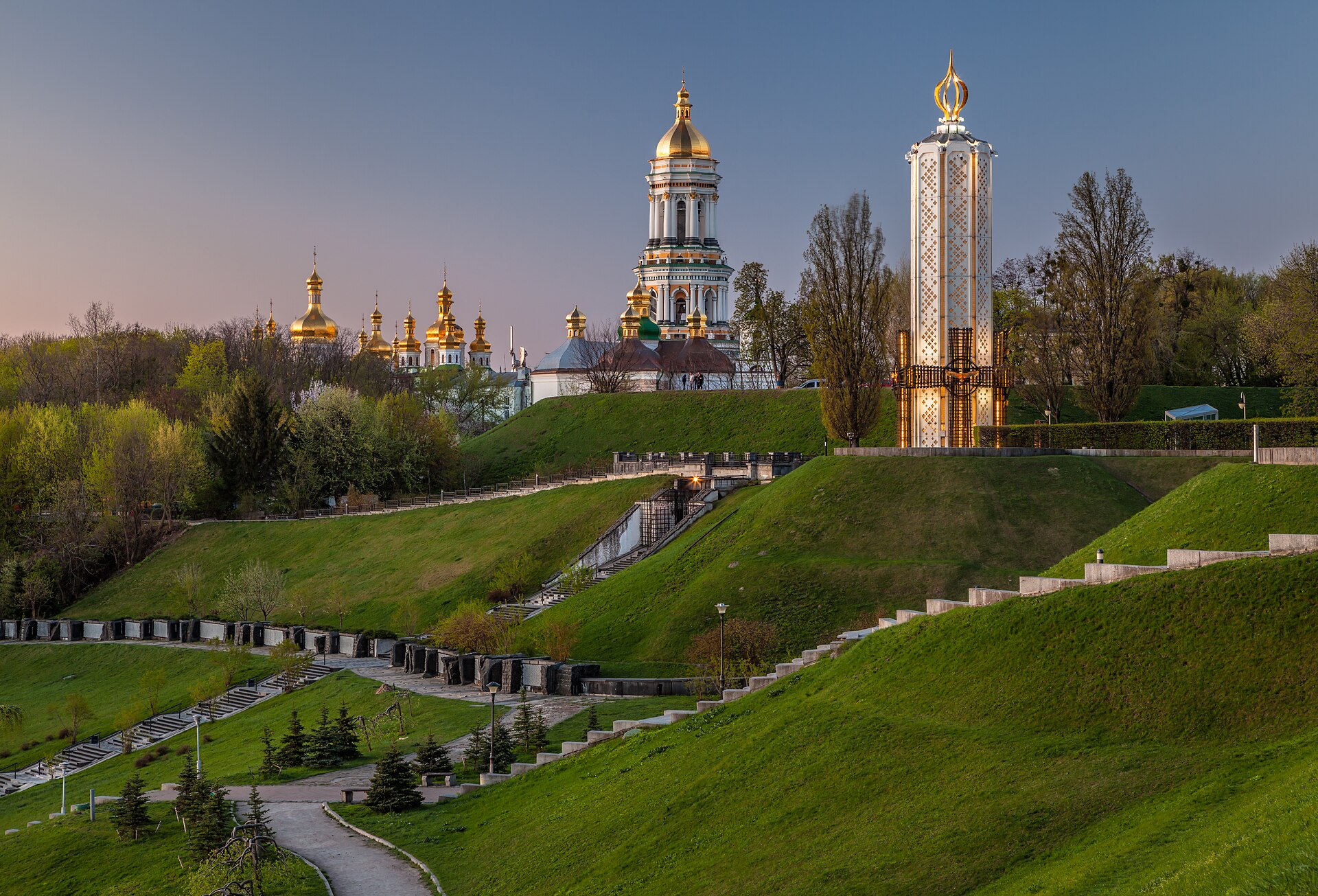
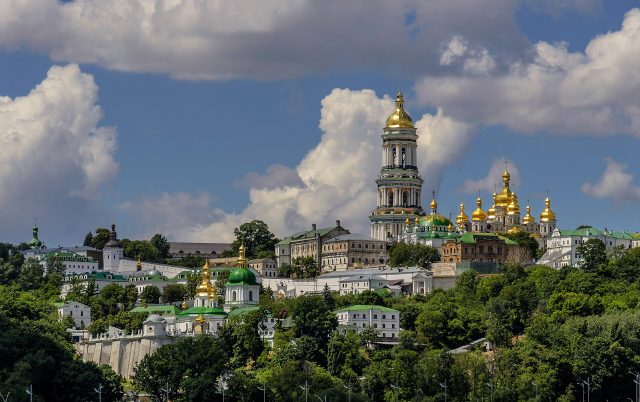
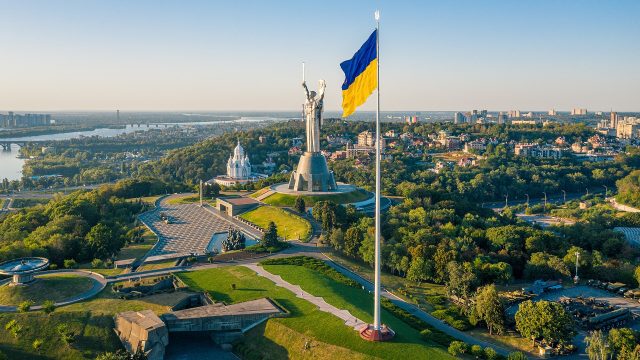
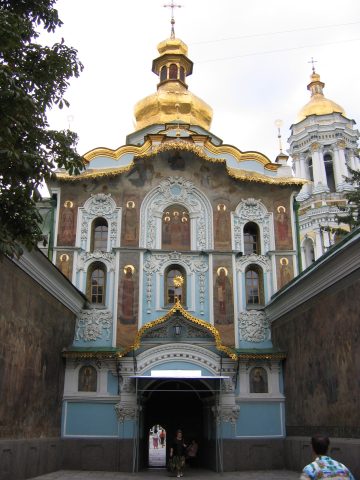
Eternal Glory Park sits on a bluff overlooking the Dnieper River in Kyiv’s Pechersk district, where the weight of history lingers in the quiet rustle of leaves and the measured footsteps of visitors. There are no carnival rides or neon signs here, just the stillness of a place built to remember. The park occupies a stretch of high ground that has long been tied to the city’s collective memory, its paths winding past monuments that mark both personal and national loss.
At the heart of the park stands the towering granite obelisk, its sharp silhouette crowned with a gilded star. The Eternal Flame flickers at its base, lit on solemn occasions, while nearby lie the graves of soldiers who defended Kyiv during the war. The approach to the monument is deliberate, lined with trees and paved walkways that guide visitors toward the center in a slow, reflective procession. The design is uncluttered, almost austere, leaving room for silence and contemplation.
The park’s origins trace back to the mid-20th century, when Kyiv was rebuilding itself after the devastation of war. Before that, the land had been home to a cemetery where artists, scientists, and other notable figures were buried. In the Soviet era, the graves were cleared, and the site was transformed into a public space. Only fragments of the old cemetery remain—some headstones were relocated, while others vanished into the past, their stories preserved now only in archives and the fading memories of those who once walked among them.
The layout of the park is simple but deliberate. Wide paths, lined with granite benches, lead visitors through rows of mature trees—linden, spruce, and oak—that shift with the seasons. In spring, the branches burst into leaf, casting dappled shade over the walkways. By autumn, the foliage turns to gold and crimson, contrasting with the dark stone of the monuments. The central staircase, flanked by symmetrical rows of trees, draws the eye upward toward the obelisk, reinforcing the sense of reverence.
From the upper terrace, the view opens onto the Dnieper, its waters glinting in the sunlight, with the bridges and distant hills of the left bank stretching into the horizon. On clear days, the panorama feels almost timeless, as if the city below has paused to let the past breathe. People come here for different reasons—some to pay their respects, others to find a moment of quiet in the middle of a bustling city. Families stroll with children, students sit on the benches with books, and older visitors linger near the flame, lost in thought.
The park changes with the seasons. In winter, frost clings to the branches, and the Eternal Flame burns brighter against the snow. Summer brings gatherings—memorial ceremonies, concerts, and speeches—especially on Victory Day, when the grounds are draped in flowers. Yet even in these moments of public remembrance, the park retains its quiet dignity, a place where the past is not just recalled but felt.
Over the decades, Eternal Glory Park has become more than a memorial. It’s a part of Kyiv’s identity, a space where history is not just remembered but lived. Writers have described it in prose, filmmakers have captured its somber beauty, and artists have tried to convey the weight of its silence on canvas. In a city that has seen so much change, the park stands as a reminder that some things endure—memory, sacrifice, the quiet resolve to carry the past forward.
There’s a sense here that time moves differently. The rustle of leaves, the distant hum of the city, the way the light falls on the granite—all of it invites reflection. It’s not a place for haste. Visitors come and go, but the park remains, a steady presence on the edge of the river, holding the stories of those who came before. Whether you’re drawn by history, by the view, or simply by the need for a moment of stillness, it offers something rare: a chance to step outside the rush of the present and consider what endures.