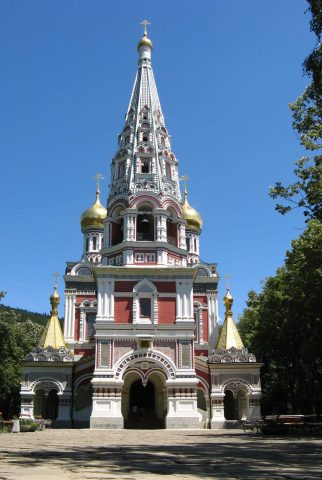
Shipka is one of those rare places where history isn’t confined to textbooks or museum displays—it lingers in the air, in the rustle of leaves, in the way the light falls on the stone monuments scattered across the hills. Nestled in the Balkan Mountains, this quiet town and its surrounding park feel like an open-air memorial, a landscape shaped by the struggles of the past. There are no grand announcements here, no crowds jostling for the best view. Instead, the place unfolds gradually, revealing itself through winding paths, sudden clearings, and the occasional glimpse of a golden dome glinting between the trees.
At the heart of the park stands the Church-Monument of the Nativity, more commonly known as the Shipka Monastery. Built in the early 20th century, it was funded by donations from across Bulgaria as a tribute to the Russian and Bulgarian soldiers who died during the Russo-Turkish War of 1877–1878. The church’s white walls and gilded domes stand out against the green slopes, but its true power lies within. Inside, the atmosphere is hushed, the air thick with the scent of wax and old wood. The walls are covered in murals depicting scenes from the war—battles, fallen soldiers, moments of quiet courage. There are no ornate decorations, just a sense of reverence, as if the space itself is holding its breath.
Just steps away, the Monument of Liberty commands attention. A massive stone lion, perched on a high pedestal, overlooks the Shipka Pass, where one of the war’s bloodiest battles took place in August 1877. Outnumbered and outgunned, Russian troops and Bulgarian volunteers held the pass against Ottoman forces in a fight that would become a defining moment in Bulgaria’s struggle for independence. Today, the area around the monument is dotted with smaller memorials and mass graves, their simple markers blending into the landscape. Walking the paths that wind through the hills, it’s easy to imagine the echoes of that summer—shouts, gunfire, the clatter of hooves on rocky ground.
The park itself is a layered space, descending in terraces from the monastery down toward the town. There are no amusement rides or souvenir stalls, just well-trodden trails leading to viewpoints and quiet corners where visitors can sit and take in the view. In summer, the shade of the trees offers relief from the heat, while autumn turns the hills into a patchwork of gold and crimson. Winter brings a different kind of stillness, with snow dusting the statues and crosses, softening the edges of the monuments. It’s a place that changes with the seasons but never loses its sense of solemnity.
For Bulgarians, Shipka is more than a tourist destination—it’s a site of pilgrimage. Every August, thousands gather here to commemorate the anniversary of the battle, laying flowers at the memorials and attending services at the church. Families come together, some traveling from distant towns, to pay their respects. The atmosphere is one of quiet reflection, a shared acknowledgment of the sacrifices made for the country’s freedom. There’s no fanfare, just a deep, unspoken understanding of why this place matters.
What makes Shipka unusual is how it balances history with the present. The monuments aren’t roped off or treated as relics—they’re part of the landscape, as much a feature of the hills as the trees or the winding paths. Visitors don’t just observe; they move through the space, climbing steps, pausing at viewpoints, reading the inscriptions on the memorials. There’s a sense of intimacy here, as if the past isn’t something distant but something that can still be touched, still be felt.
The Shipka Pass itself is a reminder of how geography shaped history. The narrow mountain route was a strategic chokepoint, and control over it meant control over the region. Today, the pass is quiet, the road winding through the hills without the urgency of battle. But the land still bears the marks of that time—trenches, earthworks, the occasional rusted artifact half-buried in the grass. It’s a landscape that invites contemplation, where the weight of history isn’t overwhelming but present, like a quiet voice in the wind.
Shipka isn’t a place for those looking for entertainment or distraction. It’s for those who want to step outside the rush of modern life and spend time in a space where the past feels tangible. There’s no need for guided tours or audio explanations—just walk the paths, sit on a bench, and let the place speak for itself. The stories are there, in the stones, in the silence, in the way the light catches the golden domes of the monastery. And if you listen closely, you might just hear them.